Since September 21, 2025, a presidential proclamation has restricted new H-1B entry to workers whose petitions come with a $100,000 payment attached, a rule set to run for 12 months absent an extension. In March 2026, the Department of Labor proposed raising the four prevailing-wage percentile levels that H-1B and green-card sponsors must pay: roughly the 17th percentile rising to the 34th, the 34th to the 52nd, the 50th to the 70th, and the 67th to the 88th. The obvious read of both moves together is that Washington has finally come for India's IT services industry, the TCS-Infosys-Wipro-HCL-Cognizant model built on rotating engineers into the United States on temporary visas.
Slow down on that. Look at what those companies were actually filing for before either rule took effect.
The top seven Indian IT majors combined got only 4,573 initial H-1B approvals in fiscal 2025.
A National Foundation for American Policy analysis of USCIS records found that the top seven Indian-based IT companies had just 4,573 H-1B petitions approved for initial employment in fiscal 2025, a 70 percent drop from fiscal 2015 and 37 percent fewer than fiscal 2024. That collapse was already years in motion before the $100,000 fee existed. The crackdown is landing on an industry that had already walked most of the way out the door.
What the new rules actually do
The proclamation's mechanism is blunt: no new H-1B petition clears entry without the $100,000 attached, for 12 months unless renewed. The Department of Labor's proposal is narrower and more targeted. Its own text explains the goal: raising the wage floors is meant to shrink the gap that "outsourcing companies pay at or near the prevailing wage" have been able to exploit, by making the floor itself higher. Both rules are aimed, on paper, at the outsourcing model.
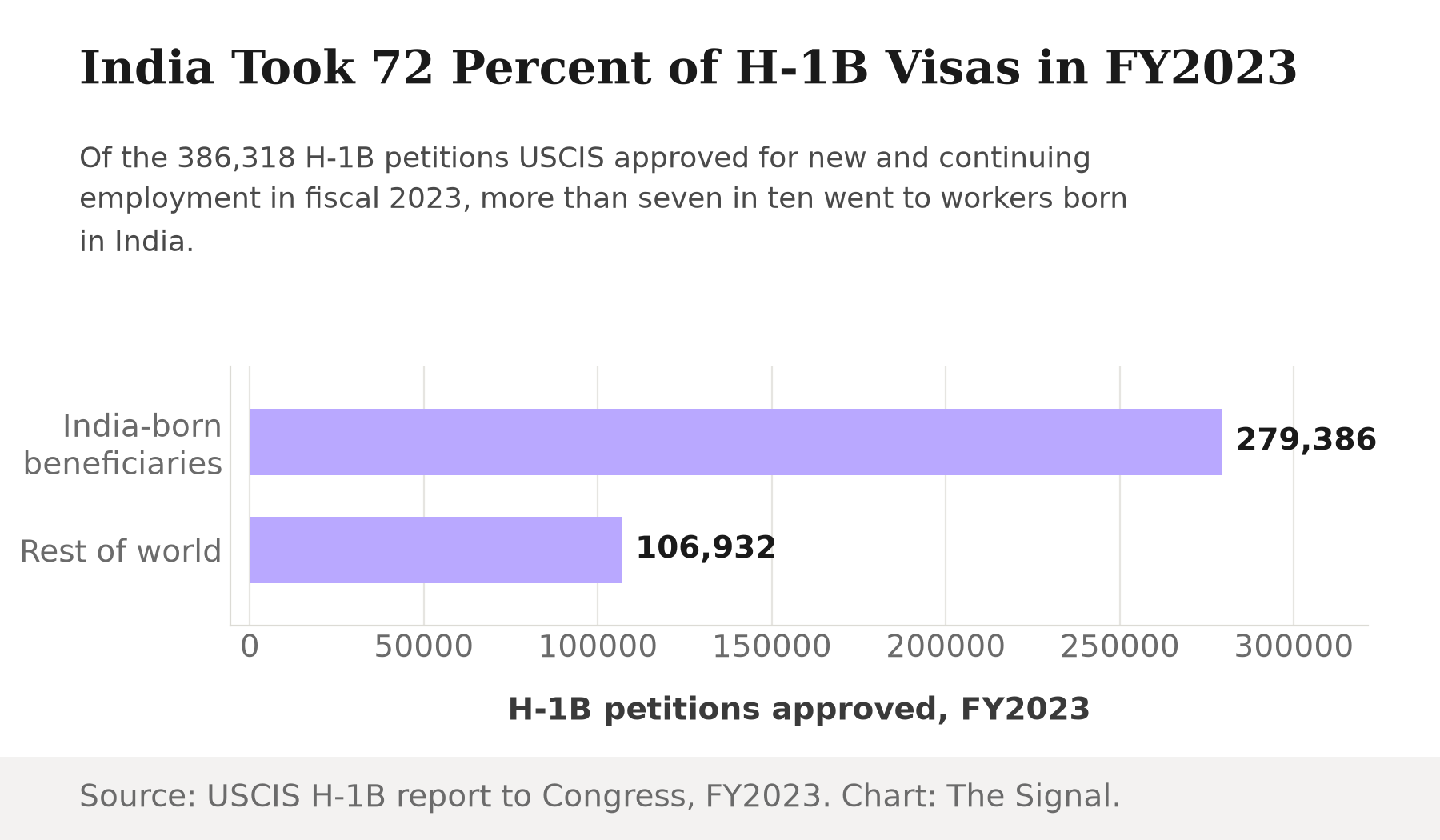
But the visa itself is overwhelmingly an individual channel, not a corporate one. USCIS's own report to Congress found that of the 386,318 H-1B petitions approved for new and continuing employment in fiscal 2023, 72 percent went to workers born in India, a share far above any other country of birth. A $100,000 entry fee attached to the petition is a cost the sponsoring employer or the worker absorbs case by case. It does not care whether the employer is an outsourcing major or a small US engineering team hiring one specialist. Given who actually holds these visas, the fee's weight falls overwhelmingly on individual Indian professionals and the specific employers still filing for them, not on "Indian IT" as an industry category.
The majors already left this business
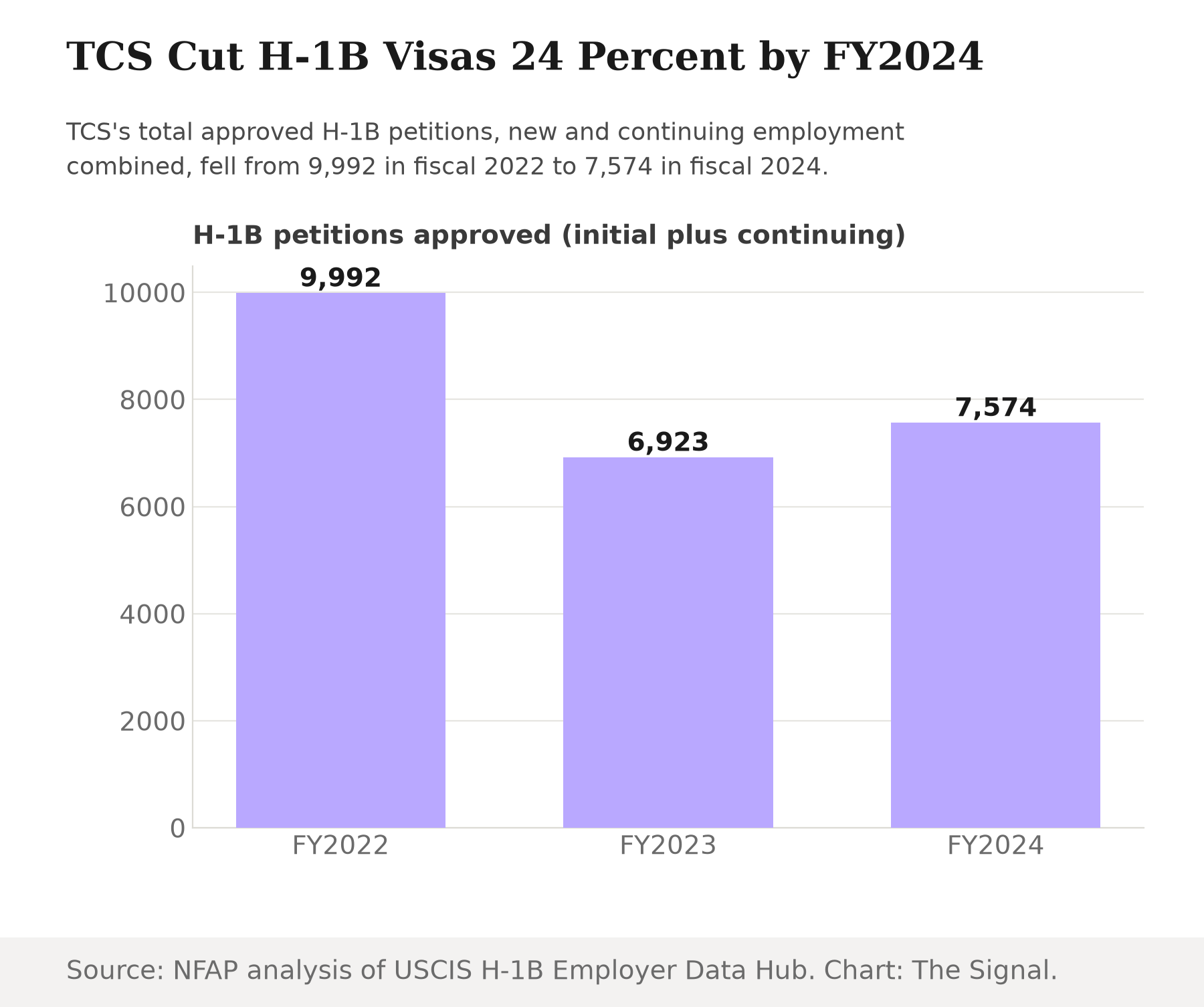
TCS's own filings show the same retreat at company scale. USCIS H-1B Employer Data Hub figures tabulated by NFAP show TCS's total approved petitions, combining initial and continuing employment, fell from 9,992 in fiscal 2022 to 7,574 in fiscal 2024, a 24 percent decline. None of that decline required a $100,000 fee or a new wage rule. It happened under the visa regime that existed before either change, as TCS and its peers built out other ways to staff US client work: local hiring on the ground in the United States, and a much larger bet on serving global clients from inside India.
Where the value actually moved
That larger bet has a name: the Global Capability Centre, an in-house delivery arm that multinationals run out of India instead of contracting an outsourcing vendor. The Zinnov-Nasscom India GCC Landscape report counted 2,117 GCCs operating 3,728 units in India, employing 2.36 million professionals and generating $98.4 billion in revenue, up 32 percent since fiscal 2021, with 506 Forbes Global 2000 companies now running one. Nasscom's own Annual Strategic Review found India housed more than 1,750 GCCs as of 2024, with the country's tech-export revenue now split roughly evenly between global multinationals, including their GCCs, and Indian IT service providers, a structural shift from the outsourcing-only era.
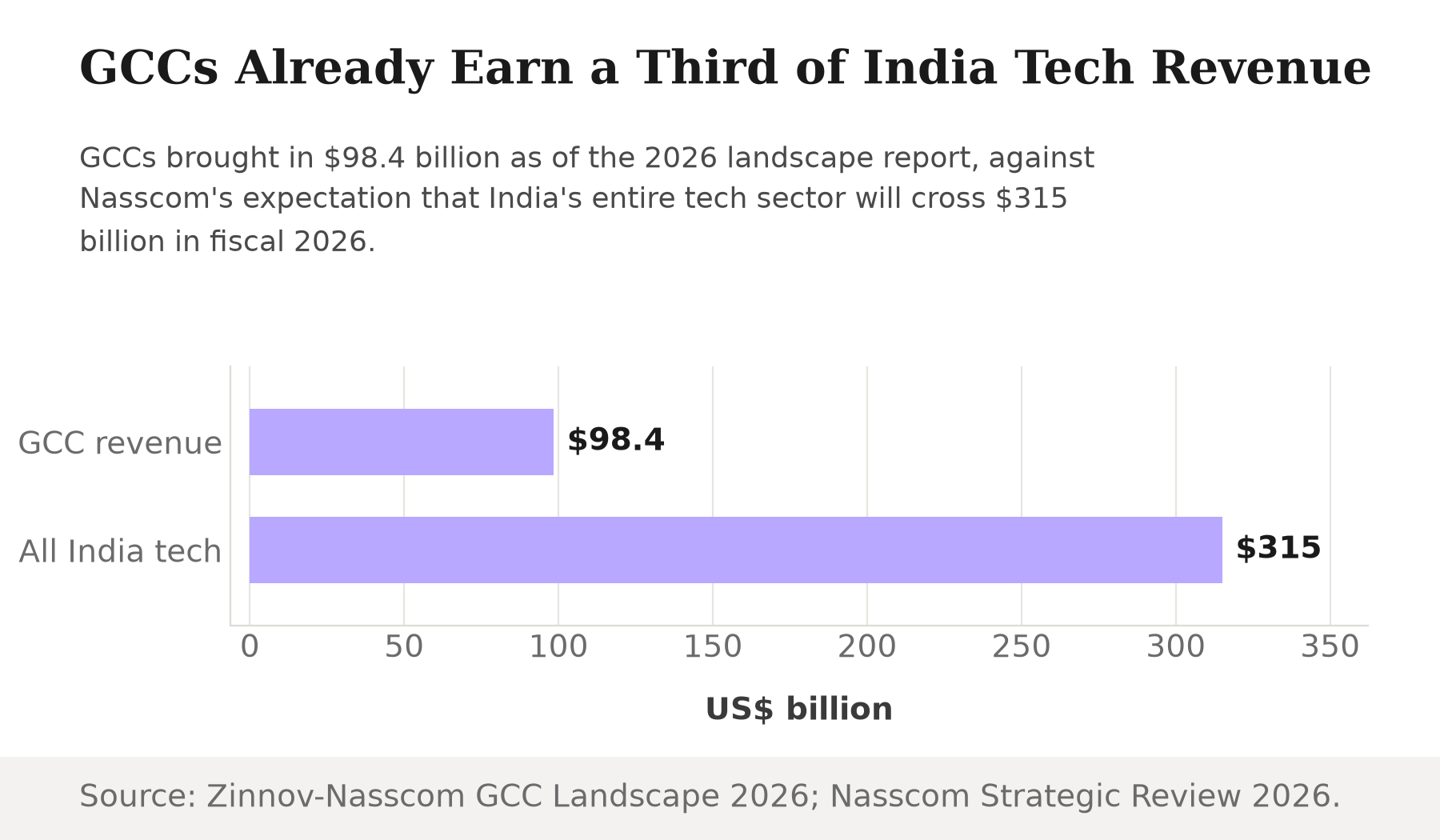
GCC revenue of $98.4 billion against Nasscom's own projection that India's entire tech sector will cross $315 billion in fiscal 2026 (with direct employment reaching about 6 million) puts GCCs at roughly a third of the whole sector's revenue already, a calculation drawn from those two separate Nasscom-linked figures. Nasscom itself attributes part of that shift in the tech sector's shape to GCC expansion. The jobs and the revenue that once required an H-1B to reach the United States are increasingly staying in Bengaluru, Hyderabad and Pune instead.
The honest objection
The strongest case against calling this a non-event is that the Department of Labor's proposed wage rule is explicitly written to squeeze the exact companies still leaning on the visa's lower wage tiers. The rule's own language targets "cases where outsourcing companies pay at or near the prevailing wage", which describes staffing firms and smaller IT vendors more precisely than it describes TCS or Infosys at their current, shrunken scale. For whichever companies are still filing thousands of H-1Bs at the bottom of the wage bands, doubling the wage floor is a real cost increase, not a rounding error.
That case is real, but it does not rescue the "attack on Indian IT" framing. It relocates the target from the top seven majors, whose aggregate initial filings are down to 4,573 a year, to a smaller and less visible tier of staffing intermediaries and individual sponsoring employers. The mechanism the rule is built to hit, and the population the visa actually serves, both point away from the household-name outsourcing companies and toward the individuals and smaller firms still running the old model at its remaining edges. That wage rule is also still just a proposal: as of its public comment period closing on May 26, 2026, the Department of Labor's filing remained a Notice of Proposed Rulemaking, not a final rule.
Even the $100,000 entry fee's own legal footing is unsettled. A US District Court in Boston vacated the fee on June 8, 2026, ruling it an unauthorized tax that exceeds presidential authority, directly contradicting an earlier federal court decision in Washington, D.C. that had upheld the same fee, leaving the rule's survival to appellate courts in two circuits rather than to the 12-month clock it was written with. Whichever way that appeal goes, it changes when the fee applies, not who it was built to hit.
The Signal
The consensus story wanted this to be Washington versus India's IT giants, a rerun of decades-old trade friction with new numbers attached. The actual numbers say the giants mostly took themselves out of the blast radius years ago, trading H-1B dependence for GCC scale, while the visa itself keeps doing what it has always done: channeling individual Indian professionals into the US market, now at a steeper price. Watch three things next: whether GCC hiring and revenue keep climbing while the top IT majors' H-1B filings keep shrinking, whether the Department of Labor's wage rule survives comment and rulemaking to actually raise the floor for whoever is still filing, and how the appeals of the Boston and Washington rulings on the $100,000 fee resolve. If GCC growth keeps outpacing the majors' shrinking filings and the wage rule survives in some form, the story completes itself: the crackdown didn't touch the industry it was aimed at, because that industry had already left the room.
Reporting basis: the H-1B entry fee is per the White House's presidential proclamation. The India-born beneficiary share and total fiscal 2023 approval count are per USCIS's own submission to Congress. The top-seven-company and TCS-specific H-1B petition figures are per the National Foundation for American Policy's tabulations of USCIS H-1B Employer Data Hub records, across two separate policy briefs from the same organization. The proposed prevailing-wage rule and its stated rationale, and its status as a still-pending proposal, are per the Department of Labor's Federal Register filing and docket. The GCC count, headcount and revenue figures are per the Zinnov-Nasscom India GCC Landscape publication; the tech-sector revenue split and the fiscal 2026 sector-wide figures are per two separate Nasscom releases. The June 2026 court ruling vacating the entry fee is per Associated Press wire coverage carried by NPR. The rest-of-world H-1B count and the one-third GCC share of total tech revenue are The Signal's calculations from those figures.