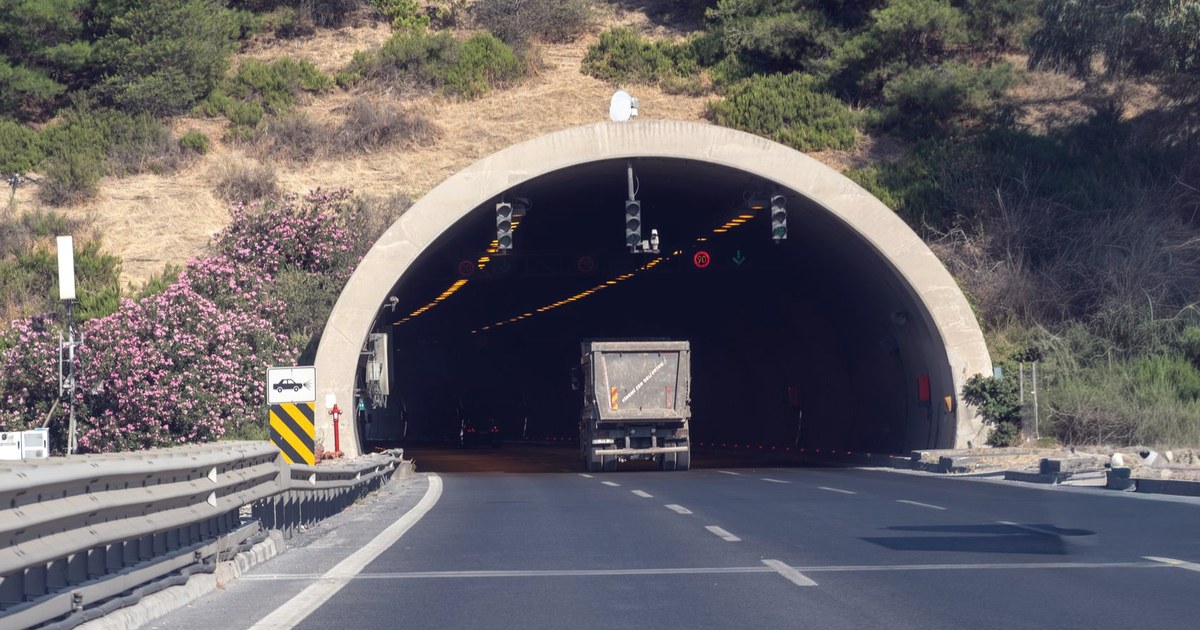
On May 1, 2026, Chief Minister Devendra Fadnavis stood at the mouth of an 8.92-kilometre tunnel and called it an engineering marvel. The tunnel had just been certified by Guinness World Records as the world's widest underground road tunnel, a set of five-lane twin bores each roughly 22.33 to 23 metres wide, and Fadnavis said the project cost Rs 7,000 crore to build, with an expected economic multiplier worth Rs 70,000 crore.
The tunnel is the centrepiece of what MSRDC, the Maharashtra State Road Development Corporation, built as the Missing Link: a bypass that shortens the Khopoli to Sinhgad Institute stretch of the Mumbai-Pune Expressway from 19 km to 13.3 km, cutting 6 km and 20 to 25 minutes off the drive, through two tunnels and two viaducts that were sanctioned in 2017 at an estimated cost of Rs 4,797.57 crore. The old alignment it replaces climbs and drops through hill terrain unstable enough that the state built an entirely new route, at a price that grew well past its original estimate, specifically to route traffic around it. MSRDC built this bypass precisely because that old alignment was the single riskiest stretch on the expressway, not to add a scenic tunnel to the map.
| Missing Link, at a glance | Figure |
|---|---|
| Old route (Khopoli exit to Sinhgad Institute) | 19 km |
| New route via the Missing Link | 13.3 km |
| Distance and time saved | 6 km, 20 to 25 minutes |
| Main tunnels | 1.75 km and 8.92 km, both 8-lane |
| Viaducts | 790 m and 650 m |
| Sanctioned cost (2017, at 2015-16 rates) | Rs 4,797.57 crore |
| Cost stated at opening (CM Fadnavis, May 2026) | Rs 7,000 crore |
Source: MSRDC's official project page; The Print.
It is worth slowing down on that framing. On July 6, 2026, a little over nine weeks after the ribbon was cut, a landslide struck near the Tunnel 2 exit on the Pune-to-Mumbai carriageway amid extremely heavy rain: MSRDC diverted traffic from 4 am, and more than 100 tonnes of debris came down on the road before the Mumbai-bound lane reopened around 10 am the same day. The bypass built to end the expressway's landslide problem had one of its own before its first full monsoon was over.
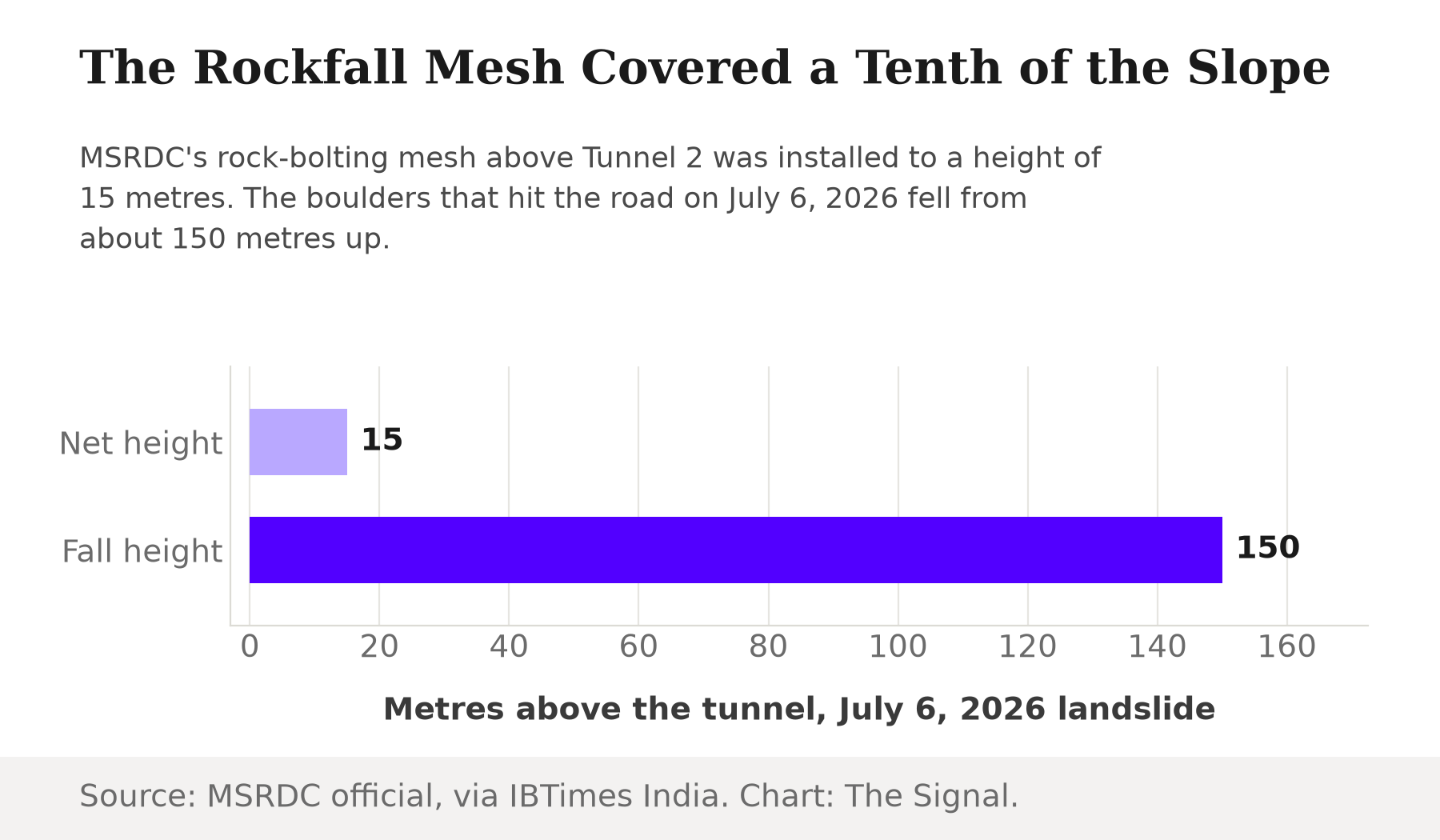
Source: IBTimes India. Chart: The Signal.
The shield covered a tenth of the slope
A rockfall mesh is not meant to stop every stone on a hillside. It is meant to catch what is likely to move above the specific structure it protects, which is why MSRDC and IIT Bombay chose a height for it in the first place. But 15 metres of coverage against a fall origin around 150 metres up is not a narrow miss: it is a mitigation system that was scoped, at best, for the bottom tenth of the slope that actually failed. Whatever combination of geology and weather triggered the slide, the protection MSRDC describes installing above the tunnel could only ever have caught a small share of that hazard by design, not by accident.
The most expensive kilometre on the map
The Rs 7,000 crore Chief Minister Fadnavis cited works out to roughly Rs 526 crore for each of the Missing Link's 13.3 km, our calculation from the project's stated cost and length. For comparison, the 701-km Samruddhi Mahamarg linking Nagpur and Mumbai, one of India's longest expressways, was built for about Rs 55,000 crore, which is roughly Rs 78 crore a km, also our calculation. The Missing Link cost nearly 6.7 times as much per km as a far longer expressway built across 10 Maharashtra districts in the same decade.
That gap is not a criticism of tunnelling economics on its own; boring twin 8-lane tunnels through a mountain is inherently far costlier than laying flat highway across the Vidarbha plains. It is context for what the state was buying at that price. This was never meant to be an ordinary stretch of road. It was engineered, at extraordinary expense, specifically to eliminate one failure mode. That failure mode reappeared within nine weeks.
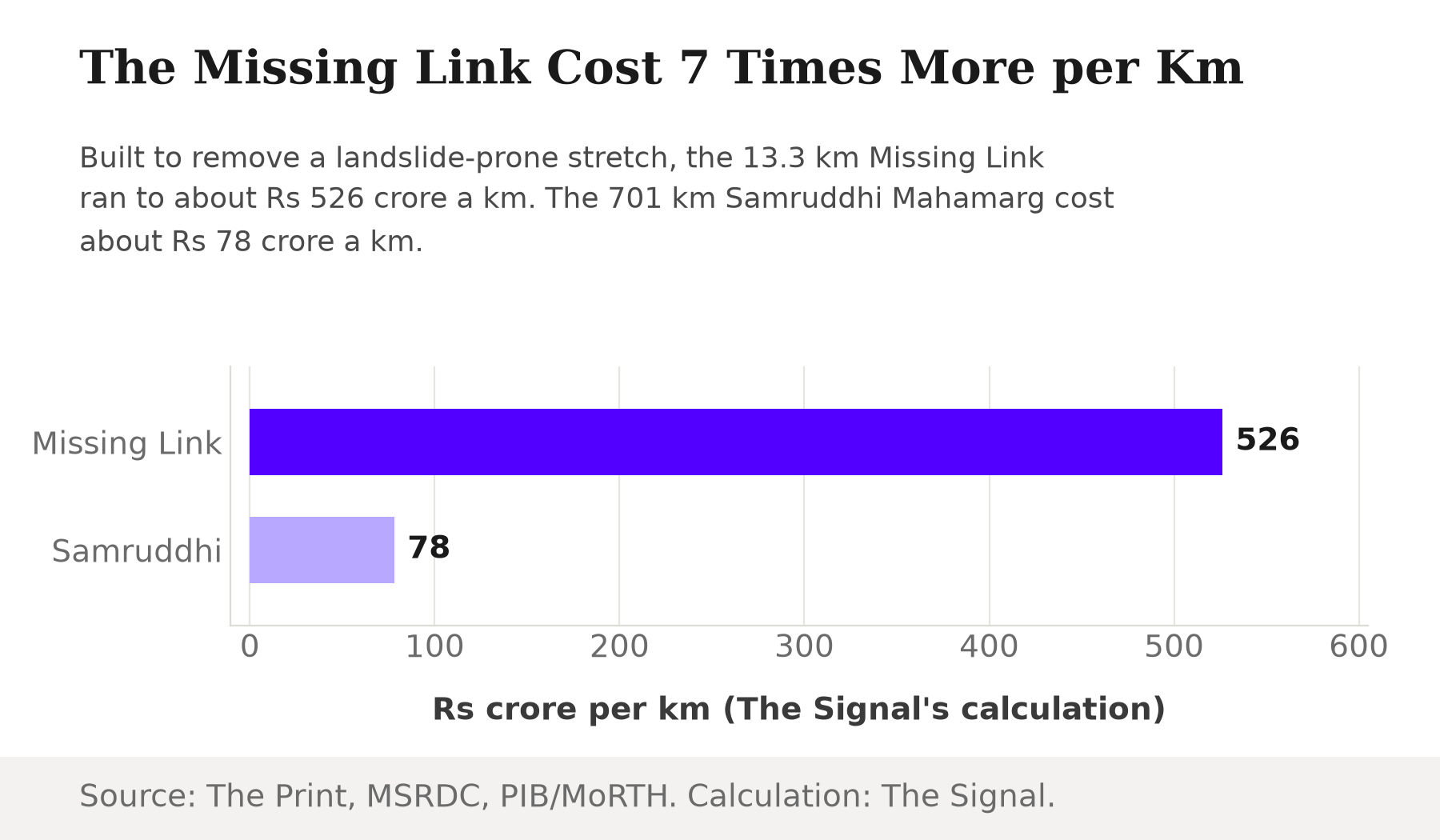
Source: The Print; Ministry of Road Transport and Highways, via PIB. Cost-per-km figures are The Signal's calculations. Chart: The Signal.
The honest objection: a genuinely extreme storm
The strongest case for MSRDC is that this was not an engineering failure but a weather event no design brief could reasonably anticipate. Lonavala, near the site, recorded 670 mm of rain in 24 hours on July 6, 2026, above the 654 mm that IMD's CWC Rainfall Frequency Atlas sets as a 1-in-1,000-year threshold for that location. A statistically once-in-a-millennium downpour is a genuinely extraordinary input, and infrastructure everywhere is built to defined return periods, not to withstand every conceivable extreme.
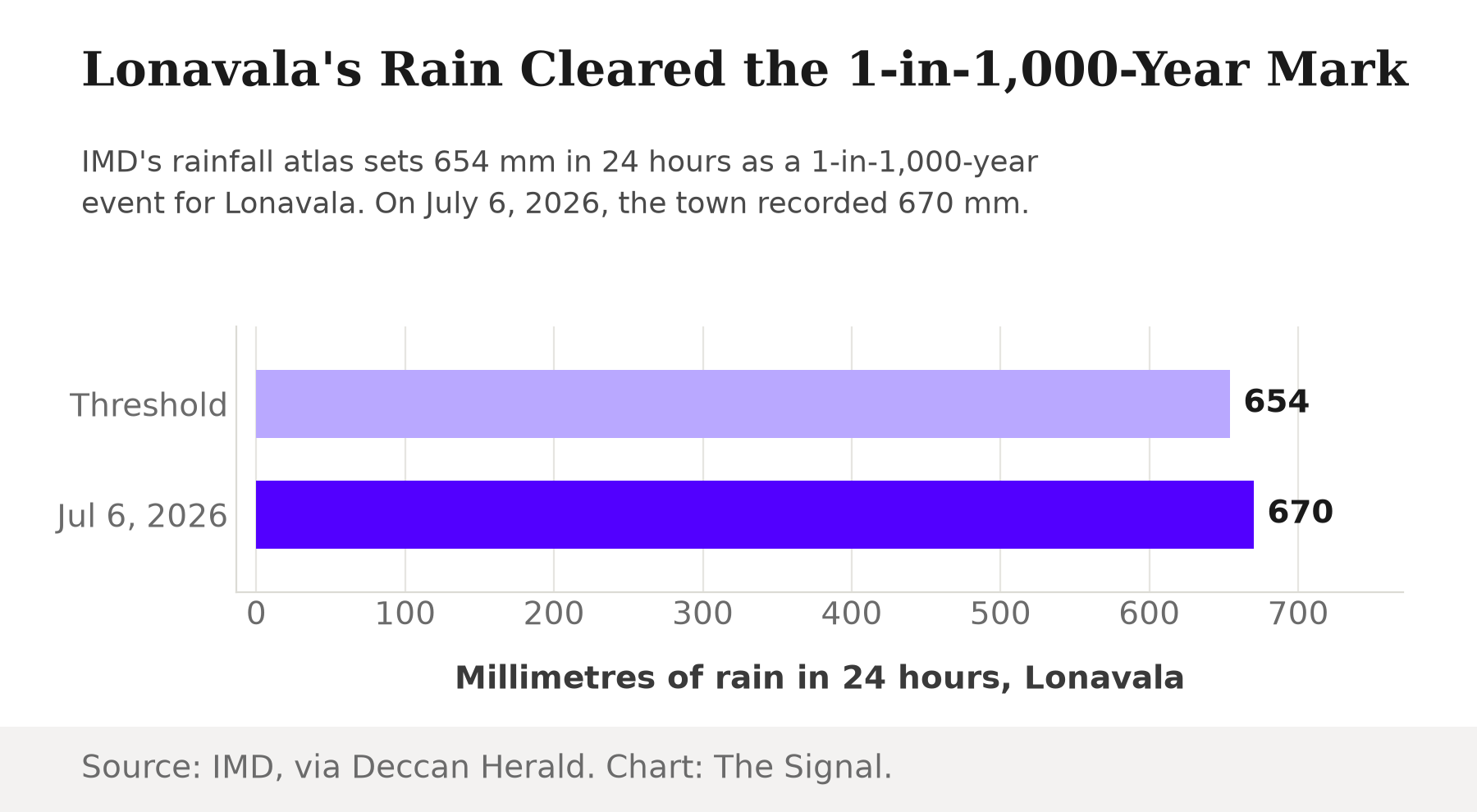
Source: Deccan Herald. Chart: The Signal.
That case is real, but it does not fully cover the gap. An extreme storm explains why a slope failed; it does not by itself explain why the structure guarding the tunnel was built to catch debris from only a tenth of the height above it. A 1-in-1,000-year rainfall event would still have been more survivable against a mitigation system sized closer to the actual slope, even if not a perfect one. The rain explains the trigger. It does not explain the ten-fold gap between the hazard height and the shield height.
The Signal
The Missing Link was not oversold on ambition. Its tunnel really is Guinness-certified and its price tag really did run to Rs 7,000 crore, and its route really does cut the old crossing by 6 km. What it was undersold on is the one thing the entire project was commissioned to fix. A mitigation system scoped for 15 metres against a slope that failed from 150 metres up is not a rounding error in a design brief; it is a gap that should have been visible before the ribbon was cut, not after the debris was cleared. Watch what MSRDC does next: if the rockfall mesh is rebuilt to match the height of the actual slope rather than the height it was first specified to, the state has learned the right lesson from a landslide it spent Rs 7,000 crore trying to make impossible. If it is patched at 15 metres again, the Missing Link's next monsoon is a rerun waiting on the right rainfall.
Reporting basis: the Missing Link's specifications, sanctioned cost and route are from MSRDC's official project page. The May 1, 2026 inauguration, the tunnel's Guinness World Record and the Rs 7,000 crore cost cited by Chief Minister Devendra Fadnavis are as reported by The Print. The July 6, 2026 landslide, the traffic diversion and the debris volume are as reported by Deccan Chronicle, per MSRDC's own statement and the Chief Minister. The 15-metre mesh height and 150-metre fall origin are from an MSRDC official's account to IBTimes India. The Lonavala rainfall figures and the 1-in-1,000-year threshold are from IMD Deputy Director General K S Hosalikar, as reproduced by Deccan Herald. The Samruddhi Mahamarg's cost and length are from a Ministry of Road Transport and Highways explainer published via the Press Information Bureau. The cost-per-kilometre figures for both expressways are The Signal's calculations from those figures.