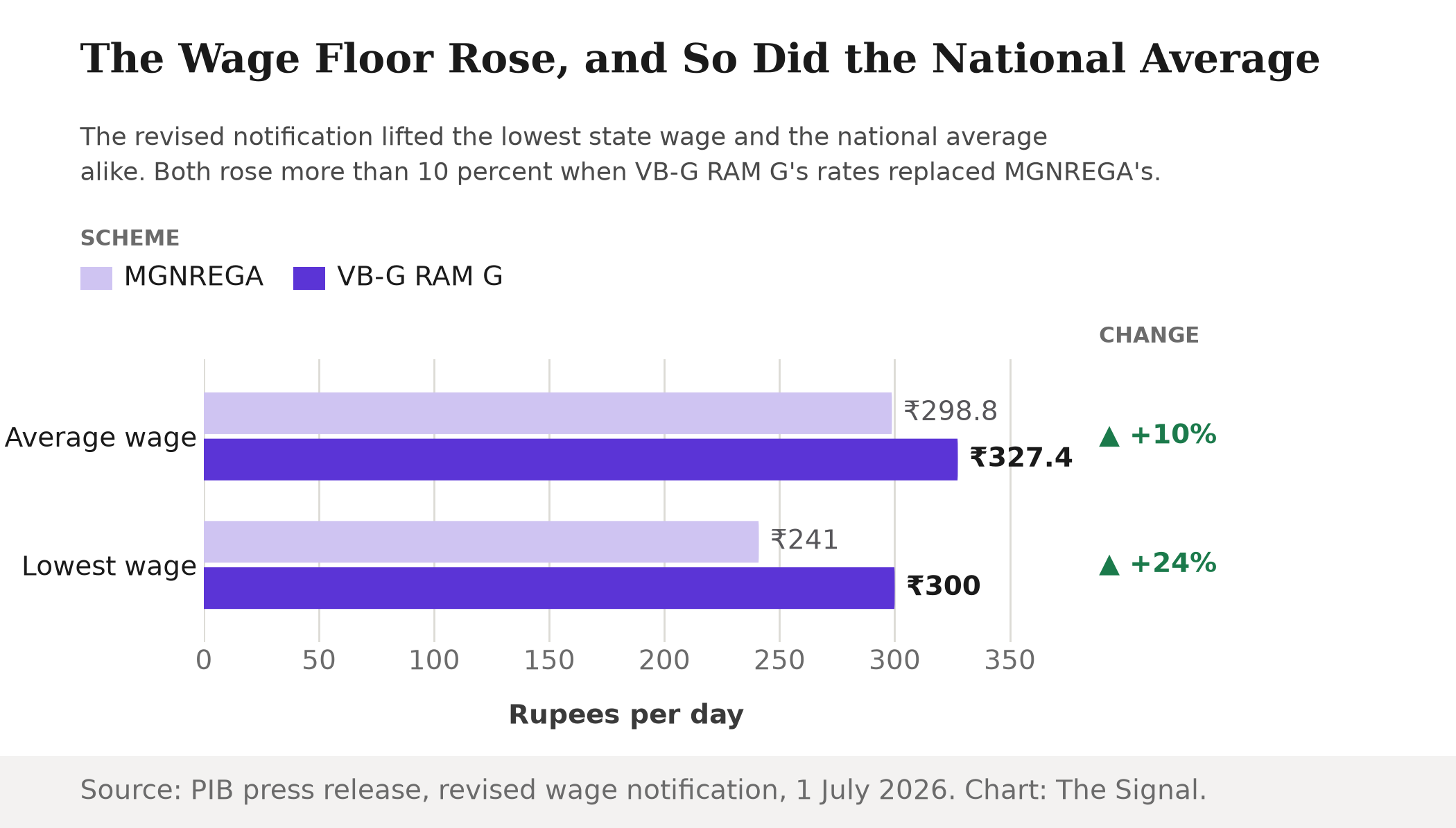
Since 1 July 2026, rural India has a new employment law, and on paper it is a straightforward upgrade. The Mahatma Gandhi National Rural Employment Guarantee Act, 2005 (MGNREGA) had promised at least 100 days of guaranteed wage employment a year to every rural household willing to do unskilled manual work, a legal entitlement that stood for two decades and became one of the world's largest rural jobs programmes by sheer reach. The VB-G RAM G Act, 2025 now guarantees not less than 125 days of wage employment per rural household each financial year, a quarter more than before. The Centre also revised the notified wage, lifting the national average from Rs 298.8 to Rs 327.4 a day, and setting a new Rs 300 floor where the lowest state rate had been Rs 241. More guaranteed days, a higher wage floor: a rural worker reading the headlines has every reason to think the new law simply pays better.
The wage floor and the national average both rose more than 10 percent in the same notification.
It is worth slowing down on that reading. MGNREGA's guarantee worked because the law made 100 percent of the wage bill, paid within 15 days of work done, a liability of the Central Government alone. That wage bill sat on a Labour Budget that was demand driven, open to further upward revision as demand rose. That single design choice, an unconditional Central payout that grew automatically with demand, is what made a legal guarantee more than a promise on paper. VB-G RAM G funds the same 15-day-payment idea, but as a centrally sponsored scheme: the standard cost-sharing ratio is 60:40 between the Centre and states, rising to 90:10 for the northeast and Himalayan states and 100 percent Centre-funded only for Union Territories without their own legislatures.
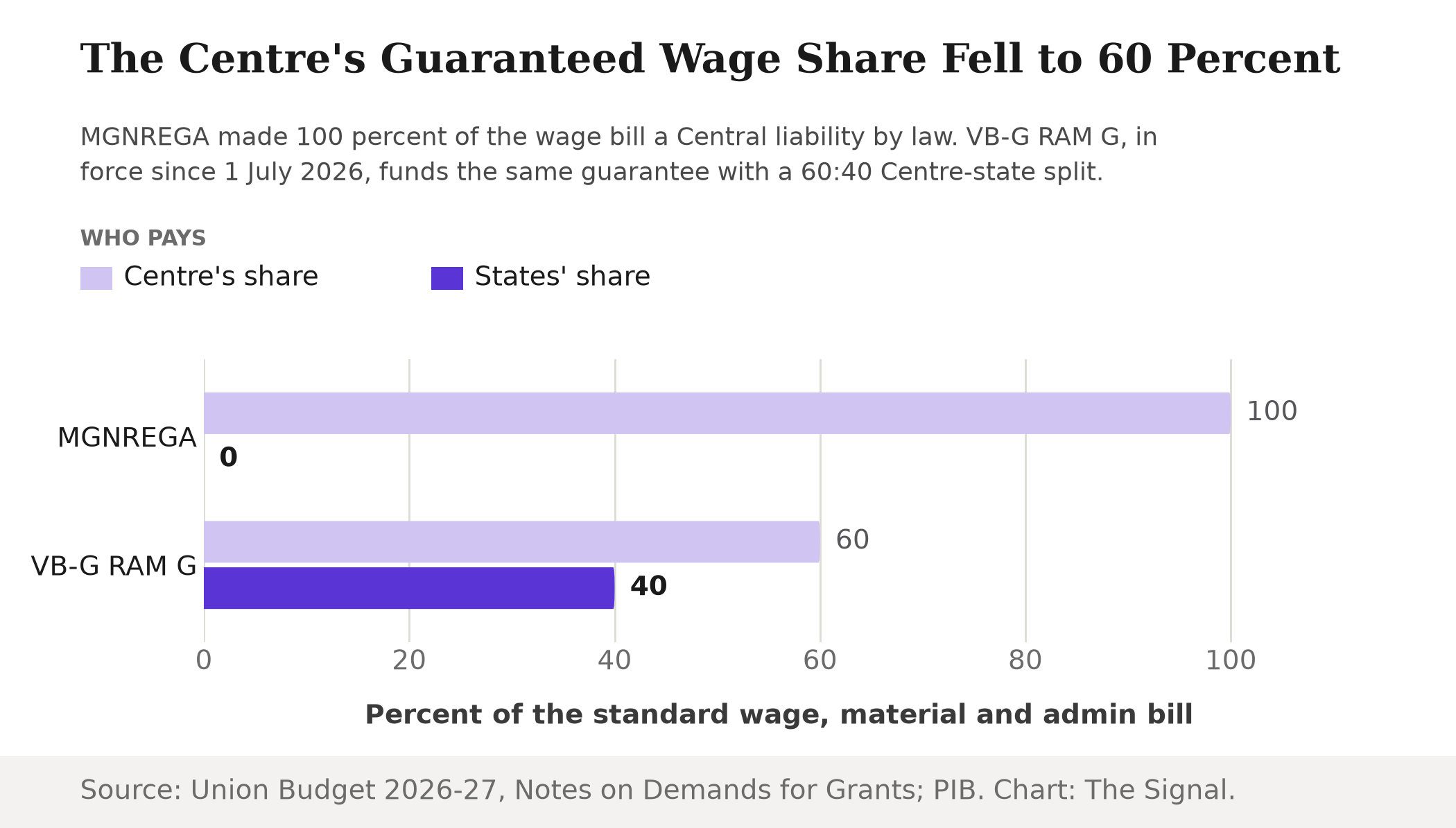
The number that carries this story is not 125. It is 40, the share of the standard bill every state now has to find on its own, on a scheme where it previously found none.
What made MGNREGA's guarantee credible
A guarantee is only as good as who is on the hook when the bill comes due. MGNREGA gave applicants a further backstop: if work was not provided within 15 days of a request, the applicant was entitled to a daily unemployment allowance, no less than one-fourth of the wage rate for the first 30 days and one-half after that, set and paid by the State Government. That allowance was itself a state liability, but it sat on top of a wage bill the Centre had already promised to cover in full. Miss the 15-day window and a state paid a penalty; it never had to co-fund the wages themselves.
The Union Budget's own account of the scheme, published as recently as its 2026-27 Notes on Demands for Grants, describes MGNREGA in exactly those terms: demand driven, subject to further upward revision, with the Centre carrying 100 percent of the wage liability. That is the mechanism VB-G RAM G's backers had to design around, and the one it changed.
What took effect on 1 July
MGNREGA, 2005 stood repealed from 1 July 2026, the same date VB-G RAM G came into force nationwide. The Union Budget earmarked Rs 95,692.31 crore for the new Act in 2026-27, its first budget cycle. Four days after the law took effect, the Rural Development Ministry released the first installment, called the Mother Sanction, of Rs 25,863 crore to states on 5 July 2026, explicitly aimed at ensuring states had adequate funds so wages could still be paid within 15 days. That single tranche is about 27 percent of the year's full allocation (our calculation, from the two budget figures above), released as a discrete installment rather than an automatically revised, open-ended budget line of the kind MGNREGA ran on.
A quarter of the year's Central allocation arrived as a single tranche, days after the law began.
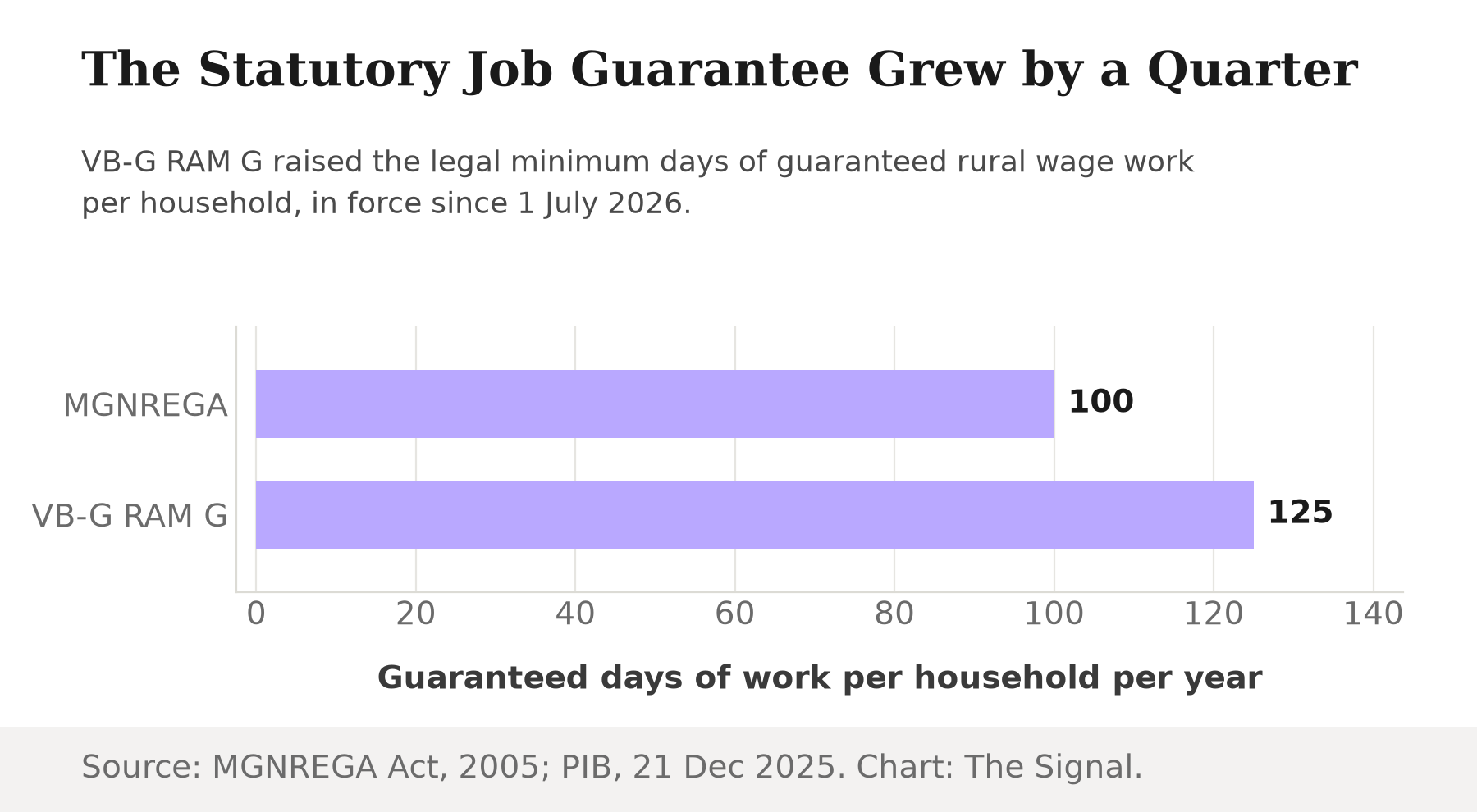
The entitlement itself is unambiguously larger. Twenty-five extra guaranteed days and a higher wage floor are real gains for any household that draws on them. What changed alongside those gains is the plumbing that has to deliver them, now running through every state's own treasury instead of one Central account.
How the guarantee and the bill diverged
Put the four numbers that matter next to each other and the shape of the trade is easier to see than in any single press release.
| MGNREGA (until 30 June 2026) | VB-G RAM G (from 1 July 2026) | |
|---|---|---|
| Guaranteed days per household per year | 100 | Not less than 125 |
| National average notified wage | Rs 298.8/day | Rs 327.4/day |
| Centre's share of the standard wage bill | 100 percent | 60 percent standard; 90 percent for NE/Himalayan states; 100 percent for UTs without legislatures |
| Scheme type | Central sector scheme | Centrally sponsored scheme |
Every figure above is the scheme's own statutory or budget document, cited inline.
The entitlement column only ever moves up. The financing column only ever moves the Centre's share down. Both are true of the same law, and neither cancels the other out.
The distinction in the bottom row is not a technicality. A central sector scheme is one the Union Government designs, funds and runs almost entirely on its own account, which is why MGNREGA's wage bill sat with Delhi regardless of how much work any single state's households claimed. A centrally sponsored scheme is a joint venture: Delhi sets the framework and puts up the larger share, but a state government has to appropriate, release and account for its own share before a worker gets paid. That second structure is common across health and sanitation programmes precisely because it forces states to co-own delivery. Applying it to a legal wage guarantee is what is new here, not the mechanism itself.
The honest objection
The government's stronger case is that this is exactly how a mature, nationally scaled welfare scheme should be financed. Centrally sponsored schemes with state co-funding are the normal template for programmes with strong local variation in cost and delivery, from health to sanitation, and bringing rural employment into that template gives states a financial stake in efficient delivery rather than treating them as a pass-through for Delhi's money. The wage floor and the day-count both rose in the same stroke, and the Centre moved fast to backstop the transition, releasing Rs 25,863 crore within days specifically so the 15-day payment promise would not slip during the changeover. None of that reads like a government trying to quietly shrink its own exposure.
The design also is not blind to state capacity. The 60:40 standard ratio rises to 90:10 for the northeast and Himalayan states, and the Centre funds Union Territories without their own legislatures in full, which is exactly the graduated support a state with a thinner tax base would need if the worry were that some states simply cannot find 40 percent. That graduation is real, and it is evidence the law's drafters thought about fiscal capacity rather than ignoring it.
But graduated support for the states everyone already expects to struggle is a different thing from removing the risk for every other state in a bad year. That case holds for a state with the fiscal room to find its 40 percent on schedule, when demand for work runs close to what was budgeted. It is weaker for a mid-sized state in a bad agricultural year, when demand for rural work spikes precisely because the state's own revenues are also under strain. Under MGNREGA's central-sector design, a demand spike was the Centre's problem to fund, by law, without regard to any state's fiscal position. Under a 60:40 centrally sponsored design, a demand spike is a bill two governments have to find money for at the same time, and the guarantee is only as fast as the slower payer.
The Signal
VB-G RAM G is not a smaller promise than MGNREGA. It is a bigger promise, funded by more parties, arriving in tranches rather than an open tap. Whether that trade works for rural households will not show up in the 125-day guarantee or the new wage floor, both of which are already law. It will show up in whether the next installment lands as fast as the first Mother Sanction did, four days after the law took effect. Watch the states with the thinnest fiscal cushion first. If their share of the bill shows up on time in a lean year, the centrally sponsored model has done its job. If it does not, the guarantee that mattered was never the number of days. It was always the one about who pays, and when.
Reporting basis: the statutory terms of MGNREGA, 2005 are from the Act's own text and Long Title on India Code. The Union Budget's characterisation of MGNREGA as a demand-driven, Central-liability scheme is from the Ministry of Rural Development's own Notes on Demands for Grants in the Union Budget 2026-27. VB-G RAM G's guaranteed days, its commencement and MGNREGA's same-day repeal, its financing structure, its budget allocation, its revised wage notification, and its first fund installment to states are each from separate Press Information Bureau releases of the Ministry of Rural Development. The share of the year's allocation represented by the first installment is The Signal's calculation from those two budget figures.