On Saturday, at the inauguration of the Pachpadra refinery in Rajasthan, Prime Minister Narendra Modi described how India came through a year of disruption in West Asia. India, which earlier imported energy from around 25 to 26 countries, expanded its sourcing to nearly 40 countries, and overcame the challenge through timely decisions, effective diplomacy and prudent management of national resources, he said. A clean story: a crisis hits, India out-diversifies it, and the credit goes to the state.
It is worth slowing down on that. The same day, the Ministry of Petroleum and Natural Gas withdrew the emergency order that had been rationing India's own gas supply since March, and its notification gave a narrower reason than diplomacy: a ceasefire, and the resumption of sea traffic through the Strait of Hormuz. Not new suppliers. Not prudent management. A shipping lane reopening.
The order was withdrawn the same weekend transit through Hormuz resumed, not when supply diversified.
Tehran had restricted transit through Hormuz after the US and Israel struck Iran on 28 February 2026, and the ministry's notification tied the withdrawal directly to that route reopening. The rationing order that followed the strikes ran from 9 March to 4 July 2026, just under four months, and it stopped in the week the strait reopened, not before.
A ration that eased twice, but never lifted
India did not just hold the line and wait for the strait to reopen. Barely six weeks after the order took effect, the government had already raised the fertiliser sector's gas allocation to about 95% of its six-month average consumption, while other industrial and commercial gas supply through city-gas-distribution networks was enhanced to up to 80%, with domestic piped gas and CNG for transport held at 100% throughout. Fertiliser plants went from a mandated floor on 9 March to a near-normal allocation by 19 April, a fix delivered inside six weeks.
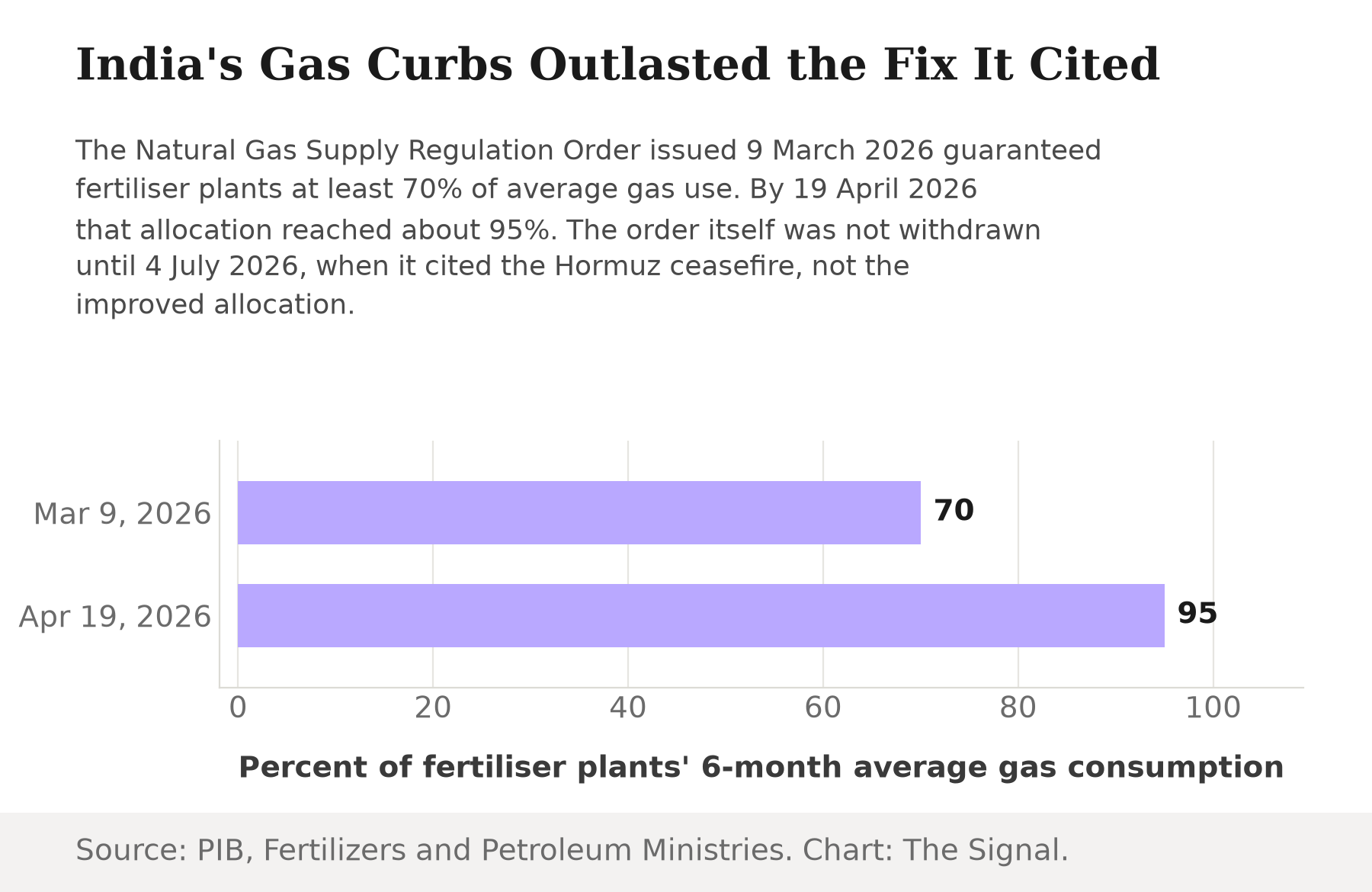
Source: Press Information Bureau, Department of Fertilizers; Press Information Bureau, Ministry of Petroleum and Natural Gas. Chart: The Signal.
The ration improved twice over, but the order authorizing it never changed. The Natural Gas (Supply Regulation) Order, 2026, notified on 9 March 2026 under the Essential Commodities Act, made fertiliser plants a "Priority Sector-2" guaranteed at least 70% of their average natural gas consumption over the prior six months, and that order, priority sectors and all, stayed on the books for eleven more weeks after the allocation had already reached 95%.
The exposure gap that explains why gas needed rationing at all
Gas needed emergency rationing during the crisis. Oil did not. Not because India buys less oil from West Asia, but because gas is the more concentrated bet of the two.
Gas is both more import-dependent and more concentrated in one region than oil.
| Metric | Crude oil | Natural gas |
|---|---|---|
| Share of India's needs met by imports | About 88% (PTI, via The Tribune); 88.6% in the ten months to January 2026 (Business Today, citing PPAC) | About half (PTI, via The Tribune) |
| Share of those imports sourced from West Asia | 40-45% (PTI, via The Tribune) | Nearly 65% (PTI, via The Tribune) |
| Exposure specific to the Strait of Hormuz | Close to 50% of crude supply, about 2.5-2.7 million barrels a day (Business Today, citing PPAC) | Rationed nationwide under the March 2026 order once transit was restricted |
Source: PTI, carried by The Tribune; Business Today, citing Petroleum Planning & Analysis Cell data.
Oil's exposure to West Asia is real too, but crude trades in a deep, fungible global market. LNG cargoes do not, which is why gas needed a legal rationing guarantee that oil never did.
The diversification Modi credited was already priced in by the market
The diversification Modi highlighted over the weekend is real, and it moved faster than any single policy could plausibly claim credit for. In the March-May 2026 quarter, the United States overtook Qatar as India's top LNG supplier: Washington's share of India's cumulative LNG imports jumped from about 8% a year earlier to 25.86%, Qatar's share collapsed 48% to just 1.72%, and the combined share of West Asian suppliers, Qatar, the UAE, Saudi Arabia and Kuwait, fell from 74.2% to 29.31%. Ship-tracking data attribute that shift to market pricing and availability, not to the government's domestic rationing order.
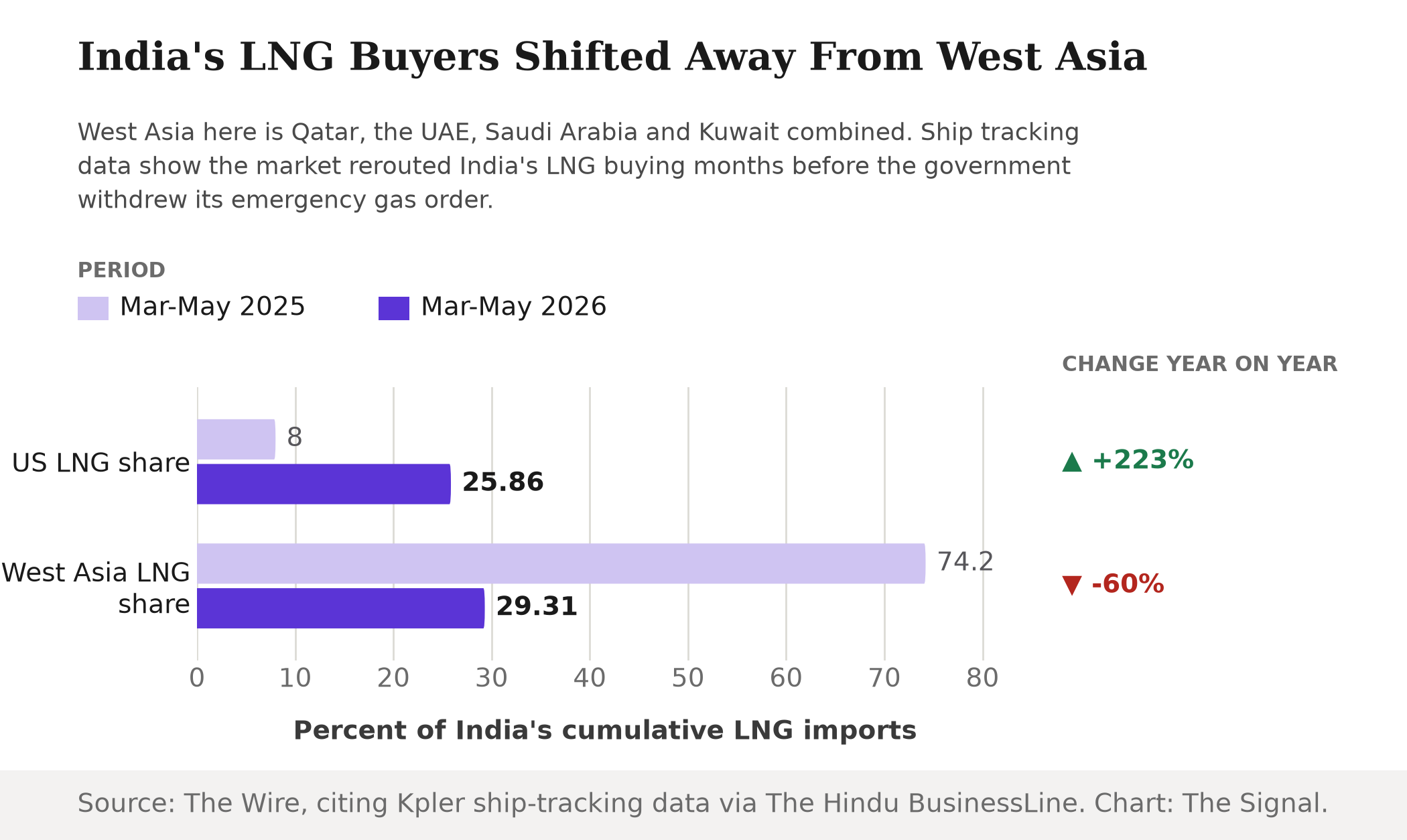
Source: The Wire, citing Kpler ship-tracking data. Chart: The Signal.
That reshuffle unfolded across March, April and May, entirely inside the window the emergency order was still rationing supply. If cheaper cargoes from new suppliers had been the reason India could lift its curbs, the order would have followed the diversification. Instead it followed the ceasefire, ten weeks later.
The honest objection
The strongest case for reading this as competent crisis management, not a lucky break, sits in the timing of the fix itself. The fertiliser allocation had already reached 95% by 19 April 2026, eleven weeks before the ceasefire and the formal withdrawal. A government merely waiting on Hormuz would not have bothered refining the allocation formula at all, let alone extending relief to industrial and city-gas users too. That argues real administrative capacity, not passive waiting.
That case holds for the ration, not the order. The ministry's own withdrawal notification names the ceasefire and the resumption of Hormuz sea traffic as the reason for lifting the rules, not the state of the allocation, already at 95% for eleven weeks. Had the supply position been the actual trigger, the order could have lapsed in April or May. It waited for the strait instead.
The Signal
Diplomacy and prudent management are the Prime Minister's own words for what happened, and the number behind them, sourcing energy from nearly 40 countries instead of 25 or 26, is real. But it describes where India's buying went, not why the domestic ration ended when it did. The government's own paperwork gives that answer: a ceasefire and a reopened shipping lane, dated the same weekend as the withdrawal. The distinction matters because the underlying exposure has not moved. Gas remains far more concentrated in West Asia than oil, and the fix that ended in July was contingent on events in Tehran, not on anything India built in the four months between. Watch the next chokepoint. If the order clears in weeks rather than months, something structural has changed. Wait on the geopolitics again, and this crisis was not a lesson learned, only a preview.
Reporting basis: the March 2026 emergency order and its terms are per a Press Information Bureau release from the Department of Fertilizers; the April 2026 easing is per a separate Press Information Bureau release from the Ministry of Petroleum and Natural Gas. The 4 July withdrawal notification and its stated reasoning, along with the crude-import-dependency and Hormuz-exposure figures from the Petroleum Planning & Analysis Cell, are as reported by Business Today. The broader oil-versus-gas import and West Asia exposure comparison is per PTI, as carried by The Tribune. The March-May 2026 LNG supplier-share shift is per The Wire, citing Kpler ship-tracking data as reported by The Hindu BusinessLine. Prime Minister Modi's remarks are as reported by All India Radio's News on Air. The four-month duration of the order and the framing of gas's relative exposure to oil are The Signal's calculations from those figures.