A PIB press release on the decision states that on 25 March 2026, the Union Cabinet approved a second decade for India's regional connectivity scheme, Modified UDAN, with a total outlay of Rs 28,840 crore over ten years, from FY2026-27 to FY2035-36. The same week, the Ministry of Civil Aviation reported that, as on 25 March 2026, UDAN had operationalised 663 routes across 95 airports, heliports and water aerodromes since its 2016 launch, with more than 3.44 lakh flights carrying over 163 lakh passengers. Read only that far, the program looks like a rare policy success story: a subsidy built to put small-town India on the aviation map, renewed for another decade on the strength of its own scorecard.
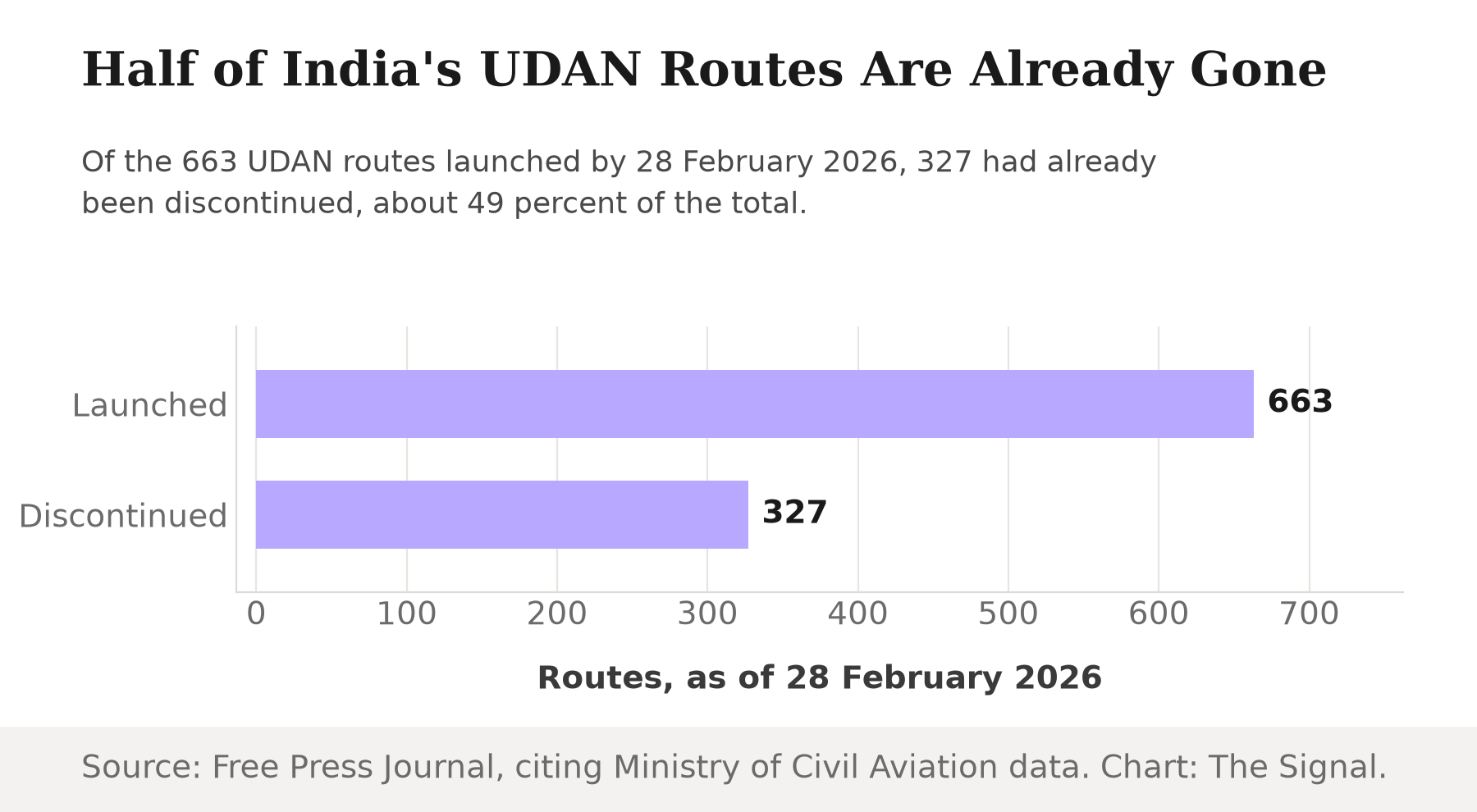
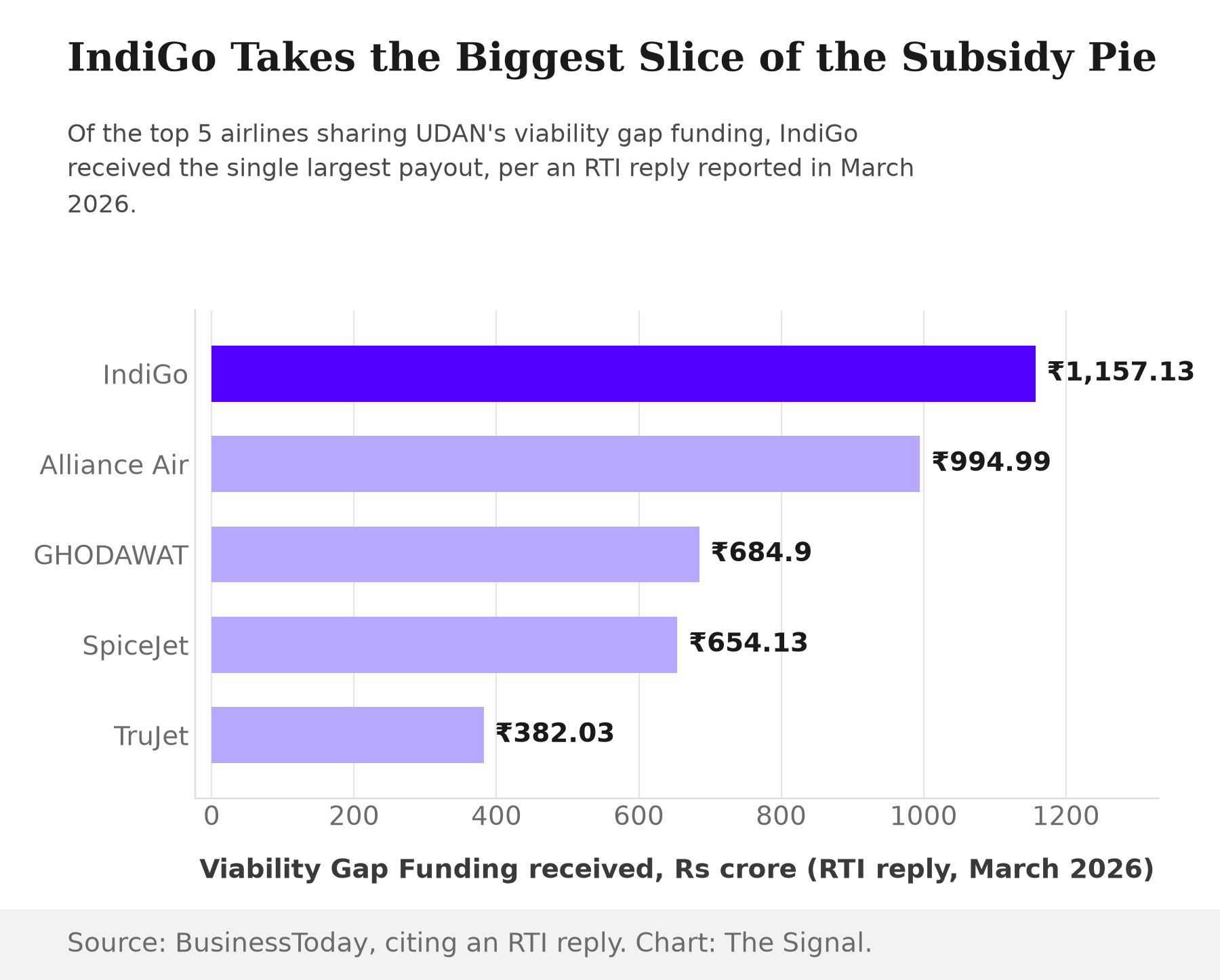
It is worth slowing down on that scorecard. Days after the cabinet decision, an RTI reply reported by BusinessToday showed UDAN has cost over Rs 10,169 crore in combined airport-infrastructure sanctions and airline subsidy since its 2016 launch, and IndiGo was the single largest recipient of that airline subsidy, at Rs 1,157.13 crore. That is a striking beneficiary for a scheme built to seed underserved markets, because IndiGo already held 63.6% of India's domestic air passenger market in January 2026, Free Press Journal reports, citing DGCA data, making it by far the dominant carrier in the very market UDAN subsidises smaller operators to enter. And per Ministry of Civil Aviation data reported by Free Press Journal, of the 663 routes launched under UDAN as of 28 February 2026, 327, about 49%, had already been discontinued, and 15 airports built for the scheme, at a cost of Rs 831.33 crore, now have no scheduled flights at all.
Half the routes UDAN has launched since 2016 are already gone.
That is the number that carries this story. A scheme can announce a decade-long renewal and a rising passenger count and still be, underneath, a machine that keeps losing the map it was built to draw. Set the over Rs 10,169 crore spent since 2016 against the over 163 lakh passengers UDAN has carried in that time and the scheme has spent roughly Rs 6,200 in public money per passenger flown, our calculation from those two government figures.
Source: Press Information Bureau; Free Press Journal, citing Ministry of Civil Aviation data. Chart: The Signal.
The subsidy's biggest winner
Follow the money and the paradox sharpens. IndiGo's Rs 1,157.13 crore in Viability Gap Funding was followed by Alliance Air at Rs 994.99 crore, GHODAWAT at Rs 684.90 crore, SpiceJet at Rs 654.13 crore and TruJet at Rs 382.03 crore, the RTI reply shows. Those five carriers together took nearly Rs 3,873 crore, about 83% of all VGF released under the scheme: a subsidy meant to spread risk across many small operators has instead concentrated in a handful of the biggest names in Indian aviation, with the largest single carrier in the country topping the list.
Source: BusinessToday, citing an RTI reply. Chart: The Signal.
The airport-side spending tells a similar story about where the money concentrates, per the same RTI reply.
Nine airports account for a large share of UDAN's development spending, led by Ayodhya.
| Airport | Development allocation (Rs crore) |
|---|---|
| Ayodhya | 347.41 |
| Kolhapur | 333.29 |
| Jharsuguda | 183.67 |
| Pakyong | 178.75 |
| Prayagraj | 161.43 |
| Amravati | 148.53 |
| Kanpur | 134.79 |
| Darbhanga | 127.82 |
| Adampur | 125.60 |
Source: BusinessToday, citing an RTI reply.
Ayodhya received the highest single airport-development allocation, at Rs 347.41 crore, a scale of investment that raises the stakes on whether the routes serving it, and airports like it, actually stay in the air.
Half the map keeps disappearing
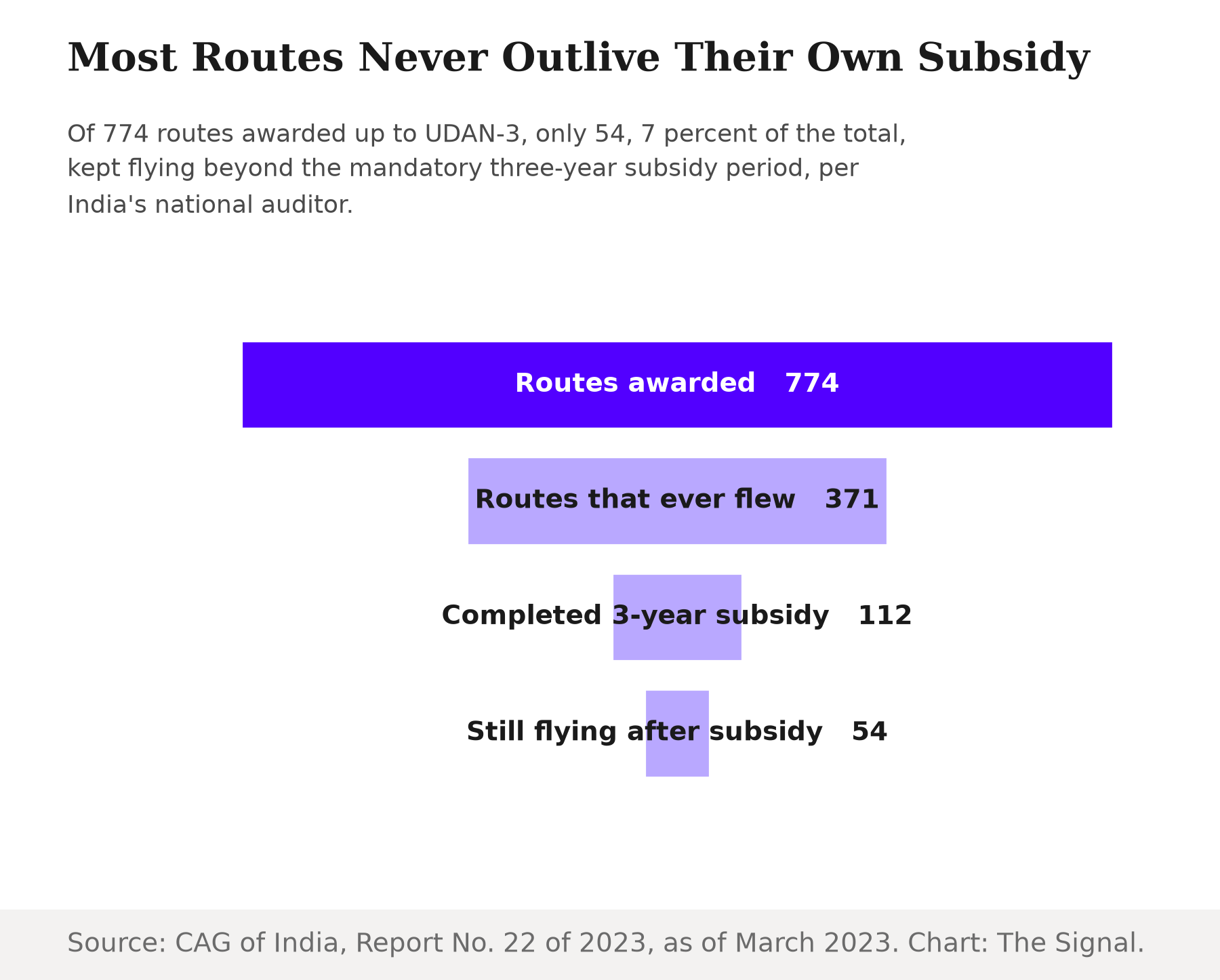
This is not a new pattern surfacing for the first time in 2026. India's national auditor, the Comptroller and Auditor General, found that up to UDAN-3, 52% of awarded routes, 403 of 774, never commenced operations at all, in a compliance audit covering the scheme through March 2023. Of the 371 routes that did commence, only 54, just 7% of all routes ever awarded, sustained operations beyond the mandatory three-year subsidy period. The same audit found the pattern repeated at the airport level: operations never commenced or were later discontinued at 83 of 116 RCS airports, heliports and water aerodromes, despite Rs 1,089 crore already spent developing them.
Source: CAG Report No. 22 of 2023. Chart: The Signal.
Three years and one cabinet renewal later, the 2026 numbers describe the same shape at larger scale. The scheme has gone from 774 routes awarded to 663 actually operationalised, and the discontinuation rate has held almost exactly where the 2023 audit left it: 49% of routes launched, versus 52% of routes awarded that never even commenced, as of the CAG's 2023 snapshot. And of the 327 routes discontinued as of February 2026, only 167 had connected an airport that transitioned from unserved or underserved to fully served status before failing: even the routes that shut down mostly did not leave behind the lasting connectivity gain the scheme was designed to create.
Named, those closures stop being an abstract percentage. The Ministry of Civil Aviation told the Rajya Sabha that Pathankot, Pakyong, Kushinagar, Aligarh, Azamgarh, Chitrakoot, Shravasti, Moradabad, Bhavnagar, Ambikapur, Rourkela, Ludhiana, Datia, Kalaburagi and Shimla are the 15 airports now left with no scheduled flights, and gave a list of reasons for the suspensions that reads like a catalogue of ordinary commercial risk rather than one-off bad luck: completion of the three-year VGF subsidy window, poor visibility and runway closures, aircraft shortages and leasing problems, airlines simply discontinuing service, contracts being handed to other operators, and low passenger load factors. That is precisely the commercial risk the subsidy exists to absorb during the concession window, and precisely what appears to resurface once the subsidy clock runs out.
The honest objection
The strongest case for the scheme is that a subsidised network needs time and tolerates failure by design. UDAN is explicitly an experiment: it pays an airline to try a route it would not otherwise fly, for a fixed subsidy window, precisely so that some routes can be tested and dropped without an airline bearing the full commercial risk. On that view, a route count that has grown from zero in 2016 to 663 operationalised by March 2026, carrying more than 163 lakh passengers along the way, is the experiment working as intended, and a Rs 28,840 crore, ten-year renewal is the government doubling down on a proven model rather than propping up a failing one.
That case holds up against a single bad year. It strains against a repeat of the exact same failure rate three years apart. The 2023 audit was a warning that most subsidised routes were not converting into lasting service; the 2026 data show almost the identical share failing again, at a larger scale and after a full redesign of the scheme into "Modified UDAN." A subsidy that keeps producing the same attrition after a rebuild is not proof the experiment works. It is evidence the design has not changed the incentive that produces the attrition, and IndiGo topping the payout list suggests part of that incentive is that the money flows most easily to the airline with the least to lose.
The Signal
UDAN's defenders can point to a decade of route launches and a growing passenger count; its critics can point to a near-50% failure rate that has barely moved since the last independent audit. Both are reading the same scheme correctly. The number worth watching over the next few years is not how many new routes Modified UDAN announces, but how many of them are still flying past their subsidy window, and who is flying them. If the next audit still shows roughly half the launches gone and the dominant carrier still topping the payout list, the scheme will have spent a second decade subsidising the same churn instead of fixing it. A connectivity scheme is not working because it launched a route. It is working when the route is still there after the subsidy stops.
Reporting basis: the 25 March 2026 Cabinet decision and the cumulative UDAN route and passenger count are both from Press Information Bureau releases attributed to the Ministry of Civil Aviation and the Union Cabinet respectively. The combined spending figure, the airline-by-airline Viability Gap Funding breakdown and the airport-development allocations come from BusinessToday's account of a single RTI reply, which is the only source for those figures. IndiGo's domestic market share is per Free Press Journal, citing DGCA traffic data. The 2026 route-discontinuation figures, including the number and development cost of the 15 airports with no scheduled flights left, are per Free Press Journal's account of Ministry of Civil Aviation data, the sole source for those specific figures. The names of those 15 airports and the ministry's stated reasons for the suspensions are per the Tribune's account of the Ministry of Civil Aviation's reply to the Rajya Sabha, the sole source for that list. The historical route-commencement and airport-operation findings are from the Comptroller and Auditor General of India's Report No. 22 of 2023, a single audit covering the scheme through March 2023. The comparison between the 2023 audit's failure rate and the 2026 discontinuation rate is The Signal's own reading of those two independently reported figures.