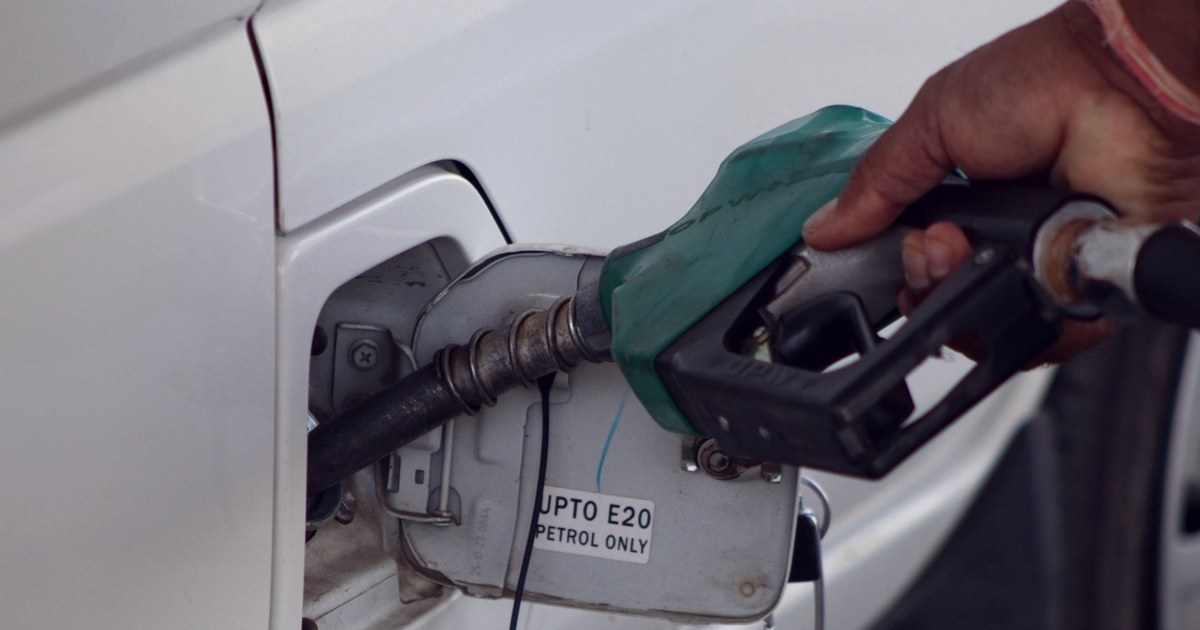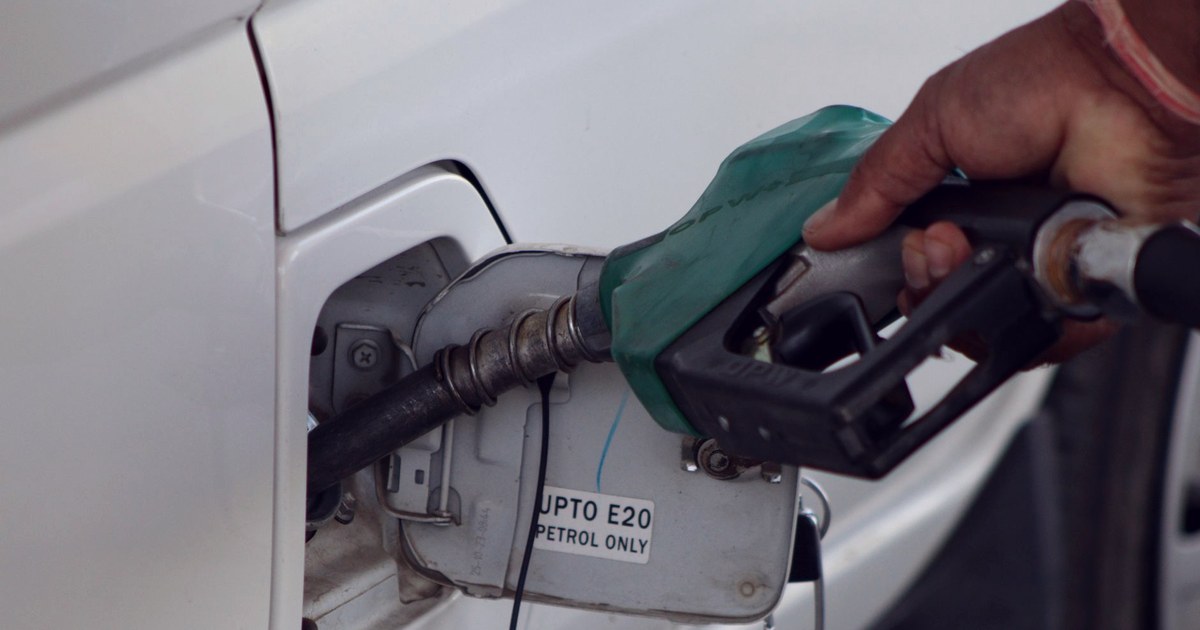
In June 2026, the Ministry of Petroleum and Natural Gas took direct aim at a wave of social media complaints about India's E20 petrol, the 20 percent ethanol blend now sold at most pumps in the country. The ministry's press release called the claims circulating online, including on mileage loss and engine damage, misleading and unsubstantiated, and said old images and videos were being recirculated. Read on its own, the message is simple: the backlash is manufactured noise, not signal.
It is worth slowing down on that. The government is not short of its own data on this exact question, because the E20 mandate was built on years of testing by its own certifying bodies. NITI Aayog's Inter-Ministerial Committee on ethanol blending reported that E20 causes a real fuel efficiency loss, worst in the vehicles least built for it: 6 to 7 percent in four-wheelers designed for plain petrol and merely calibrated for 10 percent ethanol, and 3 to 4 percent in the equivalent two-wheelers. Only four-wheelers actually engineered for 10 percent ethanol and calibrated for 20 percent, India's newest category, get down to a 1 to 2 percent loss.
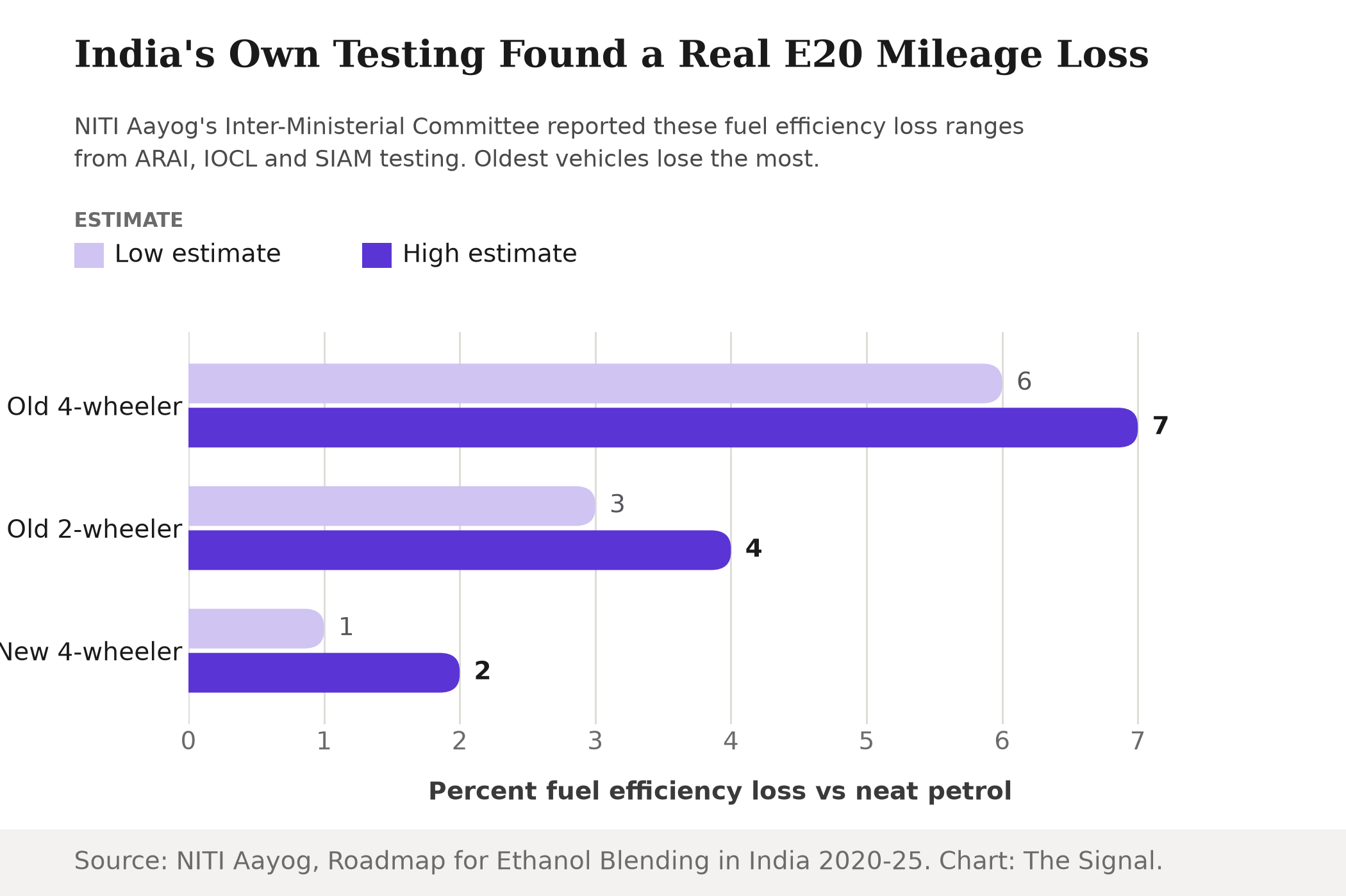
That figure is not a stray footnote invented by aggrieved drivers. The 2014-15 study behind it, run jointly by ARAI, the Indian Institute of Petroleum and IOCL, found fuel economy fell by up to 6 percent on average, and that some elastomers and PA66 plastic used in fuel systems lost tensile strength on contact with E20. The mileage complaint the ministry now calls unsubstantiated is, in the government's own testing record, a decade-old, repeatedly measured effect on the vehicles least suited to the fuel.
Independent testing outside government channels tells the same story, and sometimes a sharper one. Autocar India's own real-world comparison of three BS4-era petrol cars on E20 versus E10 found the Maruti Suzuki Dzire lost 12.4 percent in fuel economy, the Hyundai Grand i10 lost 9.2 percent, and the turbocharged Volkswagen Polo GT TSI lost just 5.2 percent, the two naturally aspirated cars already exceeding the top of NITI Aayog's certified range. A June 2026 LocalCircles survey of more than 44,000 owners of pre-2023 petrol vehicles across 305 districts found 66 percent reporting a mileage drop of more than 10 percent since early 2025, up from 45 percent just a month earlier. Neither is a viral post: one is a named automotive title's road test, the other a fielded survey, and both land at or beyond what the government's own testing anticipated.
The other side of the ledger is real too
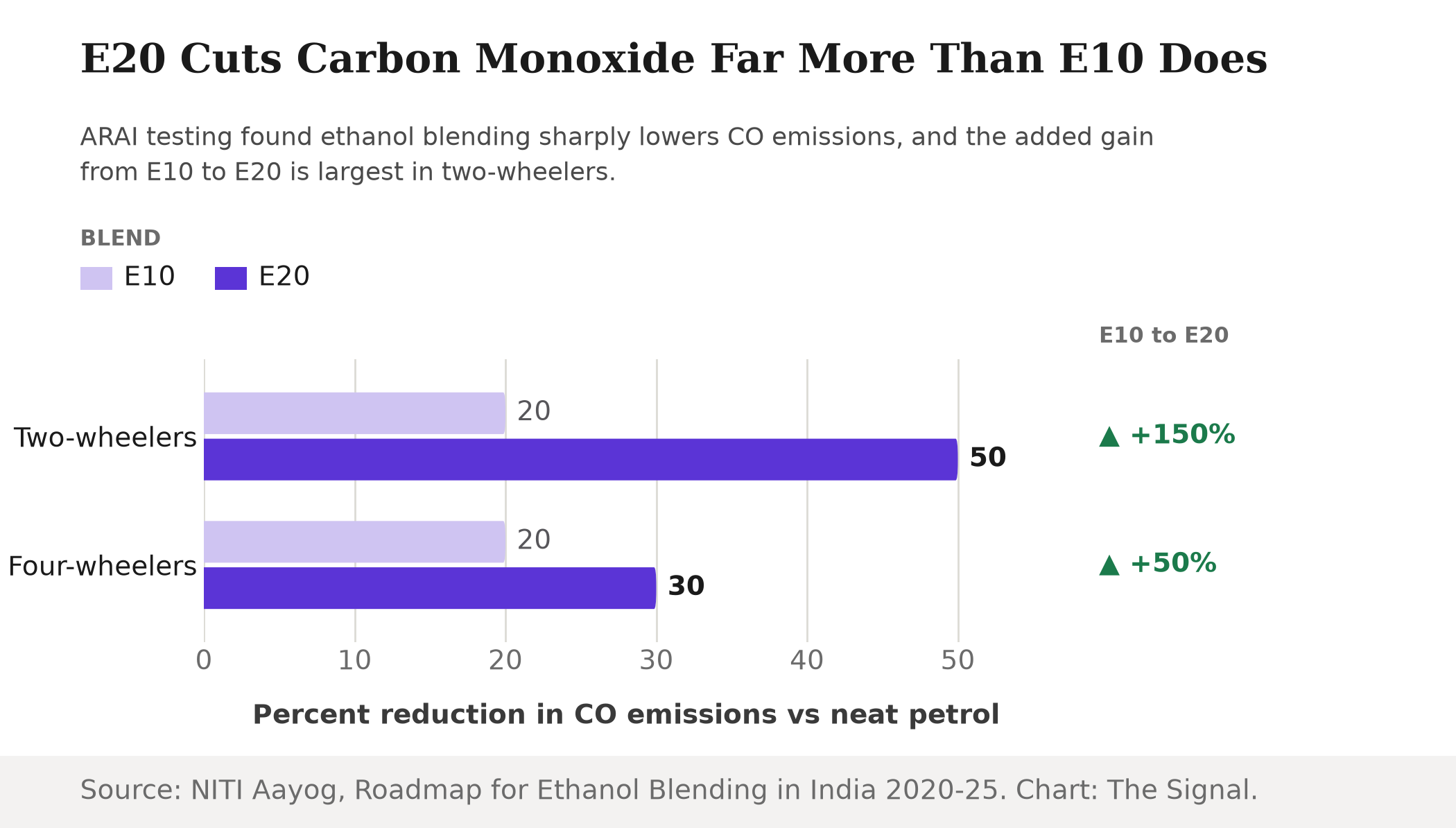
None of this makes E20 a bad bet on its own terms. ARAI testing found E20 cuts carbon monoxide emissions by 30 percent in four-wheelers and 50 percent in two-wheelers against neat petrol, well ahead of the 20 percent cut from E10.
The energy security case was explicit from the start. NITI Aayog projected in 2021 that a successful E20 rollout would save the country US $4 billion a year in foreign exchange, about Rs 30,000 crore, against net petroleum imports of 185 million tonnes that cost $55 billion in 2020-21. By June 2026, Petroleum Minister Hardeep Singh Puri said the ethanol blending programme had saved Rs 1.84 lakh crore in forex since Ethanol Supply Year 2014-15, substituted 302 lakh tonnes of crude oil, cut 909 lakh tonnes of CO2 emissions and paid farmers Rs 1.58 lakh crore, as blending rose from 1.5 percent in 2014 to 20 percent now. India still imports roughly 88.5 percent of its crude oil, and the two-wheeler fleet the mandate rides on has grown past 300 million active vehicles, per the same release.
Who carries the mileage loss, and who does not
India's on-road fleet in 2021 stood at around 22 crore two and three-wheelers and 3.6 crore four-wheelers, with two and three-wheelers alone consuming two-thirds of the country's petrol by volume, the base fleet the E20 mandate rolled out onto. The efficiency loss the government's own testing measured is not evenly spread. It concentrates in the older four-wheelers and two-wheelers that make up most of that fleet, while the newest, E20-calibrated cars absorb the smallest hit.
The government is not simply pocketing the difference either. At 2020-21 blending volumes, replacing petrol with ethanol was already costing the central government Rs 10,950 crore a year in lost excise revenue, since petrol carries an excise duty of Rs 32.98 a litre while ethanol draws only GST. And the industry side of the trade has gotten pricier too. The ministry's own August 2025 rebuttal on E20 mileage concerns showed ethanol's procurement price rising faster than petrol since the 2021 roadmap: C-heavy molasses ethanol from Rs 46.66 a litre in Ethanol Supply Year 2021-22 to Rs 57.97 in 2024-25, and maize-based ethanol from Rs 52.92 to Rs 71.86 over the same stretch. Any theoretical saving from the swap has not clearly reached the pump either. An independent analysis by the Centre for Social and Economic Progress calculated that a 15.83 percent blending rate could in theory cut retail petrol prices by roughly Rs 3.5 to Rs 5.1 a litre, but found that retail prices had not come down to reflect it. Drivers losing mileage do not appear to be getting an offsetting discount at the pump.
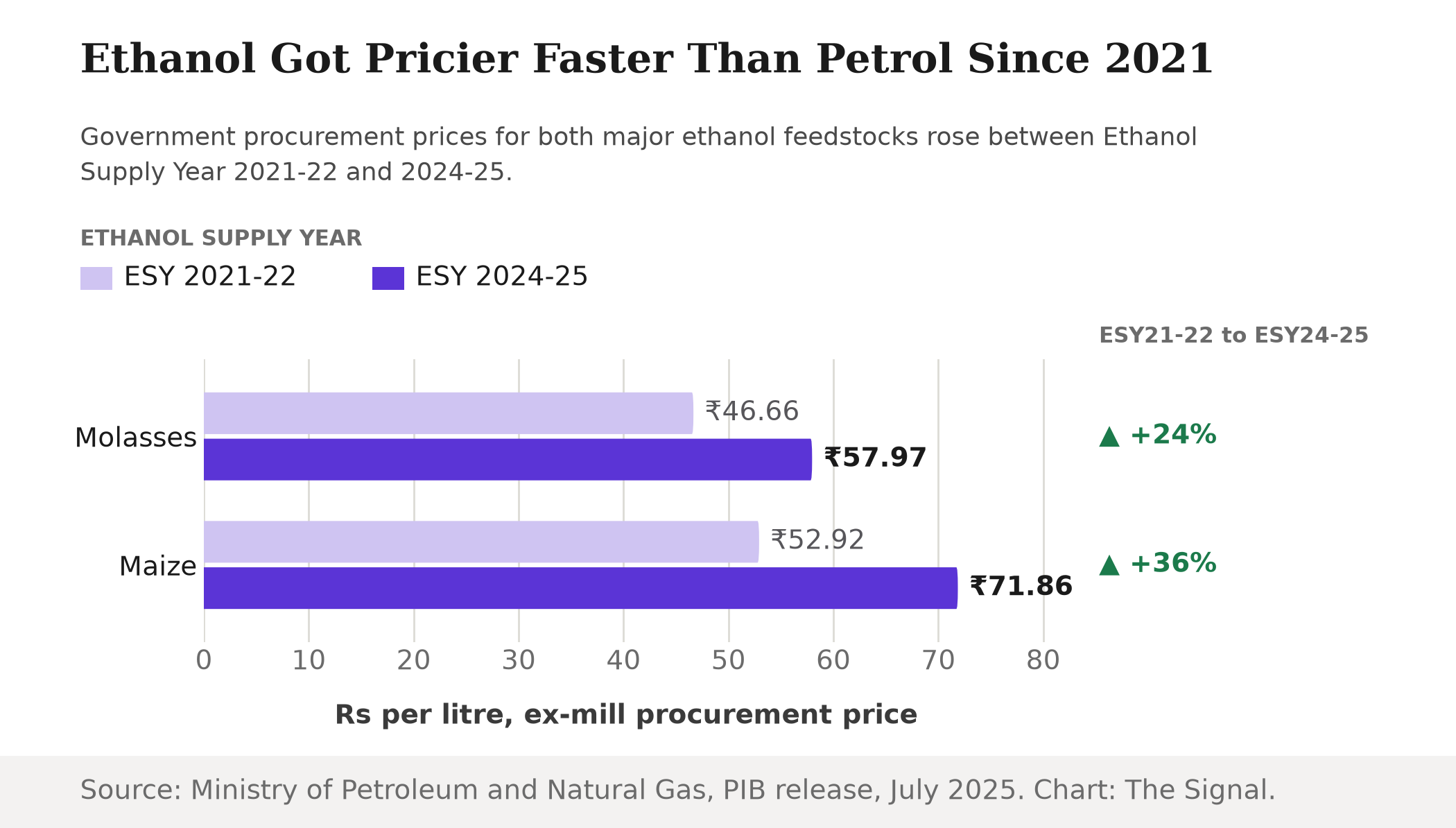
That price gap has a feedstock story behind it. Sugarcane earns Uttar Pradesh's farmers far more than the food crops ethanol production competes with for land.
| Crop (Uttar Pradesh, 2018-19) | Net return per hectare | Sugarcane's return as a multiple of this crop's |
|---|---|---|
| Sugarcane, at FRP | Rs 60,027 | Baseline |
| Paddy | Rs 24,260 | 2.5x |
| Maize | Rs 7,749 | 7.7x |
Source: NITI Aayog Task Force on Sugarcane and Sugar Industry, cost-of-cultivation data from the CACP survey.
Sugarcane's net return of Rs 60,027 a hectare was 2.5 times paddy's and 7.7 times maize's in Uttar Pradesh in 2018-19. That gap is exactly why ethanol feedstock demand channels toward sugarcane rather than food grain: the mandate does not just move money between drivers and refiners, it also reshapes which crop a farmer plants.
The honest objection
The strongest case for the government's position is that the most extreme viral claims genuinely go further than any credible figure supports. Claims that E20 destroys engines outright, voids insurance, or behaves as some invisible contaminant are not the same claim as my mileage dropped, and conflating the two, as viral posts often do, is exactly the kind of amplification the ministry says it is correcting. The carbon monoxide gains are large and measured, and the forex savings have reached Rs 1.84 lakh crore over the past decade, a real trade-off, not a hoax.
That case holds for the extreme claims. It does not hold for the specific one the ministry's own release names: mileage. The government's June 2026 statement grouped mileage complaints in with the claims it called misleading and unsubstantiated, without carving out the fact that its own Inter-Ministerial Committee had already put a number on that exact loss, years earlier, drawn from its own certifying agencies. A real, measured, single-digit effect is not the same thing as misinformation, even when it sits next to claims that are.
The Signal
The E20 rollout is not a hoax and it is not a scandal. It is a genuine trade: real energy security and emissions gains, bought partly with a mileage cost concentrated in the oldest vehicles and partly with a farm-price shift toward sugarcane, all backed by the government's own numbers. What is not defensible is dismissing the mileage complaint itself as unsubstantiated when the dismissal's own source documents disprove it. Watch whether future government rebuttals start separating the extreme viral claims from the measured ones. If they keep bundling both under one blanket denial, the credibility cost will eventually land on the true claims the ministry is right to make.
Reporting basis: the June 2026 rebuttal and the ethanol pricing figures are from Ministry of Petroleum and Natural Gas press releases via the Press Information Bureau, as is Petroleum Minister Hardeep Singh Puri's account of the programme's cumulative savings. The fuel efficiency loss ranges, the underlying 2014-15 ARAI-Indian Institute of Petroleum-IOCL compatibility study, the carbon monoxide testing, the 2021 forex projection, the excise revenue estimate and the vehicle fleet figures are all from NITI Aayog's Roadmap for Ethanol Blending in India 2020-25, a single Inter-Ministerial Committee document that compiles ARAI, IOCL and SIAM testing. The Uttar Pradesh crop-return comparison is from a separate NITI Aayog Task Force report on the sugar industry, citing Commission for Agricultural Costs and Prices survey data. The independent, non-government figures come from Autocar India's own real-world mileage test, a LocalCircles owner survey, and a Centre for Social and Economic Progress analysis of retail petrol pricing.