At a Joint Economic Forum meeting in New Delhi in July 2026, Japan's trade promotion agency announced 129 memorandums of understanding worth Rs 1 lakh crore, and its chairman said Japanese investment into India had reached roughly 2 trillion yen ($12.4 billion) in the year since the two countries' August 2025 summit. Read on its own, that is a good news story: a decades-old partnership accelerating, with a specific number attached. It is also the third time in twelve years Tokyo has put a big, specific investment figure on the table for India.
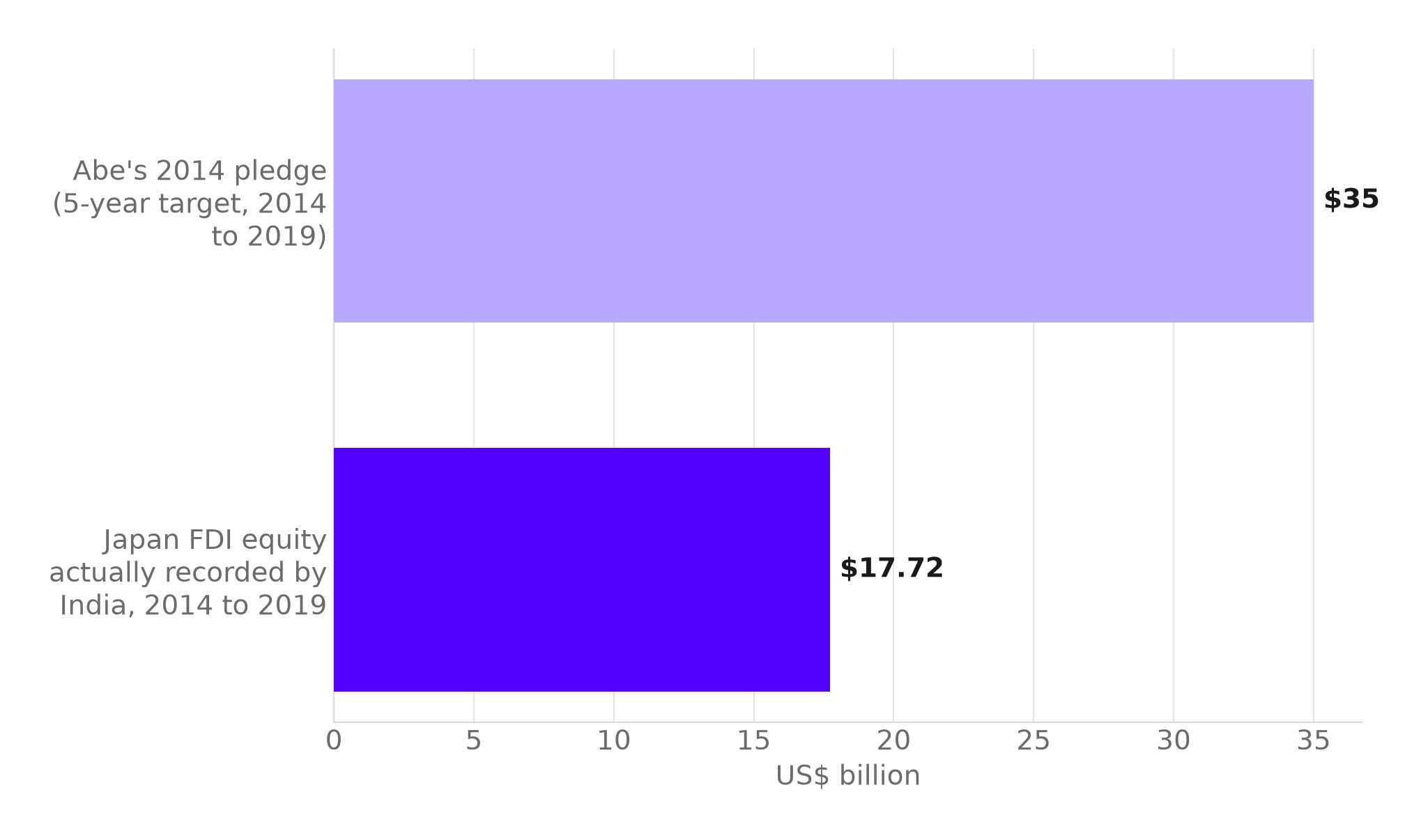
It is worth slowing down on that. The first two of those pledges are old enough that India has its own data on how much of each actually showed up, and the answer is not close to the headline number. On the one pledge with a fully closed window to check, Japan's PM Shinzo Abe promised 3.5 trillion yen, $35 billion, of investment and financing to India over five years, announced during PM Modi's September 2014 visit to Tokyo. India's own investment data show Japan's calendar-year FDI equity inflow summed to just $17.72 billion across that same 2014 to 2019 window, about 50.6 percent of the pledge (our calculation, summing six years of DPIIT's own annual figures against the $35 billion target). Half the pledge, on the one measure India itself keeps.
On the one pledge cycle with a closed window, India's own FDI data show barely half of Japan's promised sum arriving.
The pledged figure and the recorded figure sit on the same axis: US dollars of Japanese investment into India, one announced in 2014, the other tallied since by India's own investment-promotion agency.
Source: Business Today, quoting the Tokyo Declaration; DPIIT's FDI country synopsis on Japan. Realized figure is The Signal's calculation. Chart: The Signal.
Every pledge since has been bigger
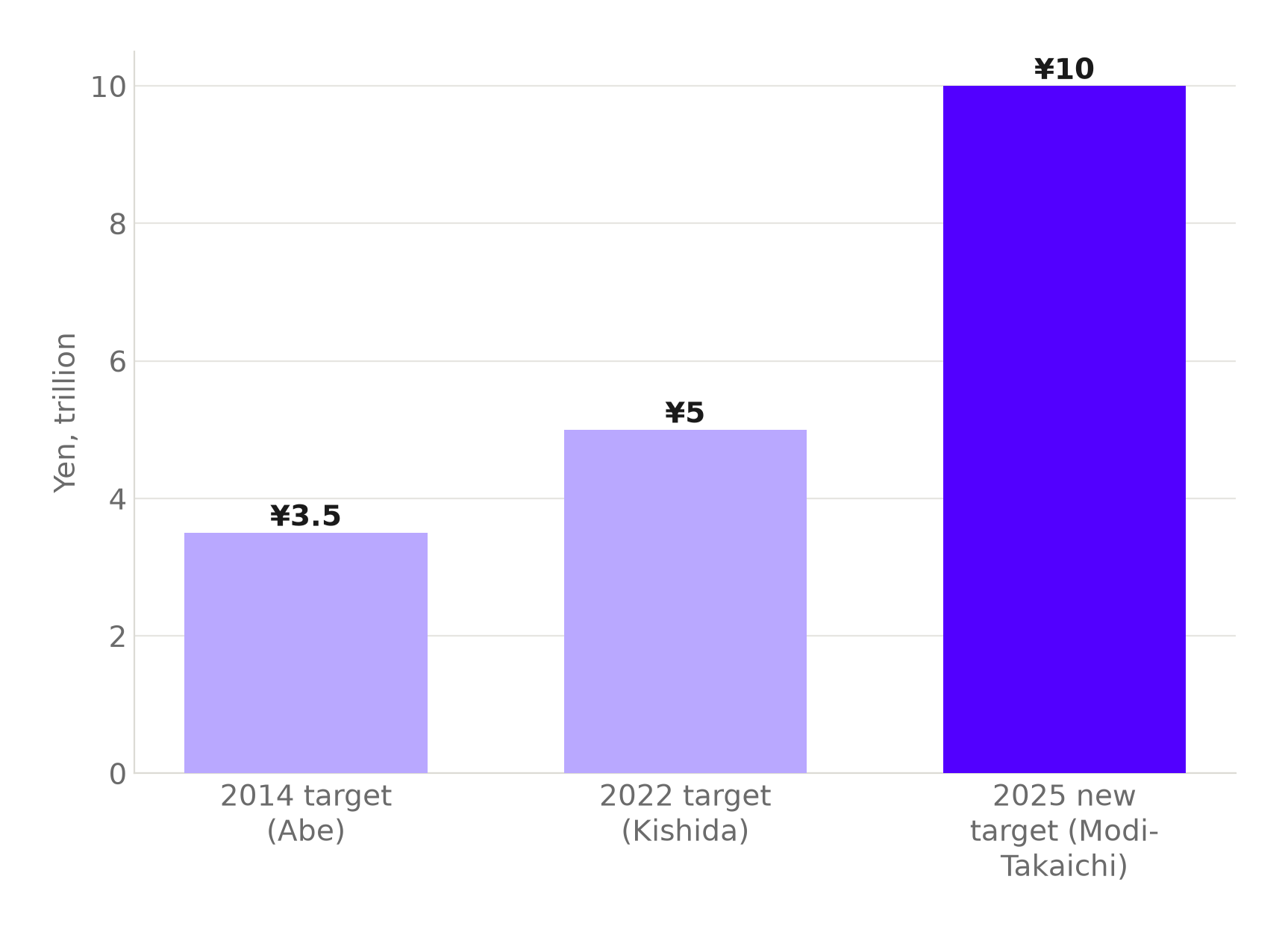
Rather than settle near the 2014 mark, each successive round has raised the target. The 2022 target of 5 trillion yen ($42 billion) in public and private investment and financing over five years was itself superseded at the 15th India-Japan Annual Summit in Tokyo in August 2025, where the two governments set a new target of 10 trillion yen in private investment. Three targets, twelve years, and the newest is exactly double the one it replaced.
Each new India investment target has been announced before the prior one's five-year window even closed.
The 2022 target had three years left to run when it was folded into a new, larger one in August 2025.
Source: Business Today; 15th India-Japan Annual Summit joint statement. Chart: The Signal.
What India's own ledger shows for the current cycle
The 2022 to 2027 window is still open, so there is no final tally yet. But India's Department for Promotion of Industry and Internal Trade (DPIIT) publishes the same equity-inflow series every quarter, and it is the closest thing to a running scoreboard. Cumulative Japanese FDI equity inflow into India stood at $38.45 billion from January 2000 to December 2022, ranking Japan 5th among source countries with a 6.14 percent share. By June 2025, that cumulative figure had reached $44.95 billion, still 5th and still about 6 percent of the total, with annual inflow of $3.18 billion in FY2023-24, $2.48 billion in FY2024-25, and $551 million in the first quarter of FY2025-26.
Add those three latest periods and Japan's FDI equity into India comes to about $6.2 billion (The Signal's calculation), against a $42 billion five-year target, on the mid-2025 data. A second way of reading the same underlying data confirms it: DPIIT's two published cumulative totals are $44.95 billion in June 2025 and $38.45 billion in December 2022, a gap of roughly $6.5 billion (also The Signal's calculation). Either way, on that snapshot the equity inflow India's own agency records was a small slice of the headline target.
Japan's FDI equity inflow into India has fallen in each of the last three periods DPIIT has published.
$3.18 billion, then $2.48 billion, then $551 million in a single quarter: a declining run, not the acceleration a doubling target would need.
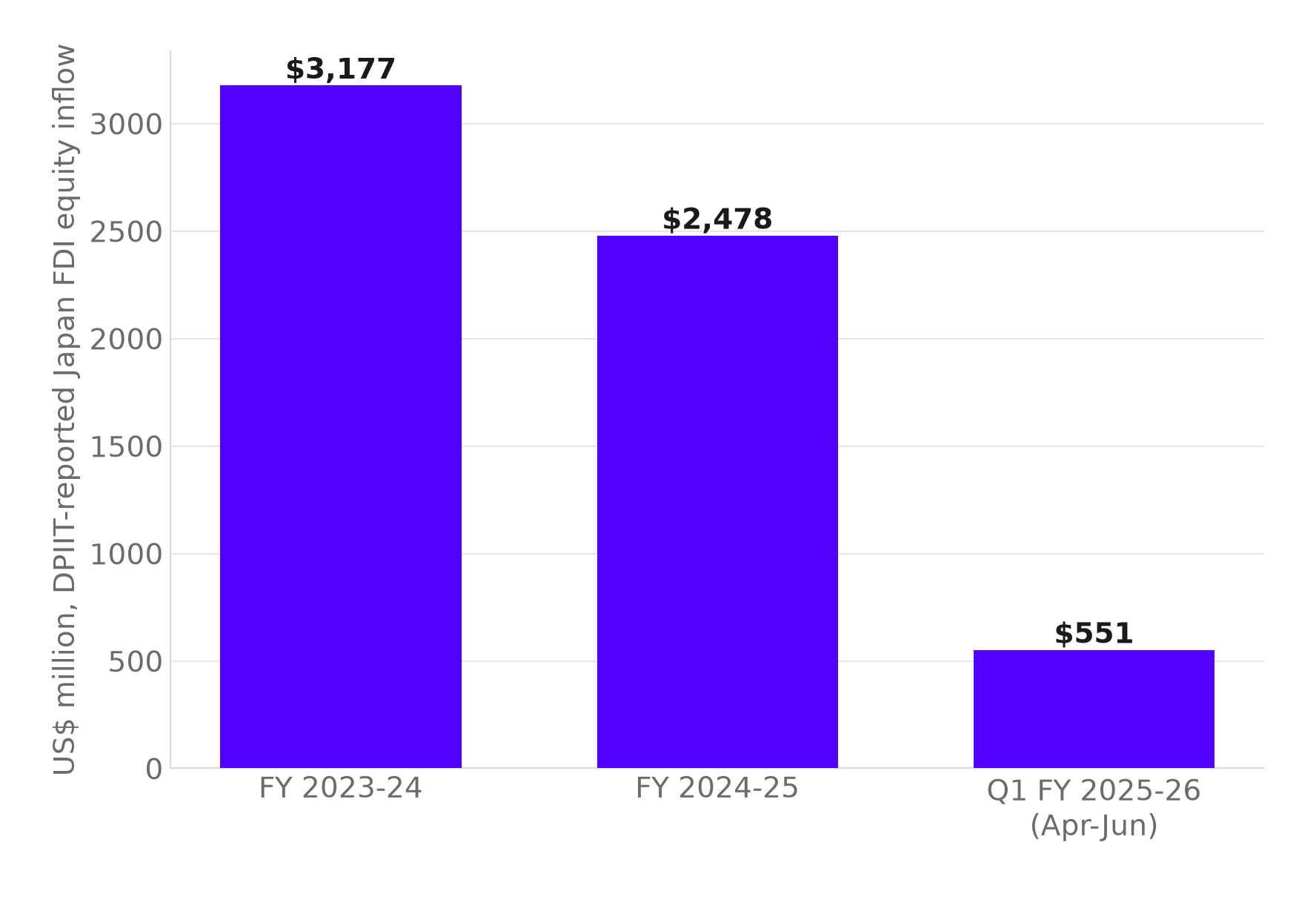
Source: DPIIT's quarterly FDI fact sheet, updated to June 2025. Chart: The Signal.
That single quarter turned out to be an outlier, not the new trend. DPIIT's newest fact sheet, covering the first nine months of FY2025-26 (April to December 2025), shows Japan's FDI equity inflow already at $3.2 billion for that nine-month span alone, more than the full-year totals recorded in either FY2023-24 or FY2024-25. Cumulative Japanese FDI equity inflow, in the same fact sheet, had reached $47.6 billion by December 2025, still ranked 5th among source countries at about 6 percent share, up from $44.95 billion six months earlier. The single-quarter low was real, but read against the newest data it looks like a trough, not a continuation of the decline.
How the three pledge cycles compare, on India's own numbers
| Pledge cycle | Announced target | Window | What India's data show |
|---|---|---|---|
| 2014 (Abe) | 3.5 trillion yen, $35 billion | 2014 to 2019 | $17.72 billion in Japan FDI equity inflow over the same years, about half the target |
| 2022 (Kishida) | 5 trillion yen, $42 billion | 2022 to 2027 | About $8.86 billion in equity inflow from FY2023-24 through the first nine months of FY2025-26, April-December 2025 (The Signal's calculation); Japan's finance ministry says 74 percent of the yen target had "materialized" by early 2025 |
| 2025 (Modi-Takaichi) | 10 trillion yen, private investment | New target, no window given | Too early for DPIIT data; JETRO says 2 trillion yen ($12.4 billion) in new investment landed in the year to July 2026 |
*Source: Business Today; 15th India-Japan Annual Summit joint statement; Embassy of India, Tokyo; DPIIT, updated to June 2025; DPIIT, updated to December 2025; The Tribune. Realized-share figures are The Signal's calculations.
The honest objection
The strongest case against reading these pledges as overstated is that Japan's own government has already said the current one is mostly delivered. By early 2025, Japan's Finance Minister Katsunobu Kato said 3.7 trillion yen of the 5 trillion yen commitment, about 74 percent, had already materialized. That is not a skeptic's number. It is Tokyo's own finance ministry, on the record, describing a pledge as nearly fulfilled.
That case is real, but it does not square with DPIIT's own equity-inflow series, and the reason is definitional, not a contradiction of fact. Kato's 74 percent figure is measured against "public and private investment and financing," a category that spans government loans, official development assistance, and committed private capital, not the narrower slice DPIIT tracks as FDI equity inflow. The two governments' pledge figures and India's own investment-promotion data are counting different things. That gap is clearest on the one window that has fully closed: measured against 2014 to 2019 equity inflow, the 2014 pledge's recorded share is just half.
The Signal
The number to watch next is not the size of the next trillion-yen target. Tokyo has raised it three times in twelve years, and each time the round before it closes. The number to watch is whether DPIIT's own quarterly equity-inflow series, the only scoreboard India keeps in its own currency of measurement, keeps closing the gap toward the 10 trillion yen target set in August 2025. It fell through FY2023-24, FY2024-25 and the first quarter of FY2025-26 before the newest fact sheet showed nine months of FY2025-26 already ahead of either of the prior two full years: one reversal, not yet a trend, and still a small fraction of the target. There is one metric in this story that sidesteps the definitional gap entirely: PM Modi's own count of roughly 1,400 Japanese companies currently operating in India, with a goal to double that number within the next 10 years. A company count cannot be redefined the way an investment-and-financing total can. If that number is still near 1,400 a few years from now, the trillion-yen targets will have been announcements. If it is closing on 2,800, the money underneath them was real after all.
Reporting basis: the initial investment pledge is per the Tokyo Declaration for India-Japan Special Strategic and Global Partnership, as quoted by Business Today. The successive target, its supersession and the newest private-investment target are from the India-Japan Annual Summit joint statement, issued by the Prime Minister's Office of India and the Government of Japan. The materialization claim for the current cycle is Japan's Finance Minister Katsunobu Kato, via a readout published by India's Embassy in Tokyo. The Joint Economic Forum's MoU count and investment figure are JETRO Chairman Ishiguro Norihiko, carried by The Tribune. All FDI equity inflow figures, cumulative and annual, are Department for Promotion of Industry and Internal Trade data, drawn from three separate DPIIT fact sheets covering different periods, the latest updated to December 2025. The company-count figure and the 10-year expansion target are PM Modi's own remarks, carried by Jiji Press via Nippon.com. The realized share of the initial pledge, the summed equity inflow for the current cycle, and the gap between DPIIT's cumulative totals are The Signal's calculations from those DPIIT figures.