For 28 years, one rule survived every WTO Ministerial Conference without exception: no government would charge customs duties on the emails, software downloads, streamed films and outsourced code that cross borders as data rather than cargo. That streak ended in Yaoundé, Cameroon. The WTO's own account of the 14th Ministerial Conference (MC14) states that the moratorium on customs duties for electronic transmissions was set to expire after members failed to reach consensus on extending it. The WTO's Work Programme on Electronic Commerce page confirms that the Work Programme and the moratorium both lapsed on 30 March 2026, the first time in the arrangement's history that it was not renewed.
Read as a headline, that sounds like a setback for open digital trade everywhere. It is worth slowing down on that.
Within days, most of the WTO's largest digital-trade economies had patched around the gap on their own. Twenty-three members, including Australia, Japan, Singapore, Switzerland, the UK and the US, signed a joint communication on 1 April 2026 agreeing to keep not charging each other customs duties on electronic transmissions. Separately, 39 members plus the EU requested interim implementation of a plurilateral Agreement on Electronic Commerce that legally binds its participants not to impose those duties on each other. India signed neither.
Zero: the number of India's free trade agreements that bind it to a customs-duty moratorium on electronic transmissions, in any form.
That is not a gap in an old, unfinished treaty. It holds across every venue where the question has come up in 2026.
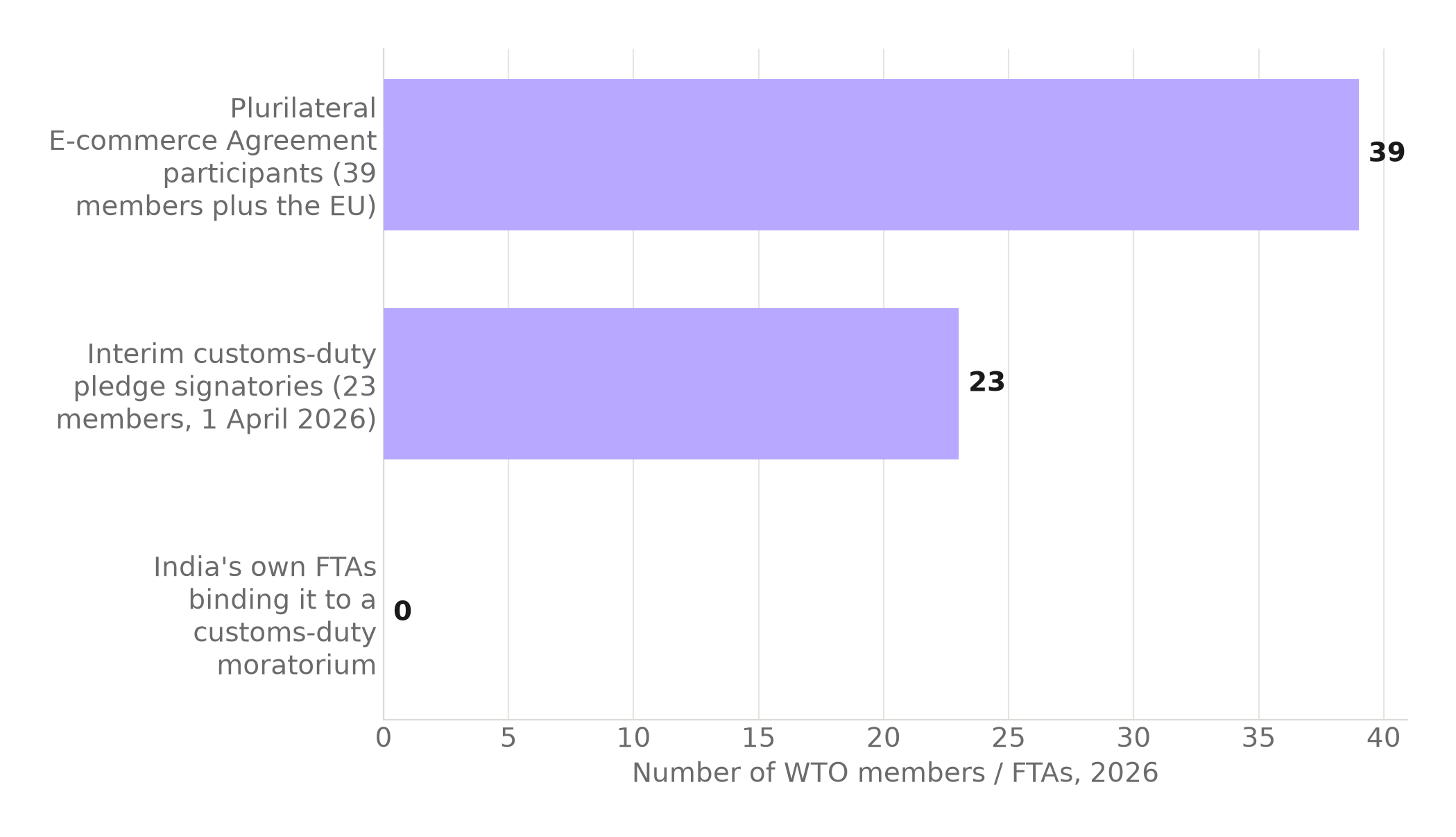
Source: WTO General Council communication WT/GC/283; WTO Declaration WT/MIN(26)/42; ICRIER Policy Brief #72. Chart: The Signal.
The FTAs go deep, except on this one clause
The zero is not for lack of effort elsewhere in the same treaties. The UK-India CETA's digital trade chapter runs to 21 separate articles, including one that bars either government from requiring a company to hand over or grant access to its software source code. The EU-India Free Trade Agreement's digital trade chapter incorporates most of the rules from the WTO's own Electronic Commerce Joint Initiative, the plurilateral track that produced the binding duty-free rule, even though India itself is not a member of that initiative. Both treaties build detailed rulebooks covering data flows, source code and digital services. Neither commits either side to a moratorium on customs duties for electronic transmissions, and neither does the UAE CEPA.
India's newest trade deals build detailed digital trade chapters and skip the same clause every time.
The pattern holds across three separate treaties, negotiated with three different partners, in different years.
| Trade agreement | Digital trade chapter | Binds either side to a customs-duty moratorium |
|---|---|---|
| UK-India CETA | 21 articles, including a bar on demanding software source code | No |
| EU-India FTA | Incorporates most of the WTO Electronic Commerce Joint Initiative's rules | No |
| UAE CEPA | Full digital trade chapter | No |
Source: UK-India CETA, Chapter 12; European Commission; ICRIER Policy Brief #72. Table: The Signal.
What holding out is worth
There is a concrete number behind the holdout. India's own forgone customs revenue from the WTO moratorium, using bound tariff rates on digitizable products, is estimated at $1.53 billion in 2020 alone and $4.92 billion cumulatively over 2017 to 2020, according to a South Centre research paper by a UNCTAD economist. That is real money, and it gives India's negotiators a concrete fiscal reason to keep the tariff option open rather than sign it away permanently.
The revenue India forgoes by not taxing electronic transmissions is not a small or a one-off figure.
A single year's figure and a four-year cumulative figure, both from bound tariff rates on digitizable products.
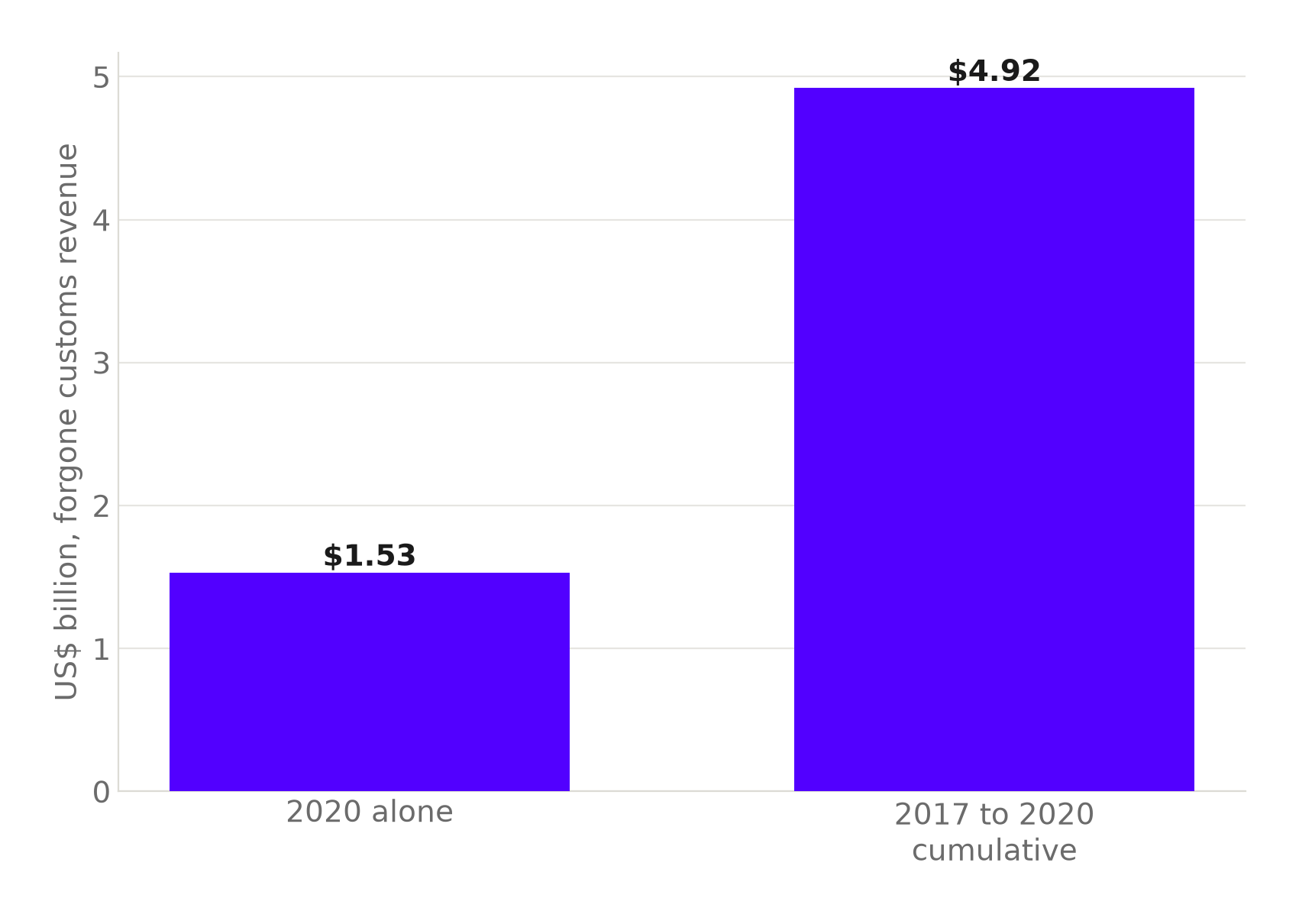
Source: South Centre Research Paper 157. Chart: The Signal.
The honest objection
The strongest case for India's position is that this is not just India's problem. The same South Centre paper finds the tariff revenue loss has exceeded $1 billion for several other developing economies too, including China, Mexico, Nigeria, Pakistan, Paraguay and Thailand. On that reading, India is making the same calculation a whole bloc of digitizable-product importers has reason to make, rather than acting as an outlier for its own narrow benefit, and keeping its options open until the WTO revisits the question is simply prudent.
That case is real, but it sits awkwardly next to what India has already proven it can earn without any tariff of its own. India accounts for roughly 35% of the global IT services market and was the world's fourth-largest exporter of digitally delivered services, with $257 billion in such exports in 2023, more than the combined total of all other low- and middle-income countries. That figure did not require India to tax anything crossing its own border. It required the opposite: other governments not taxing India's digital exports to them. A forgone-revenue argument sized in the low single-digit billions looks smaller set against an export base that size, and it does not explain why India also skipped the same clause when negotiating brand-new treaties like the UK CETA and the EU FTA, where there was no old obligation to defend and only a new one to avoid.
The Signal
None of this proves bad faith. It proves a consistent revealed preference, repeated at a lapsed multilateral moratorium, an interim pledge India never joined, a plurilateral pact it sat out too, and three separate bilateral treaties negotiated with three different partners in different years: every time India has had the chance to lock in duty-free electronic transmissions, it has chosen not to. The clause is cheap to include and costly to promise away, and India's negotiators keep choosing not to promise it. Watch what happens the next time India signs a digital trade chapter from scratch. If the moratorium clause finally appears, the calculus has changed. Until it does, India's exporters keep earning on an openness that other governments extend to them without India extending it back.
Reporting basis: the WTO's moratorium lapse and the history of the Work Programme on Electronic Commerce are per the WTO Secretariat's own published pages. The 1 April 2026 interim pledge and the plurilateral Agreement on Electronic Commerce are per the WTO's own General Council and Ministerial declarations, WT/GC/283 and WT/MIN(26)/42. The EU-India FTA's digital trade chapter is per the European Commission's own summary; the UK-India CETA's digital trade chapter is per the treaty text published by the UK government. The finding that none of India's FTAs commit to a customs-duty moratorium, and the India IT services and digital export figures, are from two separate ICRIER-IIFT policy briefs. The forgone-revenue figures and the multi-country comparison come from a single South Centre research paper by a UNCTAD economist, with no second source backing those numbers. No figure in this piece is The Signal's own calculation.