On Friday, 30 October 2026, Intel shares plummeted 29%, their worst day since the 1970s. The trigger was a weak outlook. Intel said it expects revenue between $15 billion and $16 billion this quarter, against analyst expectations of $17.1 billion. CEO Lip-Bu Tan said customers "began signaling a PC slowdown based on the memory prices and availability."
The headline that travelled furthest was about Washington. The US government owns roughly a tenth of Intel, and the value of those holdings dropped by about $12 billion on Friday. Read quickly, it is a story about a subsidy gone wrong.
It is worth slowing down on that. The loss is real on paper but it is not a verdict on the deal, and what it exposes is a design choice that India made differently.
The loss is bigger than the cheque
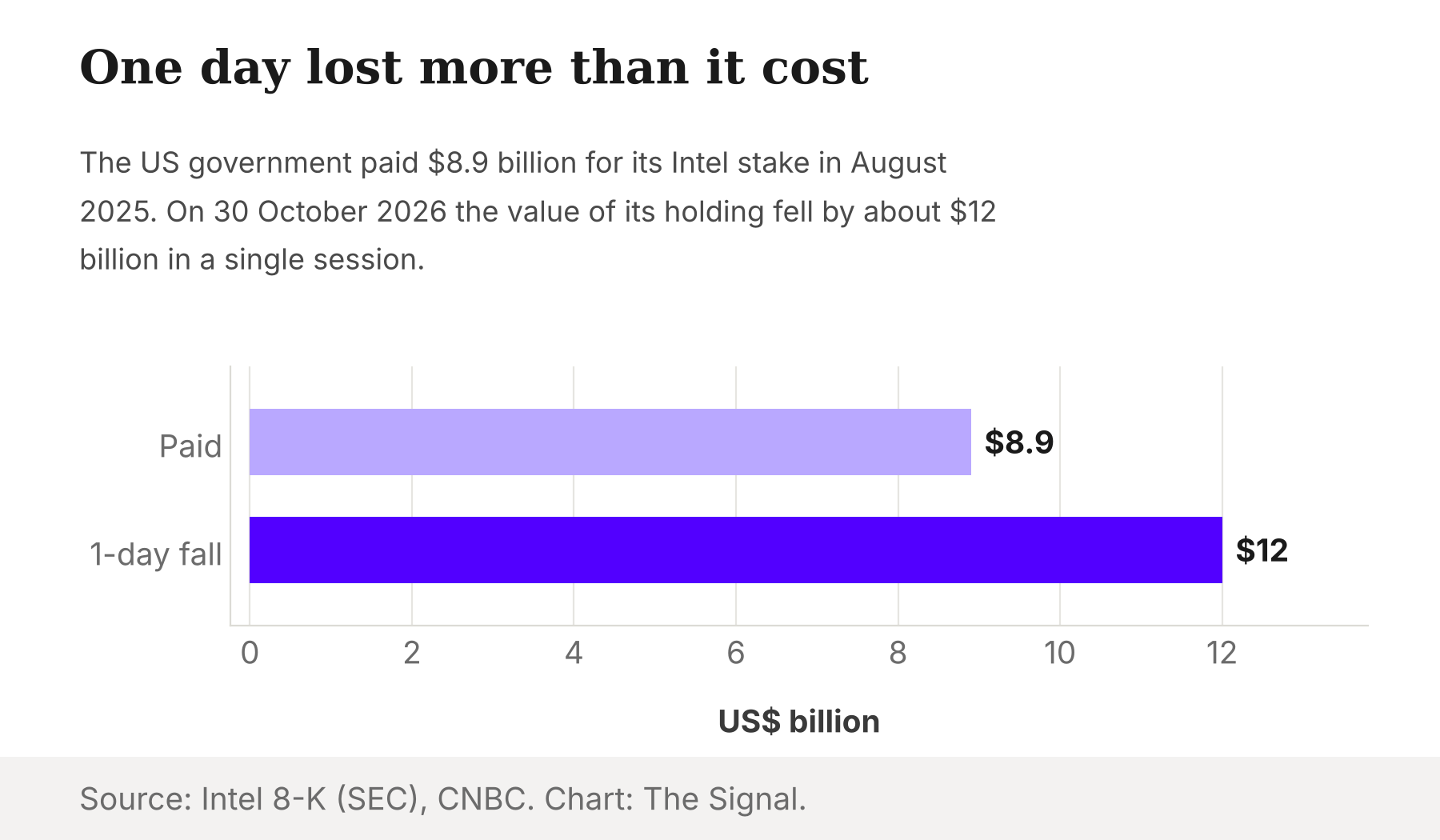
Start with what Washington paid. Under the August 2025 agreement, the government agreed to purchase 433.3 million primary shares of Intel common stock at $20.47 per share, a 9.9 percent stake. That is about $8.9 billion. One session on Friday erased about $12 billion of value, roughly 1.35 times the entire purchase price.
A single day's paper loss exceeded everything the government paid for the stake.
That sounds ruinous until you read the second number. Intel stock was still up more than 70% for the year after the fall, so the stake remains profitable. The fall subtracted from a large gain. It did not turn a position into a loss. The loss is a mark, not a payment, and it reverses if the shares recover.
Where the money came from
The second fact in the filing matters more for India. The stake was not new cash. It was funded by the remaining $5.7 billion in CHIPS grants previously awarded but not yet paid, plus $3.2 billion from the Secure Enclave program, according to Intel's own filing.
In other words, Washington turned money it had already awarded into shares. A grant is a cost the moment it is paid. A share is an asset whose value moves every trading day, up on the way in and down on Friday. The same dollars now carry market risk and market upside, and the taxpayer sees both on a screen.
India pays differently
India's fab scheme starts from the other end. The Scheme for setting up Semiconductor Fabs provides fiscal support of 50% of the project cost on a pari-passu basis to the approved applicants, according to the India Semiconductor Mission. If support is given as equity in part or in full, the government's share will not exceed 49% of total project equity. So the instrument allows equity, but the default is a share of the project cost, not a listed stake.
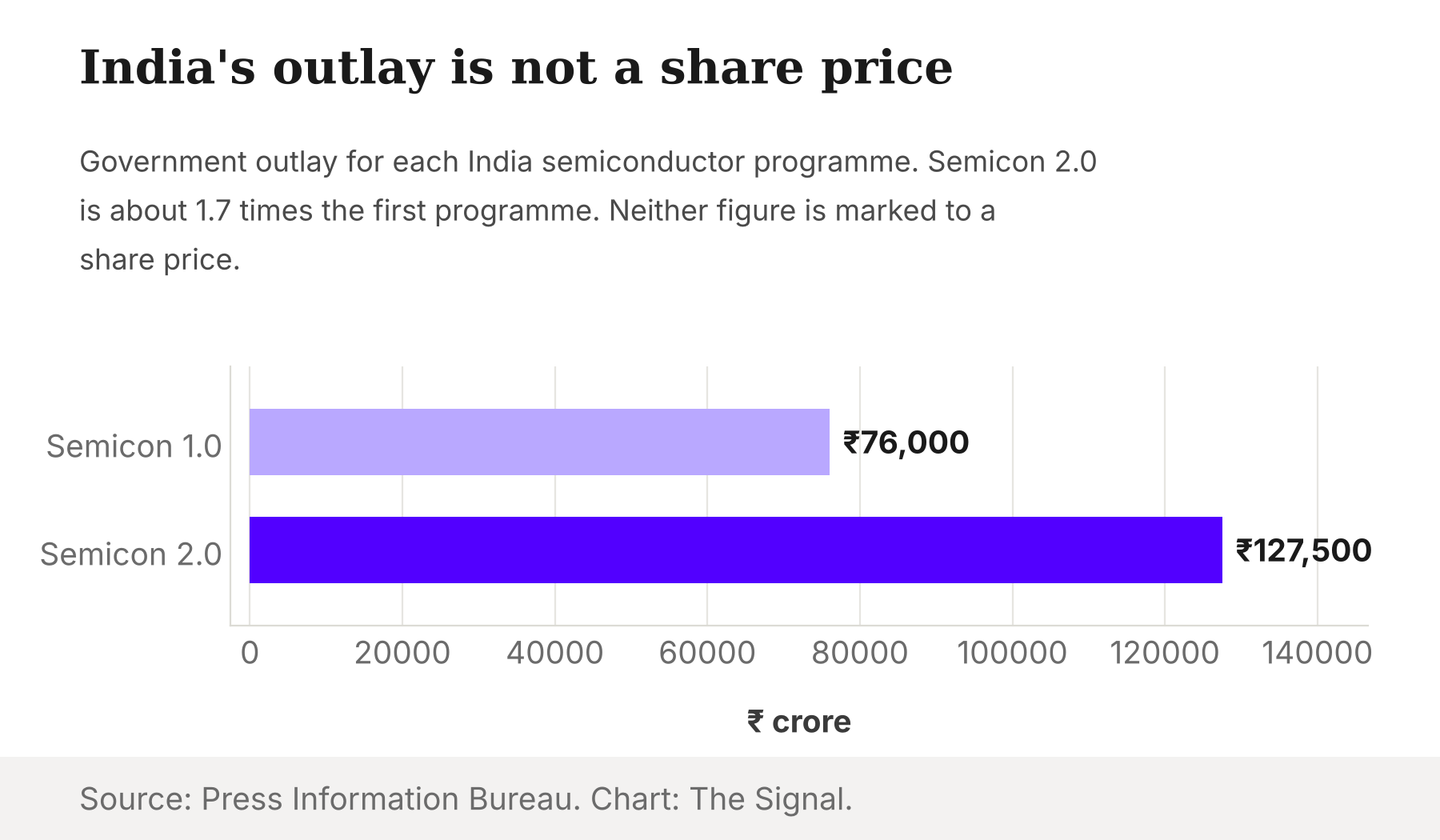
The sums are large and growing. Semicon 1.0 had an outlay of Rs 76,000 crore. The Cabinet approved Semicon 2.0 with a total budget outlay of Rs 1,27,500 crore in July 2026, about 1.7 times as much.
Set the two designs side by side.
Both governments back chip plants, but the risk lands in different places.
| United States (Intel) | India (fab scheme) | |
|---|---|---|
| How support is given | Grants converted into 433.3 million shares at $20.47 | 50% of project cost, pari-passu |
| Government equity | A 9.9 percent stake | 49% of project equity if equity is used |
| What moves daily | The value of the holding | Nothing on a screen |
Sources: Intel 8-K exhibit filed with the SEC; India Semiconductor Mission.
The risk India holds is execution
A grant does not flash a number when a cycle turns, but the risk has not gone. It sits in whether the plants get built and run. Twelve manufacturing units have been approved under the first programme with cumulative investment of over Rs 1.64 lakh crore, and the government's own release says three of them, Micron, Kaynes and CG Semi, have started commercial production.
Washington's exposure updates every second a market is open. India's updates when a plant ships or fails to: a slowdown like the one Intel described would show up as a utilisation number in a quarterly filing, not a price.
The honest objection
The strongest case against this comparison is that a grant is the cheaper way to back a plant, because equity ties the state to the cycle. Intel's drop came from weak PC demand and memory costs, which are the business's risks and not the deal's, and the stake is still profitable.
That is fair, and nothing here argues that equity is better. The point is narrower. Equity shows the cycle on a screen the day it turns. A grant defers it.
The Signal
About $12 billion left the value of Washington's Intel stake in one day, against $8.9 billion paid. The stake still sits on a gain, and that upside is the part of the design a grant never gives a taxpayer.
India backs fabs with 50% of project cost and has now approved Rs 1,27,500 crore for Semicon 2.0. The number to watch is not a share price. It is how many of the 12 approved units are producing when the chip cycle next turns.
Reporting basis: the Intel share-price fall, the loss on the US holding and the guidance are per CNBC, with the year-to-date gain and the CEO's quote per TechCrunch, both reporting the 30 October 2026 session. The purchase terms and funding sources of the US stake are from Intel's exhibit to its 8-K filing with the SEC, the single origin for those terms. India's support rate and equity ceiling are from the India Semiconductor Mission's scheme page. The programme outlays and the approved and producing unit counts are from Press Information Bureau releases. The ratio of one day's loss to the purchase price, and the growth between the two outlays, are The Signal's calculations from those figures.