On Monday, Microsoft confirmed it is offering voluntary buyouts to about 60,000 employees, more than a quarter of its global workforce. The offer covers staff at level 70 and below in participating teams in Canada, India, the United Kingdom and the United States. The easy read writes itself: a software giant is shedding people to pay for artificial intelligence.
It is worth slowing down on that. Microsoft employed approximately 223,000 people on a full-time basis at 30 June 2026, 121,000 in the US and 102,000 internationally. So the offer reaches about 27% of that headcount. An offer is not a departure, though, and the gap between the two is where the story sits.
The offer is not the exit
The number that matters is the take-up rate. Microsoft has not set a target. A spokesperson pointed to similar programmes at other tech companies that saw 3% to 5% take-up, according to Fortune. Microsoft's own earlier voluntary retirement offer did far better: more than 30% of roughly 8,750 eligible workers accepted, TechCrunch reports. That is more than 2,600 people.
Apply those rates to the 60,000 eligible and the range is wide. At 3%, about 1,800 people leave. At 5%, 3,000. At the earlier program's 30%, 18,000. Against a base of 223,000 employees, that is between 0.8% and 8.1% of the workforce.
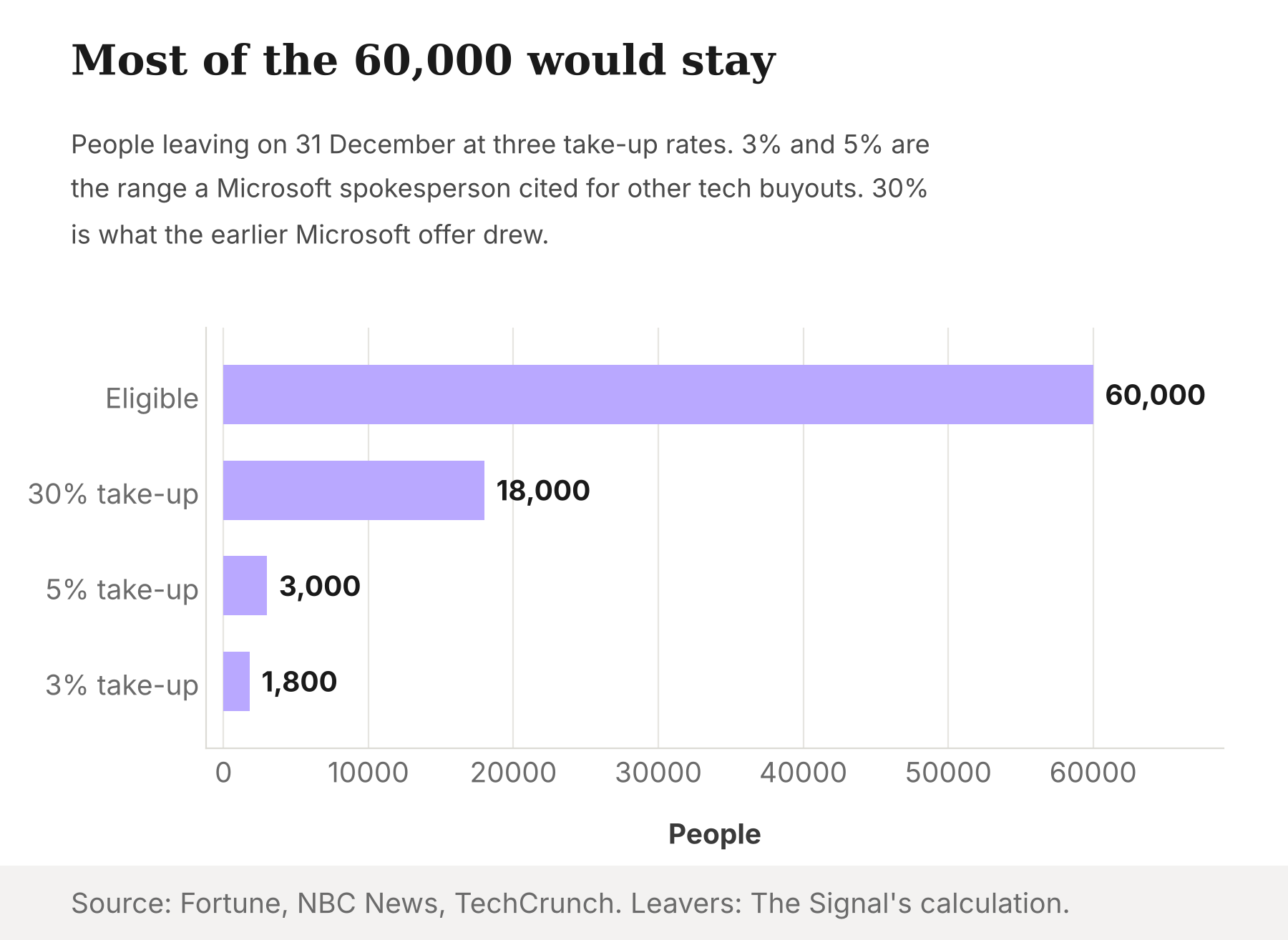
KUOW expects take-up this time to be lower than the earlier program's, partly because that offer was more generous. The honest range is therefore the lower two bars, not the top one. A headline of 60,000 is a ceiling on who is asked, not a forecast of who goes.
A cost cut at a time of rising profit
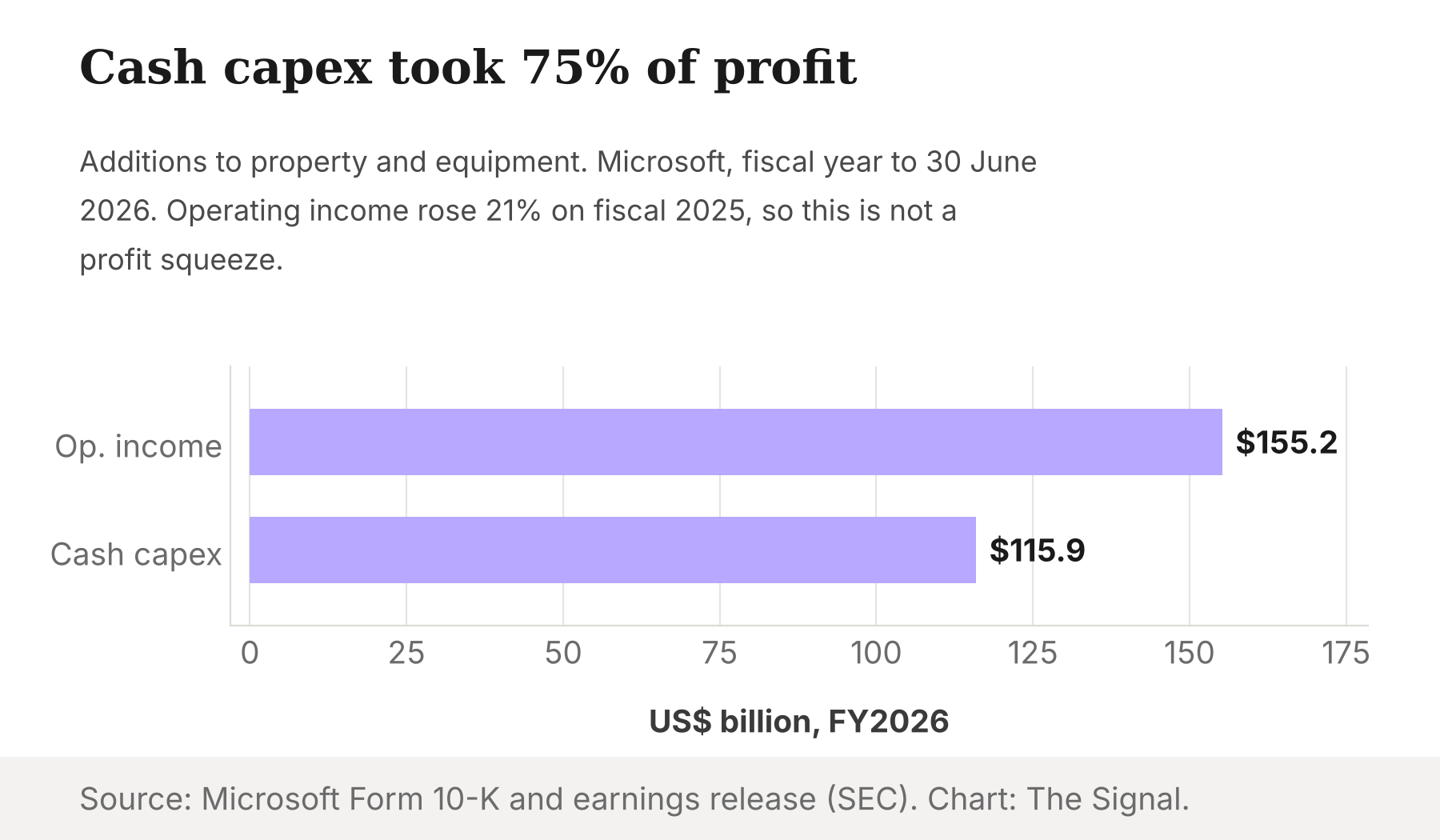
A buyout usually signals a company under pressure. Microsoft's accounts say otherwise. In the fiscal year to 30 June 2026, revenue was $331,839 million against $281,724 million a year earlier, and operating income was $155,237 million against $128,528 million. Operating income rose 21%.
The pressure is on the spending side. In the same year, Microsoft's cash additions to property and equipment were $115,948 million, about 75% of that $155,237 million of operating income. Spread across 223,000 staff, that is roughly $520,000 of equipment and buildings added per employee in a single year.
The spending is not tapering. Microsoft expects about $175 billion of capital expenditures in calendar 2026, down from an earlier $190 billion estimate only because of an accounting change to asset useful lives. CFO Amy Hood told investors that "outside of this useful life impact, our calendar year 2026 CapEx investment expectations remain unchanged."
Put the two together and the shape is clear. The company is directing about three-quarters of operating income into equipment and buildings, and it is asking a quarter of its staff whether they would like to go. Microsoft says AI is not behind the offer.
What Microsoft says
A Microsoft spokesperson said AI is not driving the buyouts. The offer, the spokesperson said, is comparable to Microsoft's standard severance, which varies by market. Eligibility was set by the heads of each organisation, so the sales organisation and some engineering teams are excluded.
That statement should be taken at face value. Nothing in the public reporting gives a figure for what the buyout would cost or save, so no one outside Microsoft can link a buyout dollar to a data centre dollar. Fortune's framing is narrower than a swap: Microsoft is cutting headcount to control costs while it continues to spend heavily on AI. The careful claim is that the two are happening at once, not that one funds the other.
What it means from India
India is on the eligibility list, and that is the part Indian readers can act on. Employees in the US, UK, Canada and India must accept by the first week of December and leave on 31 December, Fortune reports. The deadline is about five weeks away.
Beyond that, the public record is thin. Microsoft's filing reports only a split of 121,000 US staff and 102,000 international. It does not say how many of the 102,000 are in India, and none of the reporting on the offer gives an India headcount or says how many Indian staff are eligible. Any estimate of how many Indian jobs are affected would therefore be a guess. The Signal does not make one.
The honest objection
The strongest case against reading the offer as small is that a voluntary programme selects its own leavers. Those who accept are the people who can most easily find another job. A 3% take-up that removes the people a team can least afford to lose can matter more than 8% that removes the people it can. Heads of each organisation decided who is eligible, which limits the risk but does not remove it.
That is a fair point, and the take-up range above says nothing about who is in it. Watch who goes, not only how many.
The Signal
The headline number is 60,000. The number that decides the story is how many accept, and the rates on record imply somewhere between 1,800 and 18,000, with KUOW expecting the lower end. For Microsoft, the offer looks like a dial it can turn on headcount while profit rises and cash capex takes 75% of operating income. For staff in India, it is a decision with a first-week-of-December deadline and no public data on how many others face it. An offer to a quarter of the company is a question put to each person in it, and the answers arrive in December.
Reporting basis: the buyout offer, its eligible countries and the roughly 60,000 figure are per Reuters, as carried by NBC News, and confirmed to TechCrunch by Microsoft. The deadline, the 3% to 5% take-up range cited by a spokesperson and the memo details are per Fortune. The earlier retirement program's take-up is per TechCrunch. The statement that AI is not driving the buyouts and the expectation of lower take-up are per KUOW. Headcount, revenue and operating income are from Microsoft's Form 10-K for the year ended 30 June 2026, and additions to property and equipment are from Microsoft's fourth-quarter earnings release, both filed with the SEC. The calendar 2026 capital expenditure outlook and the CFO's quote are per CFO Dive, reporting on Microsoft's July 2026 earnings call; the Fortune and KUOW details rest on Microsoft's own memo and spokesperson statements, so they are counted as Microsoft's account, not as independent confirmation. No India headcount or buyout cost was available. The 27% share, the leaver counts at each take-up rate, the 0.8% to 8.1% range, the 21% rise in operating income, the 75% capex share and the per-employee figure are The Signal's calculations from those figures.