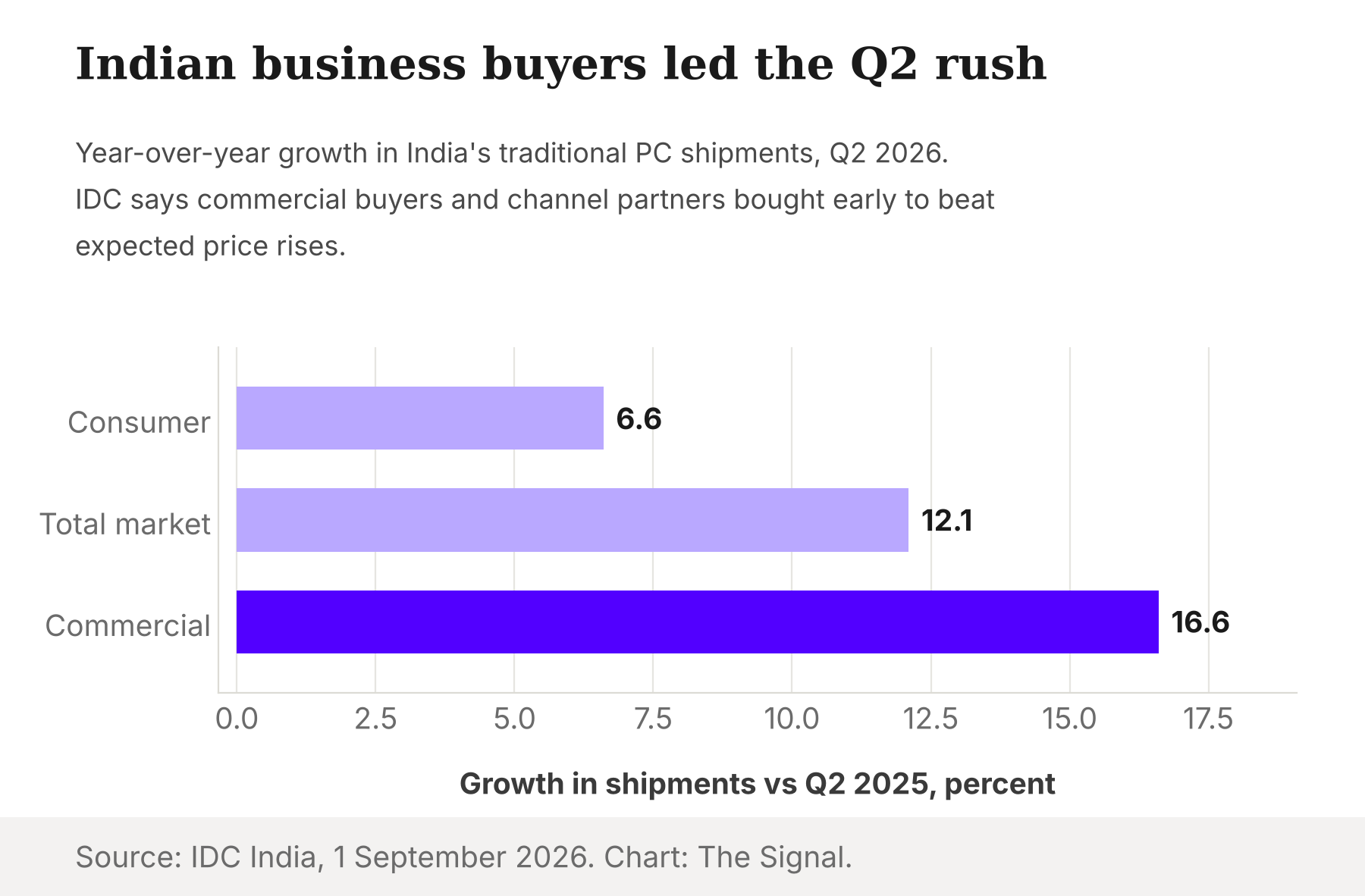
The headline on India's PC market this year was growth. IDC India reported that the traditional PC market shipped about 3.9 million units in the June quarter of 2026, up 12.1% on a year earlier, with consumers up 6.6% and commercial buyers up 16.6%. Read alone, that is a market shrugging off a global memory shortage.
It is worth slowing down on that. The same IDC release explains where the growth came from: channel partners built inventory ahead of expected price increases driven by memory cost pressure, and commercial buyers moved purchases up to lock in current pricing. Those are shipments into warehouses and corporate budgets, bought early because everyone expected prices to rise. They are not a rise in the number of Indians who want a laptop.
The world already sent the bill
The rest of the world ran the same experiment a quarter earlier and has now reported the hangover. IDC's preliminary tracker shows worldwide PC shipments fell 20.1% year over year in Q3 2026, to 62.7 million units. IDC's own diagnosis is blunt: the earlier pull-in borrowed volume from the second half.
A second tracker agrees. Omdia counted worldwide desktop, notebook and workstation shipments down 21.2% to 58.1 million units, and said that pull-forward activity had buoyed the PC market in the first half of the year. The two firms count slightly different product sets, which is why 20.1% and 21.2% differ. The direction and the cause are the same.
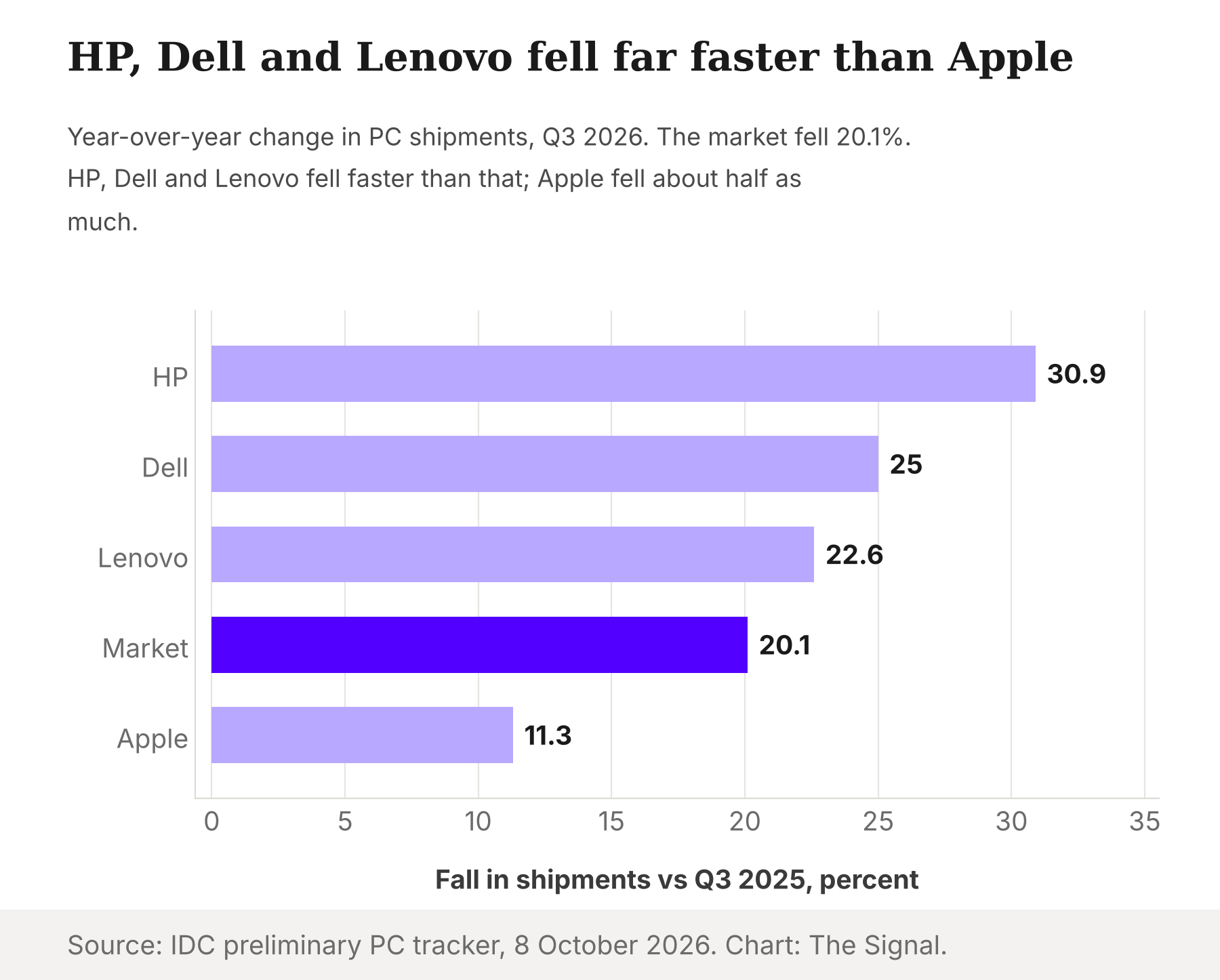
The pain was not shared evenly. IDC's vendor table shows Lenovo shipped 14.9 million units (down 22.6%), HP 10.3 million (down 30.9%) and Dell 7.6 million (down 25.0%), while Lenovo, HP and Dell all fell faster than the market. Apple shipped 5.9 million Macs, down 11.3%, roughly half the market's rate of decline.
HP, Dell and Lenovo fell faster than the market in the quarter after the stocking-up.
Three of the four vendors IDC lists fell faster than the 20.1% market. Apple fell about half as fast.
Why prices, not demand, drive the cycle
The mechanism is memory. Omdia's analyst Ben Yeh said the cost share of DRAM and SSDs in PCs has risen sharply from a typical level of around 15% to nearly 40%. When a component goes from a seventh of the cost to two-fifths, a maker cannot absorb it on thin margins. Prices rise, and buyers who can wait, wait.
The supplier side was still tightening this summer. In July, Counterpoint Research raised its Q3 DRAM price forecast from 5% to 10% quarter on quarter to 10% to 20%, as customers continued to pull forward orders. Everyone was buying early, which pushed prices up, which gave the next buyer a reason to buy early.
India felt the front of this. In April, Asus India's vice president Arnold Su said the company expected device prices to rise by as much as 45% by the third quarter of 2026 compared with December 2025, and named the sharp rise in RAM and SSD prices as the primary reason. That is one company's forecast, not a measured retail price, but it shows why a rational Indian buyer or distributor would have bought in the spring.
India's growth was concentrated among the buyers best placed to buy early.
Commercial buyers, who can lock in a purchase order, grew nearly two and a half times as fast as consumers (16.6% against 6.6%).
IDC already expects the Indian fade
India's own analysts are not treating the 12.1% as a trend. IDC expects commercial momentum to be roughly flat in the second half of 2026, while consumer demand could slow sharply as rising device costs cause buyers to delay. IDC's Navkendar Singh said sell-in of PCs might start dwindling from Q4 2026 onwards, and that 2027 could prove more challenging as enterprise order volumes normalise.
Globally, the forecast is worse. Omdia forecasts a 24% year-over-year decline in the fourth quarter of 2026 and a further 7% decline across 2027. Relief is distant: in March 2026, IDC India's Bharath Shenoy said these pricing pressures could persist for six to seven quarters, as reported by Storyboard18. And on prices, IDC's Jitesh Ubrani said in October that we don't expect pricing anywhere near what it was a year ago.
IDC and Omdia have not yet published an India figure for the September quarter that we could verify, so the Indian hangover is an inference from the global pattern and from IDC India's own outlook, not a reported number.
The honest objection
The strongest case against this reading is that India is structurally different. Supporters would say India still has room for first-time buyers. And the government has spent years building local assembly: 27 manufacturers including Acer, Asus, Dell, HP and Lenovo were approved under the PLI scheme for IT hardware, and about Rs 15,554 crore of incentives had been disbursed under the broader electronics PLI, with 59 companies reporting incremental production of about Rs 2,45,375 crore in the financial year to December 2025. On that view, India has more of a cushion than a market that only imports.
That case is real, and it may soften the fall. But it does not touch the mechanism. The PLI list is of PC brands assembling in India, and the cost line that Omdia says has moved from about 15% to nearly 40% is DRAM and SSDs inside the machine. The government figures also cover electronics and IT hardware together, so they say little about laptops alone. A local assembly line can lower freight and duty exposure. It cannot, on its own, change what memory costs.
The Signal
India's 12.1% quarter was real shipments and a poor guide to demand. Distributors and corporate buyers took delivery early, and IDC's own Indian analysts expect that to turn into weaker sell-in from the fourth quarter. The rest of the world, which stocked up first, has already shown what that looks like: a 20.1% fall in a single quarter, with HP, Dell and Lenovo falling faster than the market.
For a buyer, the practical read is that IDC does not expect pricing to return to last year's levels, so waiting for a rebound is a weak plan. For the industry, the number to watch is IDC India's September-quarter print. If it shows growth near the June quarter's, the cushion argument wins. If it shows a fall nearer the global 20%, then India did not escape the memory squeeze. It only scheduled it for later.
Reporting basis: global shipment counts for the latest quarter are from IDC's preliminary tracker and from Omdia's release, two separate analyst firms using different product definitions. India's shipments and the outlook for the rest of the year are from IDC India's own release, and the pricing duration view from IDC India's analyst is as reported by Storyboard18. The Asus India price forecast is per Outlook Business reporting of an Asus executive and is a company forecast, not measured prices. The DRAM price forecast is from Counterpoint Research. PLI details are from Press Information Bureau releases. IDC's figures are preliminary and track shipments into the channel, not consumer sales. The comparisons of Apple's fall to the market's and of commercial to consumer growth are The Signal's calculations from those figures.