The headline version of the rule is simple. On 28 November 2025 the Department of Telecommunications told WhatsApp, Telegram, Snapchat, Arattai, ShareChat, Josh, JioChat and Signal to keep each app "continuously linked to the SIM card" installed in the device, "making it impossible to use the app without that specific, active SIM." As of 22 October 2026, Digit reports that 1 January 2027 is being cited as the operational start date, with the compliance deadline pushed to 31 December 2026 and the blanket six-hour web logout replaced by risk-based logouts.
The logic is easy to follow. The ministry's stated rationale is that accounts keep working after the SIM is removed, deactivated or moved abroad, which lets scammers use Indian numbers without holding the Indian SIM. Tie the account to the SIM and the account stops being portable. Read that way, the fix closes a real gap.
It is worth slowing down on what the fix actually does. Binding does not verify a person. It verifies that a live SIM is in the phone. Whoever holds the SIM holds the account. So the rule moves the weak point from the app to the SIM registry, and the question becomes how reliable that registry is.
The registry is the anchor
The DoT's own release says binding anchors every account to "a live, KYC-verified SIM." The numbers on how clean that KYC has been come from the same department.
In a Lok Sabha reply published on 10 December 2025, the Minister of State for Communications said that 1.44 crore connections reported by citizens as "Not My Number" had been disconnected after failing reverification, and that DoT's ASTR tool had disconnected more than 86 lakh connections acquired through forged documents. A lakh is 100,000 and a crore is 100 lakh, so the forged-paper count alone is 8.6 million SIMs.
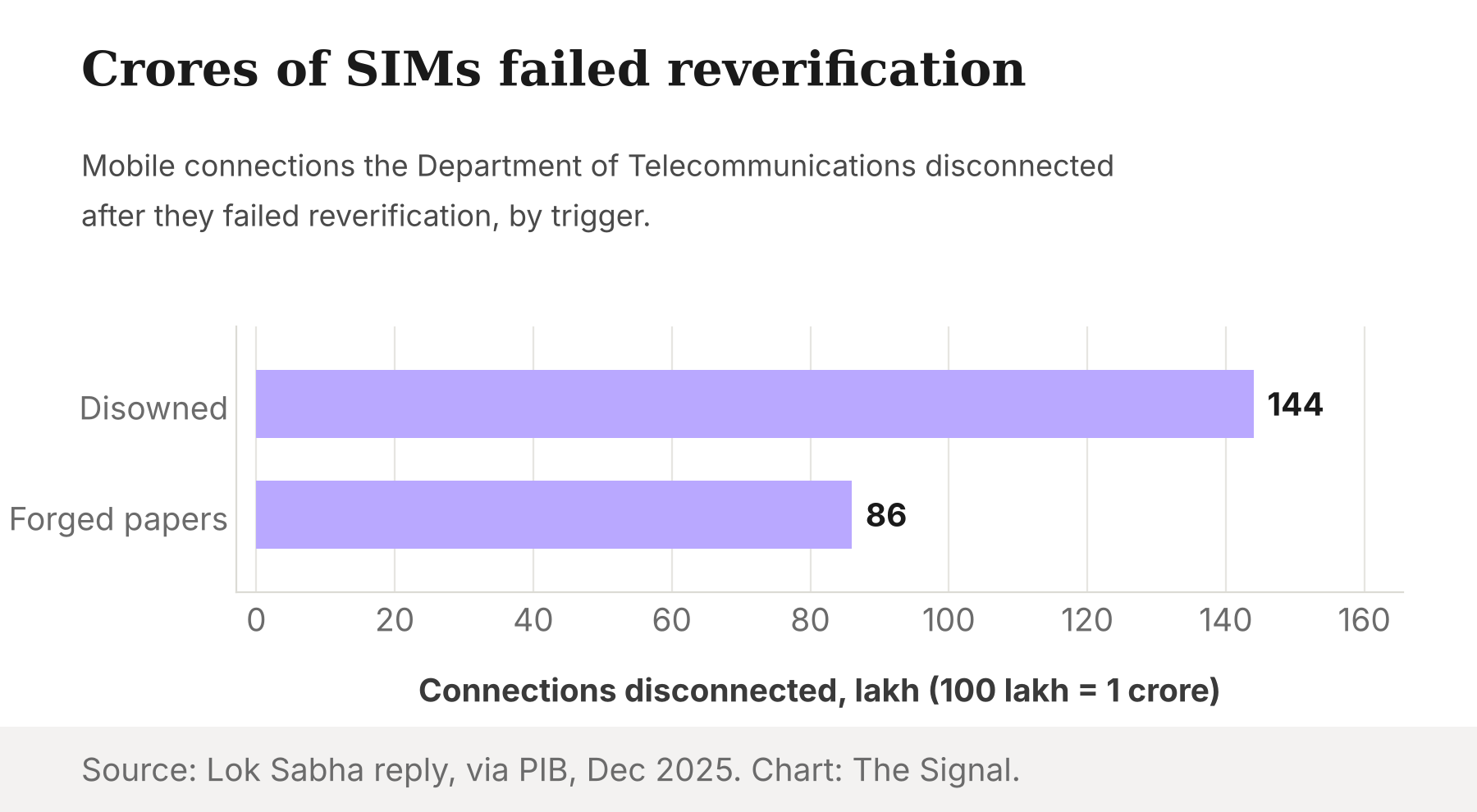
Those are two different triggers, and they are not a fraud tally. A disowned number can be an innocent clerical or retail error. But the forged-document count is specific: these are connections that someone obtained by faking the identity proof that the binding rule now treats as ground truth.
The same pattern shows up on the app side. In a Rajya Sabha reply on 5 February 2026, the ministry said that, based on 7.7 lakh citizen inputs, 39.43 lakh mobile connections had been disconnected and 2.27 lakh handsets blacklisted, and that WhatsApp had disengaged 28 lakh profiles or accounts associated with shared mobile numbers. The 86 lakh forged-document disconnections from the ASTR tool are more than double the 39.43 lakh that the Chakshu citizen-report analysis produced. The two counts cover different programmes and dates, but the department's own detection tool is finding more bad connections than the public is.
What the rule changes, and for whom
Think of the SIM as a lock and the account as the door. Binding makes the lock mandatory. It does nothing about who can buy a lock. A fraud operation that was happy to run accounts from abroad on an Indian number, the pattern the DoT describes, now needs a live Indian SIM in a handset. That is friction, and the DoT is right that friction matters. The mule SIM is the obvious substitute, and the 86 lakh forged-document connections DoT has already disconnected suggest the supply of bad SIMs has been large enough to find at scale.
The cost lands elsewhere too. Business Today reports that users who use WhatsApp over Wi-Fi without the registered SIM in the phone, people with linked tablets and computers, and people who change SIMs often while travelling may face access problems, and that WhatsApp has begun beta testing SIM binding on Android. The DoT release says a user roaming with the SIM in the handset is unaffected. Honest users bear the friction first. Operators who can obtain SIMs on false papers bear it last.
The money side tells you where to look
If binding works, it should shrink the losses that end up in complaints. Today those losses mostly stay lost. From FY2023-24 to FY2025-26, the National Cyber Crime Reporting Portal logged more than 53.87 lakh cyber fraud complaints, with more than ₹56,087 crore reported, more than ₹9,079 crore marked as lien and more than ₹206 crore refunded.
Divide the figures: ₹9,079 crore of lien against ₹56,087 crore reported is about 16 percent, and ₹206 crore refunded is about 0.4 percent, or under ₹1 for every ₹100 reported. Both come from the same Parliament reply. Money that has been frozen is a small slice; money that has come back is smaller still.
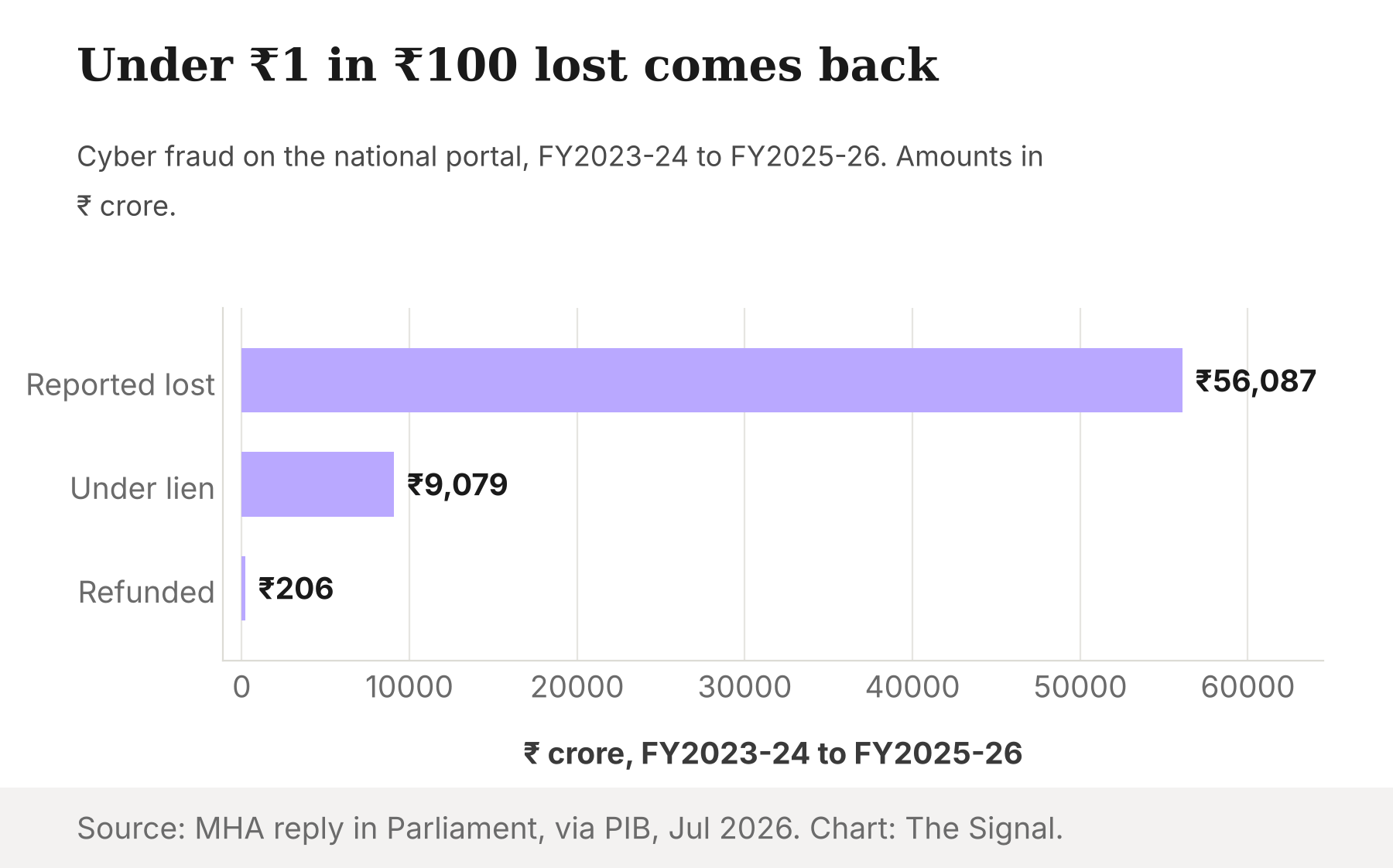
These are reported amounts and a snapshot of a rolling process, so the refund share will rise as liens are released. The same release says the CFCFRMS has saved more than ₹11,158 crore across more than 32.80 lakh complaints as of 30 June 2026, which is a different measure and should not be netted against the refund figure. The point stands: prevention at the entry point is worth more than recovery at the exit, and that is the DoT's argument.
The honest objection
The strongest case for binding is that no control has to be perfect to be worth having. The ministry itself notes that device binding and automatic session logout are widely used in banking and payment apps, where they raise the cost of account takeover. Tying messaging accounts to a SIM makes scams run from abroad on Indian numbers harder, and every forged-SIM purchase is a cost an operator now has to pay up front. Because the registry is imperfect, the argument goes, it should be fixed, not abandoned.
That is a fair case, and the evidence supports half of it. Binding raises the price of the attack. What it cannot do is tell a forged SIM from a real one. Whether it cuts losses depends on a variable the rule does not touch: how many bad SIMs still get issued.
The Signal
SIM binding converts a messaging problem into a telecom KYC problem. That is progress only if the KYC holds. The department has already disconnected more than 86 lakh connections that were acquired through forged documents, and the same ministries report that only a sliver of reported fraud money has come back.
Watch two numbers after 1 January 2027. The first is how many connections ASTR disconnects for forged documents, set against the 86 lakh already reported: a falling count means issuance is tightening, a rising one means bad SIMs are flowing as before. The second is the NCRP loss figure in the next parliamentary reply, against the ₹56,087 crore reported for FY2023-24 to FY2025-26. A lock is only as good as the keys that can be cut for it.
Reporting basis: the SIM-binding directions, their rationale, the roaming exemption and the web-logout requirement are from the Department of Telecommunications' directions, as published by PIB and on the DoT website. The forged-document and Not My Number disconnections are from a Lok Sabha written reply of 10 December 2025, and the Chakshu, handset and WhatsApp figures are from a Rajya Sabha written reply of 5 February 2026, both via PIB. The complaint, lien, refund and CFCFRMS figures are from the Ministry of Home Affairs' reply to Parliament of 22 July 2026, via PIB. The January 2027 start date, the extended deadline and the change to risk-based logouts are per Digit's 22 October 2026 report, and the user-impact points are per Business Today's report of the same day; neither was checked against a published DoT notice, so those details rest on secondary reporting. The lien and refund shares and the comparison of ASTR and citizen-report disconnections are The Signal's calculations from those figures.