
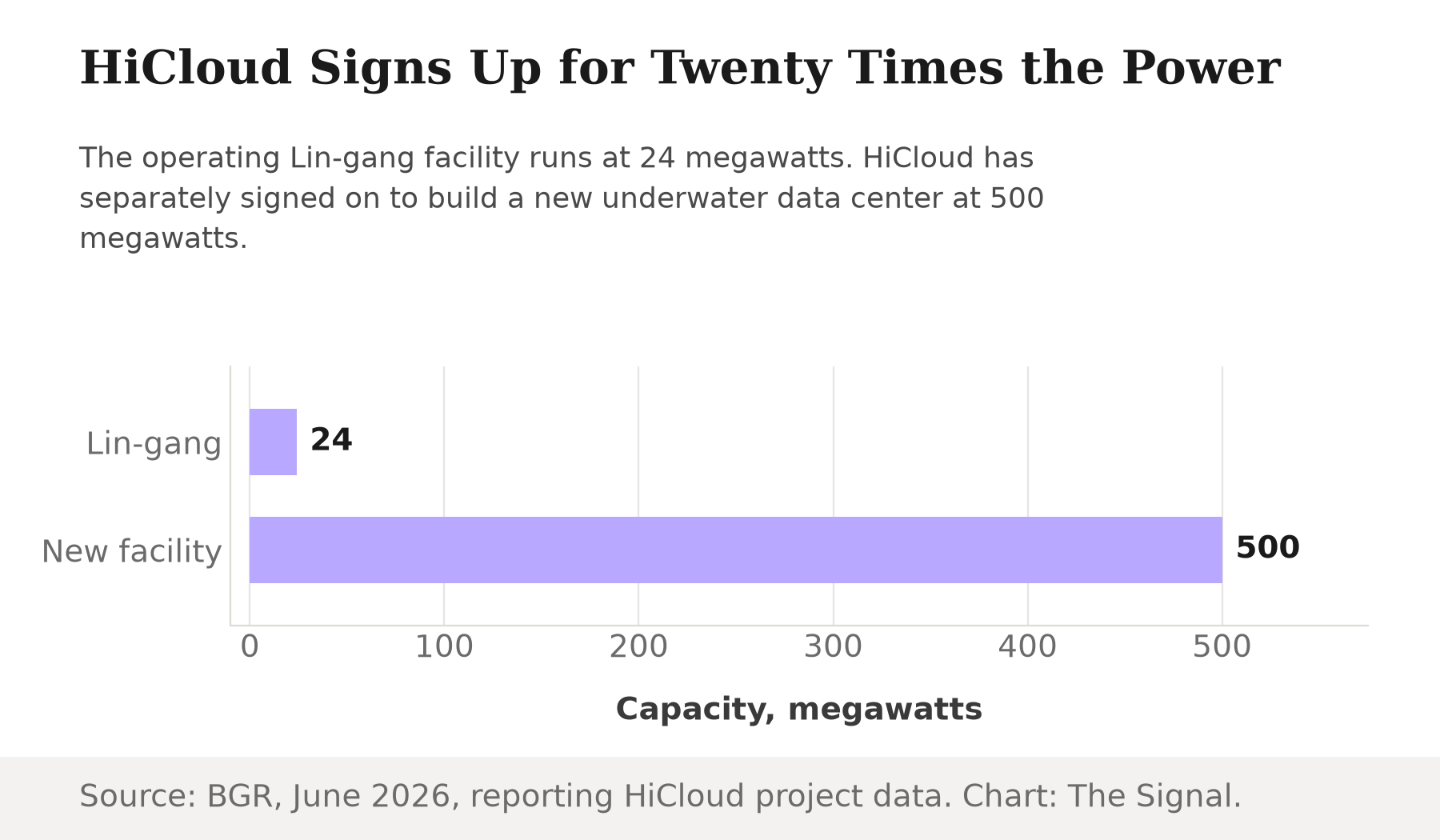
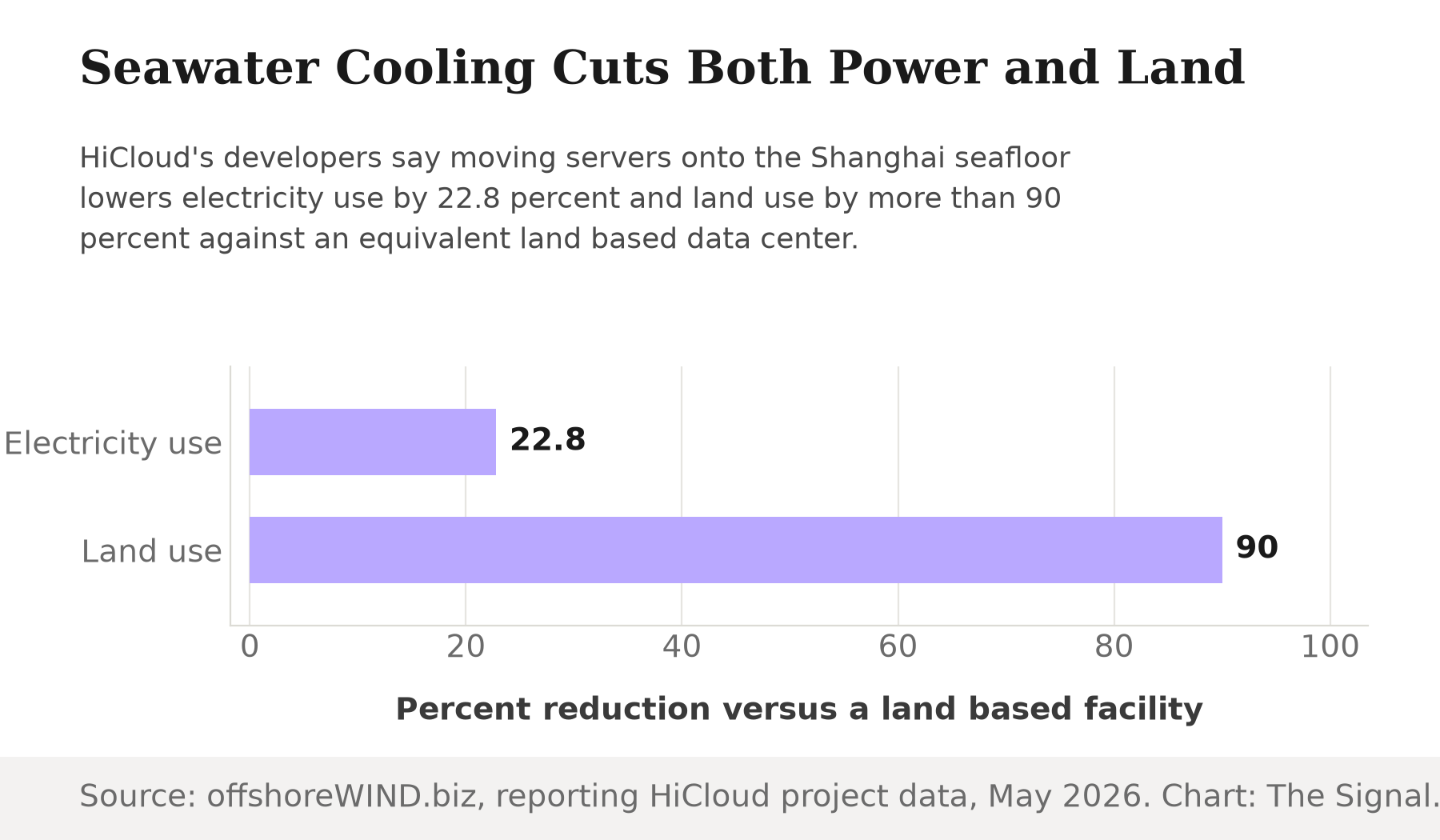
In February 2026, a Chinese company switched on a data center that runs on the seafloor. Shanghai Hailanyun Technology, known as HiCloud, lowered a facility holding about 2,000 servers onto the seabed near Lin-gang, outside Shanghai, built for roughly $228 million and rated at up to 24 megawatts at full capacity (BGR reports). Its developers say seawater cooling lets the facility use 22.8 percent less electricity and more than 90 percent less land than an equivalent land based data center, while holding a power usage effectiveness of about 1.15 (offshoreWIND.biz reports). HiCloud is not stopping there either: the company has separately signed on to build a new underwater data center rated at 500 megawatts (BGR reports), more than twenty times the capacity now running at Lin-gang. The Lin-gang zone's own targets go further still: authorities there say the facility is designed to draw about 95 percent of its electricity from offshore wind, with cooling power held under 10 percent of total draw (Tom's Hardware reports). Read only that far, and the story is simple: China has leapfrogged into a genuinely new kind of infrastructure.
It is worth slowing down on that. Underwater servers as a concept did not begin in Shanghai.
Between 2018 and 2020, Microsoft ran almost the same experiment off Scotland's Orkney Islands. Project Natick sank a shipping-container-sized unit holding 864 servers to the seafloor for about two years, and when marine specialists retrieved it in the summer of 2020, the results ran the opposite way most engineers would expect: a failure rate one eighth of what Microsoft saw with an identical group of servers on land (Microsoft's own project report states). The experiment worked. Then, in 2024, Microsoft confirmed that it had ended the program and would build no further underwater data centers, even while acknowledging the pilot's own results had been positive (IT Pro reports).
Two attempts, one of them abandoned
One underwater data center was shut down. A newer one just scaled up twenty-fold.
| Facility | Servers | Capacity | Status | Reported result |
|---|---|---|---|---|
| Microsoft Project Natick, Orkney Islands | 864 | not disclosed | Retrieved 2020; program ended 2024 | Failure rate one eighth of an identical land based group |
| HiCloud Lin-gang, near Shanghai | about 2,000 | 24 MW | Operating since February 2026 | Cuts land use over 90 percent and electricity 22.8 percent; PUE about 1.15 |
Microsoft's Project Natick figures are per Microsoft's own project report and IT Pro's reporting of the program's end. HiCloud's Lin-gang figures are per BGR and offshoreWIND.biz.
The gap between those two rows is not an engineering gap. Microsoft's own numbers said underwater servers failed less than an identical group on land (Microsoft's own project report states). It stopped building anyway. Asked about it afterward, Cloud Operations and Innovation chief Noelle Walsh did not point to a technical failure. She pointed to a change in priorities: "I would say now we're getting more focused," she said. "We like to do R&D and try things out, and you learn something here and it may fly over there. But I'd say now, it's very focused" (TechSpot reports). A hyperscaler running hundreds of conventional sites chose to keep building the kind it already knew how to build. Someone else did not.
The land and power China is buying down
The reason that matters beyond one Chinese port town is the trajectory underneath it. The International Energy Agency projects that global data center electricity consumption will more than double between 2024 and 2030, reaching about 945 terawatt-hours, and it names AI as the most important driver of that growth (Carbon Brief, citing the IEA's Energy and AI report, states). Every additional gigawatt of that demand needs two things a hot, crowded coastline or city rarely has enough of: land to build on and a way to carry heat away. That is precisely what HiCloud says its seawater engineering buys down, at a 90-percent-plus reduction in land and a 22.8 percent reduction in electricity against a comparable land based facility (offshoreWIND.biz reports).
What this means for India's landlocked buildout
India is scaling data center capacity fast, and every megawatt of it sits on land, cooled by moving air. Installed capacity grew from about 375 megawatts in 2020 to around 1,500 megawatts by 2025, and the Ministry of Power expects electricity demand from data centres to reach 13.56 gigawatts by 2031-32 (A Ministry of Electronics & IT press release via the Press Information Bureau states). An Invest India brief projects that installed capacity will nearly triple again, from about 1.5 gigawatts today to nearly 5 gigawatts by 2030, backed by an estimated $60-70 billion of announced investment over the next five years (An Invest India brief reports).
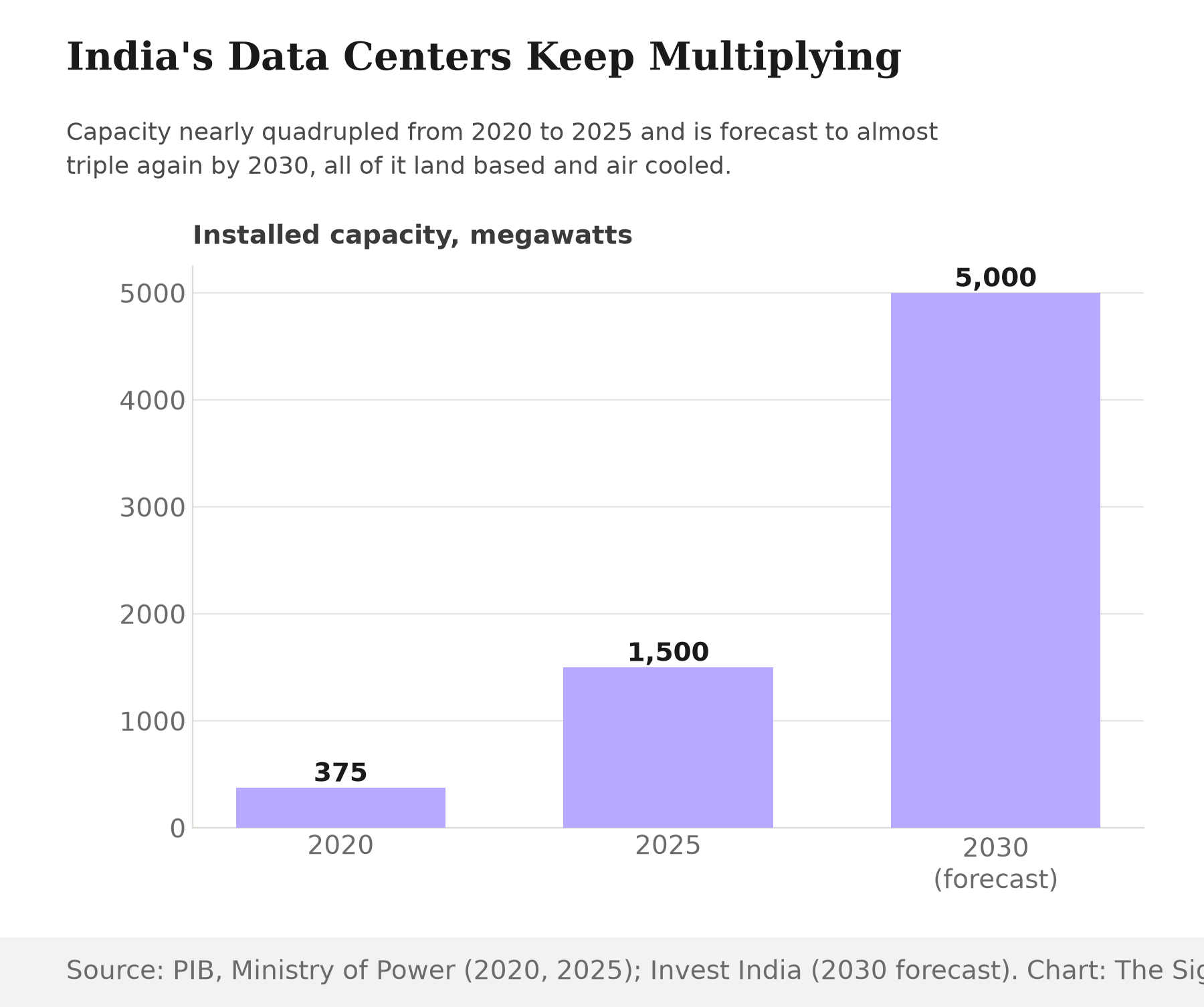
None of that new capacity is being cooled by the sea. It is cooled by air, in a country whose baseline keeps rising: India logged its eighth warmest year on record in 2025, with the national annual mean land surface air temperature 0.28 degrees Celsius above the 1991-2020 long period average (The World Meteorological Organization, relaying the India Meteorological Department, reports). Every fraction of a degree that baseline climbs makes air cooling work harder for the same server load, which is exactly the cost line HiCloud's engineers say they erased by moving underwater.
No Indian operator has built anything like it, but the idea has reached at least one Indian research lab. Researchers at IIT Bombay, led by Prof Gurubalan Annadurai, published a methodology this year for deep seawater cooling, prototyped for a 100-megawatt data center on the Andaman and Nicobar Islands. Their model found it could cut annual cooling energy by 79 percent, with a payback period of just eight months (An IIT Bombay research highlight reports). It is a paper study of one remote island chain, not a plan for Mumbai or Chennai, but it is the first sign that India's own engineers see the same gap HiCloud is selling into.
The honest objection
The strongest case against reading this as a lesson for India is that HiCloud's facility is not proof that underwater cooling travels anywhere. It is a single, first-of-its-kind commercial deployment on one stretch of Chinese coastline, at a scale and capital intensity most operators cannot match. Microsoft's own retreat, despite the better failure rate its 2018-2020 trial recorded, is itself evidence that the economics do not travel even where the engineering works (IT Pro reports). A company that builds hyperscale data centers on every continent walked away from its own working prototype. That case is real.
It strains, though, against the shape of the two numbers China is now selling. A land saving of more than 90 percent and an electricity saving of 22.8 percent are not marginal engineering wins; they are exactly the two inputs a hot, land-constrained buildout is short of (offshoreWIND.biz reports). Microsoft's abandonment says underwater data centers may not fit one hyperscaler's business model. It says nothing about whether the constraint they solve for is real. A country planning to almost triple installed capacity to near 5 gigawatts by 2030 (An Invest India brief reports), in a year that just ranked among its eight warmest on record (The World Meteorological Organization, relaying the India Meteorological Department, reports), is short on exactly the two things HiCloud claims to have solved.
The Signal
The point is not that India should start sinking server racks off Mumbai or Chennai. Nothing in the record above says any Indian company or hyperscaler has tried, or that it should. One IIT Bombay paper modeling a single island chain is not a national pivot (An IIT Bombay research highlight reports). The point is where the binding constraint actually sits. Two separate engineering teams, one at Microsoft and one at HiCloud, have now shown that land and cooling are movable costs rather than fixed ones, once an operator is willing to leave the coastline. India is about to spend $60-70 billion finding out whether it can bring those same two costs down while staying on land, in a country that keeps setting new warm-year records (An Invest India brief reports; The World Meteorological Organization, relaying the India Meteorological Department, reports). Watch what gets built next, and where. A data center's real cost is not the servers inside it. It is the land under it and the air, or water, that keeps it cool.
Reporting basis: figures for HiCloud's Lin-gang underwater data center, including its cost, capacity, launch date, and the seawater cooling savings its developers cite, are per HiCloud's own data, as carried separately by BGR and by offshoreWIND.biz. The facility's offshore-wind power target and cooling-share target are per Lin-gang zone authorities, as carried by Tom's Hardware. Natick's server count, its below-land failure rate, and Microsoft's 2024 confirmation that it would build no further underwater data centers come from Microsoft's own account of the project and its account of the shutdown, as carried by IT Pro. Noelle Walsh's comment on Microsoft's shift toward "more focused" priorities is per TechSpot's report of her remarks. India's installed data center capacity for 2020 and 2025, and the Ministry of Power's demand forecast for 2031-32, are from a Ministry of Electronics and IT press release via the Press Information Bureau. India's 2025 warm-year ranking and temperature anomaly are per the India Meteorological Department, as carried by the World Meteorological Organization. The 2030 capacity and investment forecast is from an Invest India brief. Global data centre electricity projections come from the International Energy Agency, as carried by Carbon Brief. The IIT Bombay deep seawater cooling methodology and its Andaman and Nicobar prototype findings are per an IIT Bombay research highlight. The twenty-fold gap between Lin-gang's operating capacity and HiCloud's newly signed facility is The Signal's calculation from those two figures.