On 8 September 2026, Australia's Prime Minister's office unveiled the exposure draft of a Digital Duty of Care law built around a mechanism it calls "My Feed, My Way." Australians over 16 will be able to opt in or opt out of the algorithm easily, choosing whether their default feed on platforms like Instagram, TikTok and X is sorted by an engagement algorithm or shown in a plainer, non-personalised order. Miss that duty of care and the penalty is real: non-compliance could attract fines of up to A$109.2 million, about US$78.6 million. Read only the announcement and this looks like a major handover of control from platform to user: a legal switch, backed by a nine-figure fine, sitting in every Australian adult's settings menu.
It is worth slowing down on that framing. Australia is not the first to legislate an algorithm off switch. The European Union's Digital Services Act already requires very large online platforms to offer users at least one recommender-feed option that is not based on profiling, and TikTok, Facebook and Instagram have offered exactly that choice to EU users for more than two years. The switch Australia is about to install already exists elsewhere. What matters is what happened when it did.
Few EU users flip the switch, and fewer stay flipped.
The DSA Observatory, an EU legal-research platform tracking the Digital Services Act's implementation, finds that few users choose the non-personalised option, and that even users who try it often switch back to the engagement-optimised default because of poor usability. The legal right has existed on Europe's largest platforms for two years. The behavioural shift it was meant to produce mostly has not.
The one part of Australia's law that is not a choice
Buried in the same draft is a second, structurally different rule that gets less attention than "My Feed, My Way." For users under 16, the law offers no choice at all: platforms must switch off personalised algorithms and endless-scroll features entirely. No toggle, no settings menu. The algorithm is simply off.
| Age group | Algorithm rule under the exposure draft |
|---|---|
| 16 and older | Can opt in or opt out of algorithmically recommended content, via "My Feed, My Way" |
| Under 16 | Personalised algorithms and endless-scroll features switched off entirely; no choice offered |
Source: Australian Prime Minister's office and ABC News, on the exposure draft unveiled 8 September 2026.
Australia has already run this exact experiment on a related, separate law. When its under-16 social media minimum-age rule took effect on 10 December 2025, the government did not wait for teenagers to deactivate their own accounts. More than 4.7 million under-16 accounts were deactivated, removed or restricted within days of the law coming into effect, the Prime Minister's office said, citing eSafety Commissioner data as of mid-January 2026. That is what a mandatory default does. There is no settings menu involved.
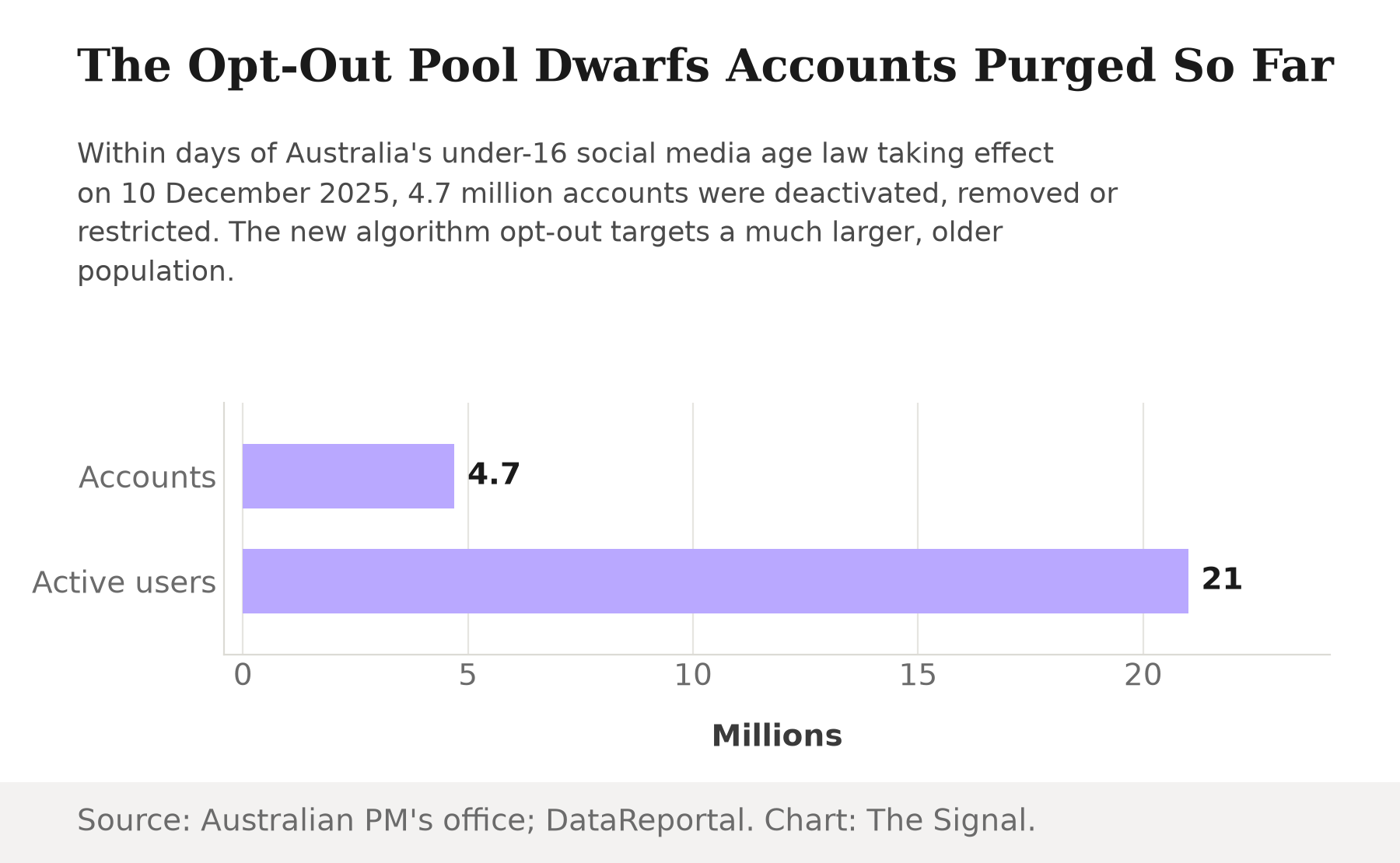
The contrast is the story. A mandatory switch, aimed at a narrower population, produced millions of changed accounts within days. The optional switch aims at a far larger population and has already been tested in Europe for two years, yet it has produced almost no measurable change.
Who the opt-out actually has to reach
Australia had 21.0 million active social media user identities as of October 2025, equivalent to 77.7 percent of its total population, according to DataReportal's Digital 2026 Australia report. That is the pool "My Feed, My Way" is aimed at once it takes effect, well past the narrower age band the law simply mandates off.
The honest question is whether that population wants the choice at all. A YouGov survey of US adults conducted 10 to 12 August 2026 found that far more people would prefer posts arranged chronologically rather than sorted by an algorithm, 46 percent against 26 percent, exactly the appetite the law is banking on. But the same survey breaks the finding by usage intensity: among heavy users, those on social media five or more hours a day, the preference reverses, 44 percent favour the algorithm against 38 percent for chronological.
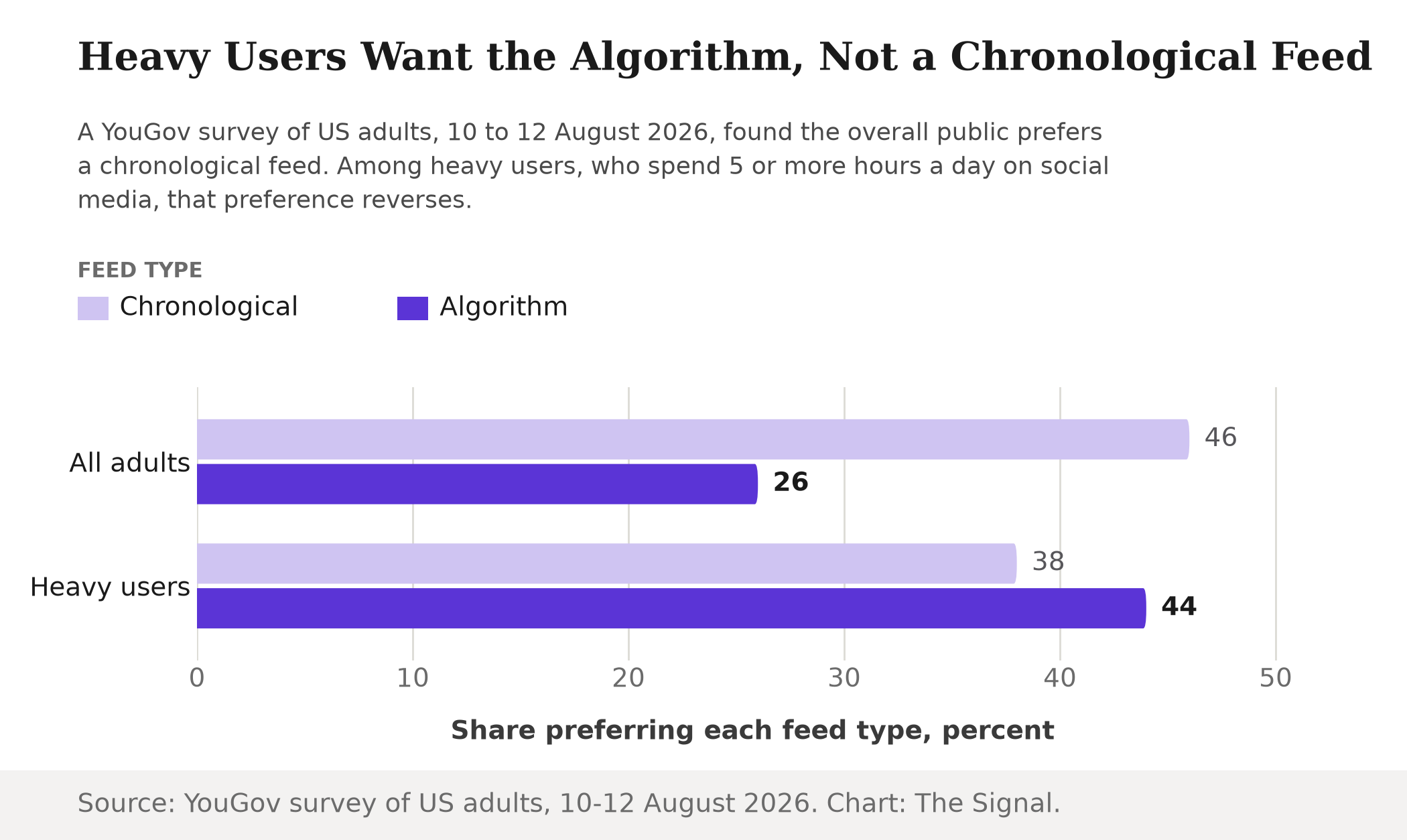
Heavy users are, by definition, already the deepest inside a feed an algorithm sorts. They are also the group whose preference runs against turning it off. That is the same asymmetry the EU has already lived through: a legal right that reaches everyone but a behavioural pull that keeps the heaviest users exactly where the default already had them.
The honest objection
The strongest case against reading Australia's law through the EU's disappointing take-up rate is that the two laws are not identical. Australia's exposure draft frames the choice as something users can do "easily," backed by a stiff penalty for platforms that make it hard to find or hard to use. The EU's failure, on this reading, is a design failure, buried settings and confusing labels, not proof the underlying idea is unworkable. A regulator that polices the friction out of the toggle could see a different outcome.
That case has real force, but it does not explain away the core problem. The EU's opt-out is not merely available, it is a legal requirement platforms must build, the same status Australia is proposing. In Europe, the legal mandate was already there. What has been missing is user appetite. A better toggle might lift take-up among people already inclined to leave the algorithm. It is a harder sell to the heavy users the YouGov data shows actually prefer it.
Where India fits
India is not yet at the mandate stage, but it is asking the same questions. At its 3 August 2026 sitting, the Lok Sabha's Parliamentary Standing Committee on Communications and Information Technology sought clarity from Meta, Google, X and Snapchat on shadow banning and the use of automated decision-making in content moderation, according to the Software Freedom Law Center, India. That is an information-gathering step, not draft legislation, and India has committed to no opt-out mechanism of any kind. If it eventually moves toward one, Australia and the EU have already supplied the evidence: a mandatory default that removes a feature changes behaviour fast; an optional toggle asking users to leave a feed they are already deep inside mostly does not.
The Signal
Australia's exposure draft will be read, correctly, as a genuine expansion of user rights over the algorithm. What it will not be, on the evidence of the one place this has already been tried, is a mechanism that changes how Australians actually experience their feed. The EU's two-year record suggests the adult opt-out will draw modest, sticky-low use, concentrated among the lightest algorithmic users to begin with. The part of the law that will visibly change behaviour on day one has no toggle at all: the under-16 shutoff, enforced the way Australia has already shown it enforces mandatory account rules, at scale, within days. Any regulator chasing a law that actually bites, in Canberra, Brussels or eventually Delhi, should watch which of Australia's two mechanisms moves the number. The mandate will. The menu, so far, has not.
Reporting basis: the exposure draft and its "My Feed, My Way" mechanism are per the Australian Prime Minister's office's own release, with the maximum penalty per MLex and the under-16 shutoff per ABC News, Australia's public broadcaster, both on the same draft. The under-16 account figure is from the Prime Minister's office, citing eSafety Commissioner data, on a separate, related law. The EU's recommender-choice rule is per the European Commission; the low-uptake finding is per the DSA Observatory, an EU legal-research platform, and rests on that single analysis. Australia's user population is per DataReportal. The feed-preference figures are from a single YouGov survey of US adults. India's committee questions to Meta, Google, X and Snapchat are per the Software Freedom Law Center, India, reporting on the committee's own proceedings.