
OpenAI switched on advertising inside ChatGPT's free and Go tiers in India on August 27, 2026, and the coverage read like a launch story: OpenAI named WPP and Omnicom as its first India agency partners, with more than 50 brands going live. The country's users are finally getting a feature the rest of the world is watching. That framing gets the sequence backwards. By the time the feature reached India, it was already live in 38 countries, including the United States, Japan, South Korea and 31 European nations. India was not first. It was one of the last big markets in the queue, arriving three days after the European rollout on August 24.
It is worth slowing down on that three-day gap, because the two launches sit on very different legal ground. In Europe, contextual ads run under the GDPR's "legitimate interest" basis without asking permission first, while the more invasive layer of personalized ads that draw on ad history and inferred interests requires a separate, explicit opt-in. That consent layer exists because it has to: the GDPR defines valid consent as a freely given, specific, informed and unambiguous affirmative act, and says silence, pre-ticked boxes or inactivity do not count. India got the same ad system three days later. It does not yet have the equivalent rule in force to test it against.
India's own consent-and-notice framework will not be binding until mid-2027.
India's Digital Personal Data Protection Rules were notified on November 14, 2025, with an eighteen-month phased compliance window that gives organisations until mid-2027 to meet the Act's notice, consent and breach-reporting obligations. That is roughly ten months after India's ad launch before the law's own machinery is due to be fully operative. OpenAI is not breaking any rule by moving now. It is simply operating in the window where there is no equivalent rule yet to break.
Two rollouts, two rulebooks
The same ad product met a binding consent rule in one market and none in the other.
| Europe (31 markets) | India | |
|---|---|---|
| Ads went live | August 24, 2026 | August 27, 2026 |
| Contextual ads (topic, city-level location, device, time, language) | Run under GDPR's "legitimate interest" basis; no opt-in asked | Same ad product; no equivalent rule yet binding |
| Personalized ads (ad history, inferred interests) | Require a separate, explicit opt-in | No equivalent requirement yet binding |
| Data-protection instrument on the books | GDPR, Recital 32: consent must be freely given, specific, informed, unambiguous | DPDP Rules, notified November 14, 2025 |
| Compliance status | Already binding on launch day | Phased in; fully binding mid-2027 |
Sources: Tech Times; Regulation (EU) 2016/679; Press Information Bureau; CNBC.
Read across the rows and the asymmetry is not in what OpenAI built. The ad product itself, contextual placements plus an optional personalized layer, appears to be the same code shipped to both regions within three days. The asymmetry is in what each region's law requires that product to prove before it can switch personalization on. Europe already had that answer on August 24; India, on the Rules' own timeline, will not fully have one until mid-2027.
The market this lands on
The size of what just got opened to advertisers is the other half of the story. ChatGPT's unique monthly users in India grew from 297 million in December 2025 to 330 million in May 2026, a base large enough that OpenAI calls India its second-largest market, with more than 100 million weekly users as of February 2026 and weekly actives that have doubled year on year.
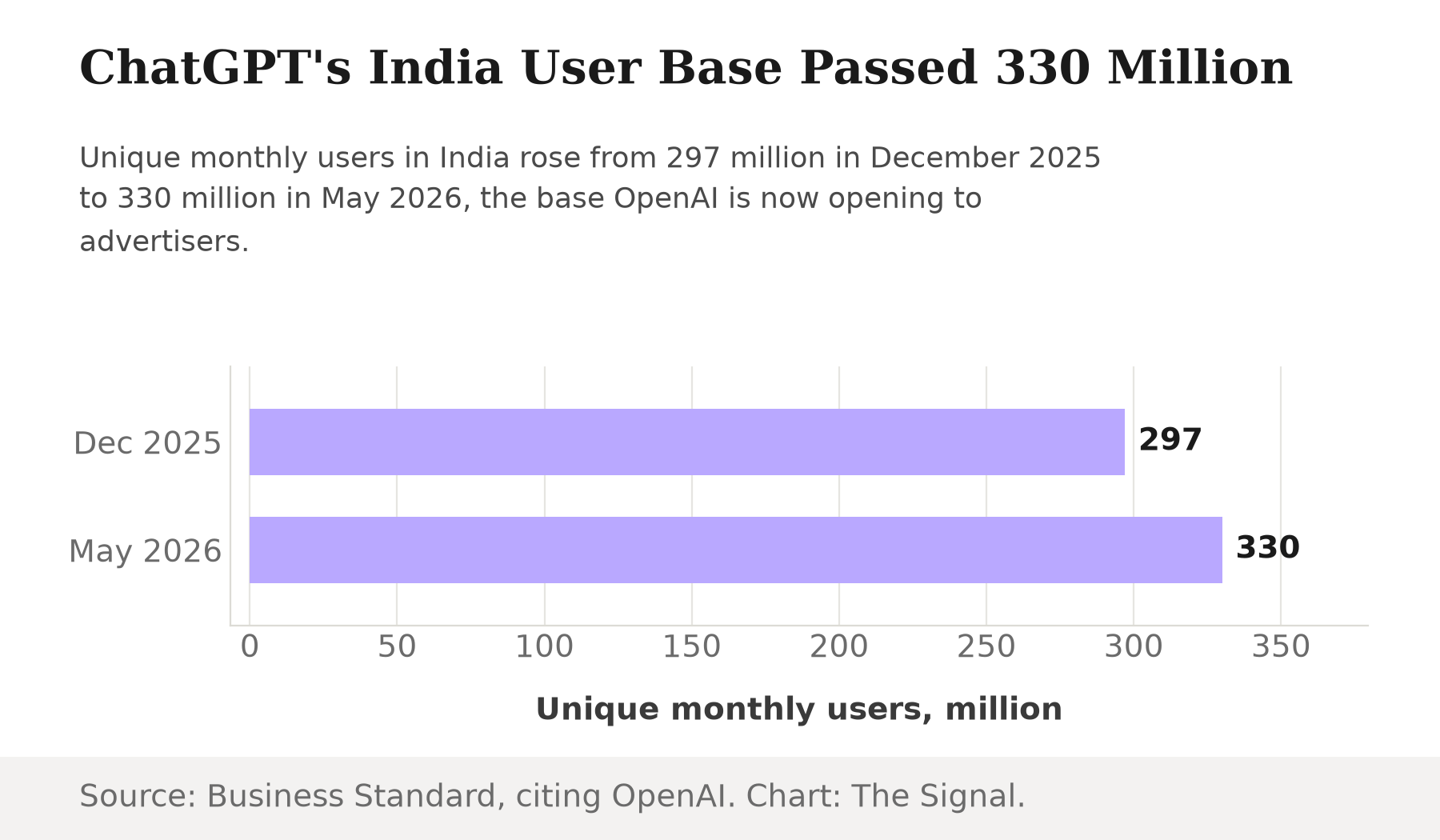
Most of that base sits exactly where the ads now show up. Ads appear only on the Free tier and the ₹399-a-month Go tier; subscribers on Plus, Pro, Business, Enterprise and Education continue to see no ads at all. Free and Go are also the tiers with the least reason to pay, which is the point: a market with hundreds of millions of people who will not pay a subscription is a market that has to be monetised some other way, and ads are that other way.
None of this happened by accident of timing. Reuters reports that OpenAI is planning to go public in 2027 and faces pressure to justify its $852 billion valuation ahead of that listing. A company preparing to justify that number to public investors needs a monetisation story that scales with its biggest user pools, not just its highest-paying ones. India supplies the scale; the ad product supplies the story.
What advertisers are being asked to pay
The commercial machinery around the launch tells the same story from the buyer's side. OpenAI will open a self-serve ChatGPT Ads Manager in India on September 4, 2026, with daily campaign budgets starting at ₹725. Set that next to what a user pays to avoid ads altogether.
A single day's minimum ad spend already exceeds a month of the ad-free Go plan.
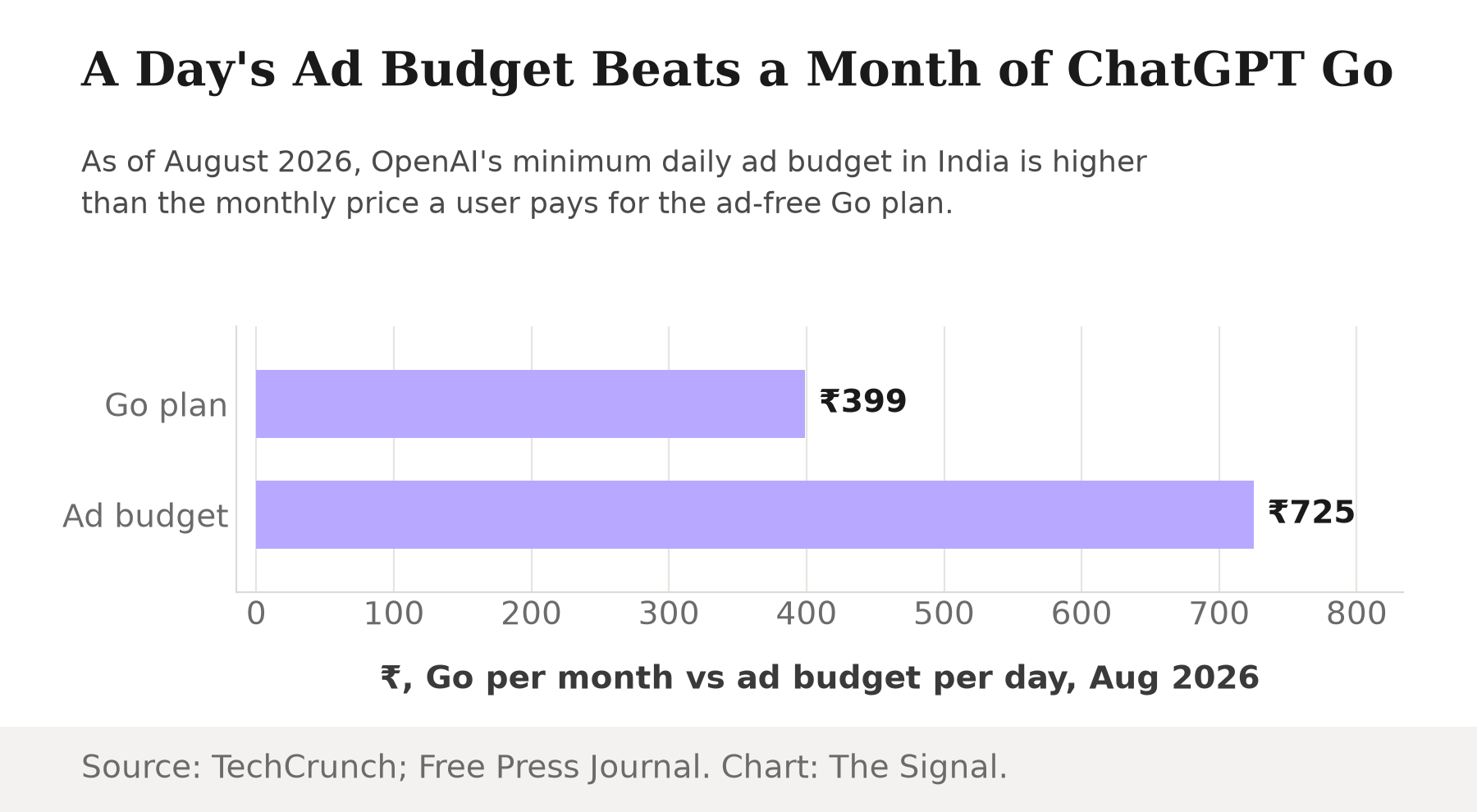
₹725 a day against ₹399 a month is not a subtle gap. A brand willing to spend the daily minimum for just one month would hand OpenAI more than fifty times what a single Go subscriber pays in the same period, our calculation from those two figures. That is the arithmetic behind the sequencing: a free-tier user is worth more to OpenAI as an ad audience than as a ₹399 subscription prospect, at least at the volumes India supplies.
The honest objection
The strongest case against reading this as a regulatory workaround is that OpenAI did not skip Europe. It launched there first, three days earlier, and built the consent architecture the GDPR requires before it built anything for India at all. On this view, the sequence is mundane: a company rolls a product out market by market, and India happened to land in the second wave alongside markets that also lack an operative GDPR-equivalent regime, not because its user base is uniquely exposed but because of ordinary launch logistics.
That case holds for the order of operations. It does not explain why the gap between "market with a binding consent rule" and "market without one" was allowed to be three days rather than ten months. OpenAI built the opt-in mechanism GDPR requires before India's launch, which means the company had the capability in hand. It simply was not required to deploy it in a market where the DPDP Rules will not compel it until mid-2027. A company can move fast in Europe because the law demands a specific architecture, and move just as fast in India because, for now, none is demanded at all.
There is a second, milder version of the defence: perhaps India's Free and Go users would have said yes to the same opt-in Europe got, had they been asked, so the missing consent layer changes nothing in practice. That may well be true. It is also untestable on the evidence available, and that is precisely the point of a consent requirement: it does not assume the answer would have been yes, it makes the company demonstrate it. Europe's users get that mechanism by law. India's users, for now, get OpenAI's word that the product is the same one Europe uses.
The Signal
The comparison that matters is not "India versus the rest of the world." It is 330 million people whose data now feeds an ad-targeting system with a lighter compliance burden than the one covering the same product in Brussels or Berlin. That gap will not last: the DPDP Rules' eighteen-month clock is already running toward mid-2027. What happens in between is the real test. Watch whether OpenAI's India ad product, once the DPDP compliance deadline arrives, still resembles what launched on August 27, or whether the version Indian users saw first quietly comes to look more like the one Europe got first. If the ad mechanics converge toward the GDPR model, India functioned as the free-run version of a system rebuilt for its permanent regulatory environment.
Reporting basis: the India launch date, tier structure and pricing are as reported by TechCrunch and the Free Press Journal; the India user counts are per Business Standard and Business Today, both citing OpenAI; the European launch date and its GDPR consent mechanics are per Tech Times; the GDPR's own consent standard is per Regulation (EU) 2016/679; the eighteen-month DPDP compliance window is from the Press Information Bureau; and the count of countries with ads live before India, and OpenAI's IPO plans, are per CNBC's Reuters-sourced report. The Go-plan-to-ad-budget cost comparison is The Signal's calculation from those figures.