On 16 July 2026, Union Minister Pralhad Joshi inaugurated a new Indian Standard Time dissemination facility at the Regional Reference Standards Laboratory in Bengaluru, built on a fiber-optic timing standard called White Rabbit. Two days later, on 18 July 2026, the Department of Consumer Affairs confirmed it had completed a verification of secure time dissemination between that Bengaluru lab and NSE's Chennai facility over the new network, working with CSIR-NPL, ISRO, SEBI, the National Stock Exchange and BSNL. Read as a ribbon-cutting, it is a tidy story: a government metrology lab links up with the country's largest stock exchange to test a sharper clock.
It is worth slowing down on why a stock exchange's clock became a national demonstration project at all. The government's own framing names the stakes plainly: high-precision time synchronisation, officials said, is what keeps financial markets, stock exchanges, digital banking, telecommunications networks and the national power grid stable. That is not the language of a lab curiosity. It is the language reached for when the thing currently relied on has started to look unreliable.
Airports already see it
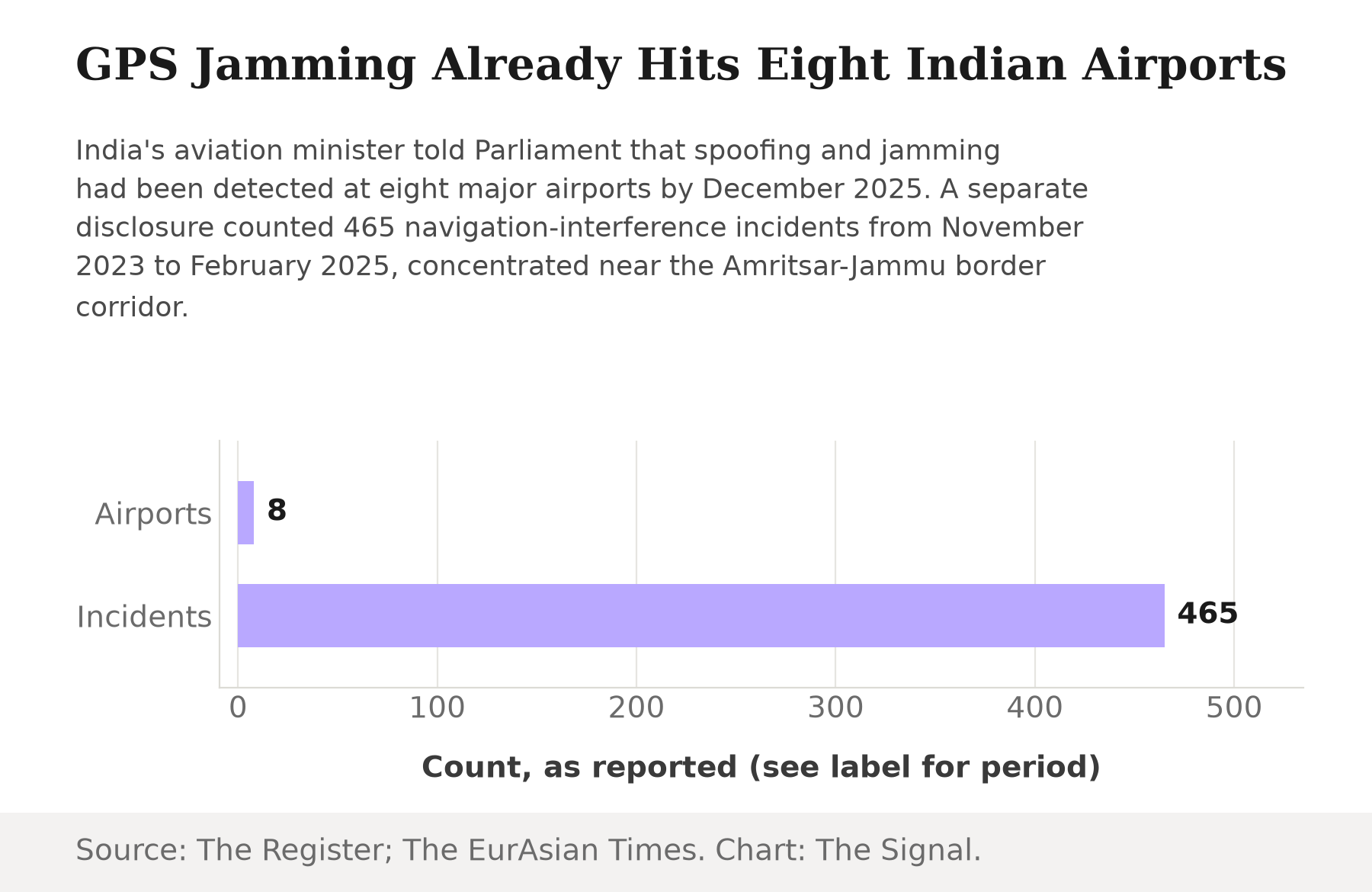
The unreliability is not hypothetical. In November 2025, India's aviation regulator, the DGCA, ordered pilots, air traffic controllers and technical units to report any suspected GPS spoofing or GNSS interference within 10 minutes of it occurring. A month later, in December 2025, India's Civil Aviation Minister told Parliament that spoofing and jamming had already been detected at eight major Indian airports. And a separate parliamentary disclosure covering November 2023 to February 2025 counted 465 incidents of interference with aircraft navigation systems, concentrated in the Amritsar and Jammu corridor near the Pakistan border. Eight airports and 465 recorded incidents are why a satellite-based clock stopped being an obviously safe default for the people who plan critical infrastructure.
The same story in the Gulf
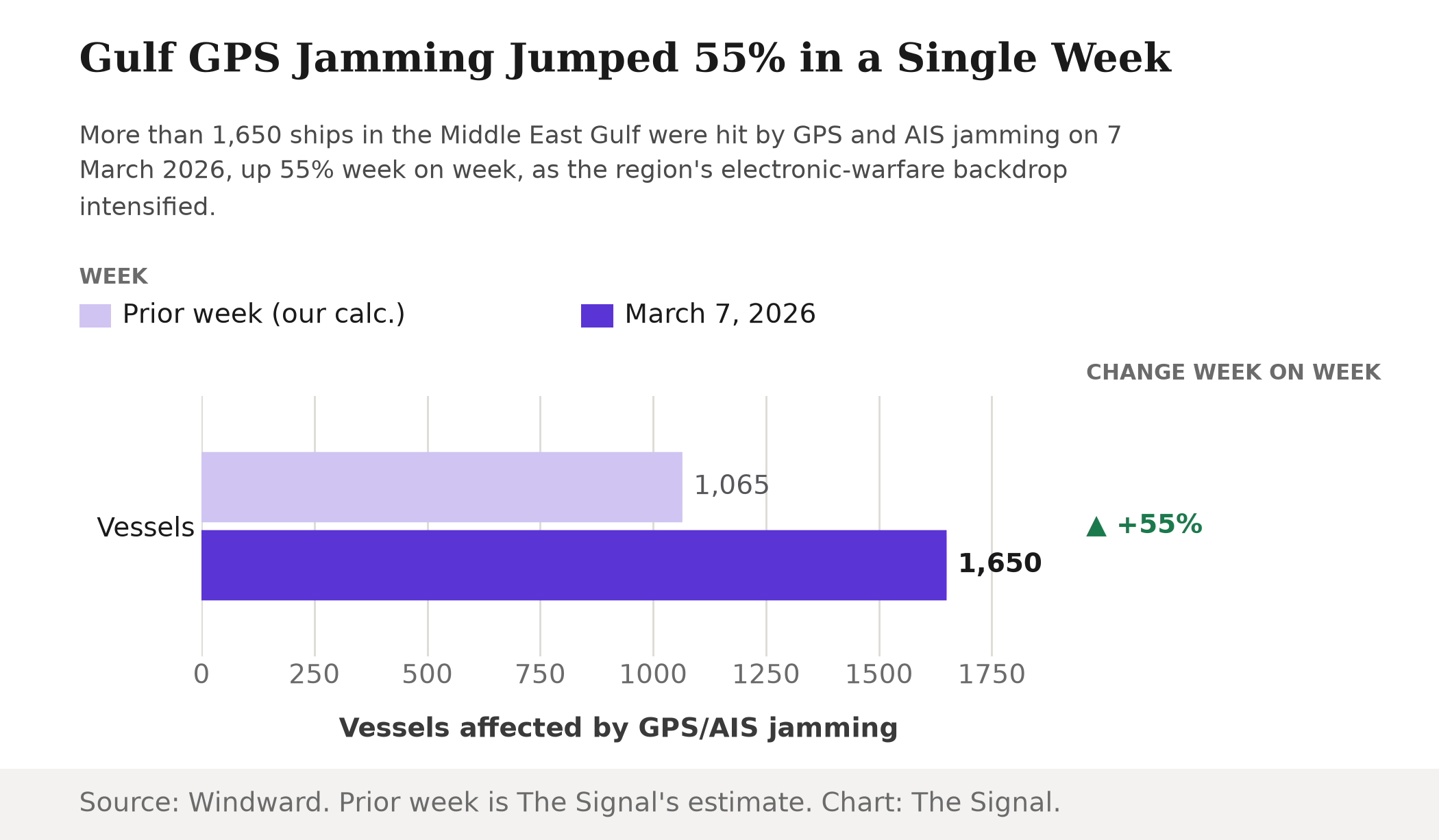
The pattern is not confined to India's own airspace. In the Middle East Gulf, GPS and AIS jamming affecting shipping surged 55% week on week to hit more than 1,650 vessels on 7 March 2026, as the region's electronic-warfare environment intensified. That week-on-week jump implies roughly 1,065 vessels were affected the week before, our calculation from the reported increase: a jump of nearly 600 ships in seven days.
A wire instead of a satellite
White Rabbit is not a marginally better GPS. It is a different physical channel: a fiber-optic link using the Precision Time Protocol, built, per the government's own account, to distribute a secure, tamper-resistant national time signal rather than pick one up from space. A November 2025 technical paper on the underlying protocol reported synchronisation over a 300-kilometre single-span fiber link with 99.86% uptime, while maintaining picosecond-level precision and sub-nanosecond accuracy, figures on a different scale from the tolerance markets run on today. Per a 2025 NIST explainer, clocks used in US automated stock trades must stay within 50 milliseconds of the reference time UTC(NIST), a standard commonly held via GPS comparison: fifty-thousandths of a second is the bar most automated trading clocks clear today, not sub-nanosecond precision.
The tolerance markets run on today is measured in milliseconds. The alternative India just tested is measured in billionths of that.
| Standard | Clock tolerance | What it is |
|---|---|---|
| US automated stock trades | 50 milliseconds | Regulatory tolerance versus UTC(NIST), commonly held via GPS comparison |
| White Rabbit fiber link (300 km demonstration) | Sub-nanosecond, picosecond-level | Lab-demonstrated protocol precision, not a live exchange spec |
Fifty milliseconds is 50 million nanoseconds. White Rabbit's demonstrated sub-nanosecond precision is roughly 50 million times tighter, our calculation from the two figures. Source: NIST; arXiv, November 2025.
The honest objection
The strongest case against reading too much into this is that nothing has changed for a live trade yet. What the Department of Consumer Affairs, CSIR-NPL, ISRO, SEBI, NSE and BSNL jointly completed was a verification exercise between two facilities, not a production cutover of NSE's trading clock. Exchanges have run on GPS-linked timing for decades without a jamming incident reaching the trading floor, and swapping the clock underneath a live market is itself an operational risk that has to be managed carefully, not rushed.
That case is real, but it argues for testing before an incident forces the issue, not against it. Interference is already showing up at eight of India's own airports, and jamming keeps escalating in the wider region. Building the resilient alternative now, with SEBI and NSE named participants in the pilot itself, reads closer to prudence than to alarm.
The Signal
The story here is not the ribbon-cutting in Bengaluru. It is that India tested the backup before the primary system failed, not after. If the pilot between the Bengaluru lab and NSE Chennai becomes a production link, and if telecom and grid operators follow, India will have quietly moved a piece of its financial plumbing off a signal that Parliament has already been told is jammed at eight of its own airports. Watch what the next update from SEBI or NSE actually describes: a live migration, or just another test. A backup that stays a demonstration is not yet a backup.
Reporting basis: the Bengaluru inauguration is per All India Radio's News Services Division, citing the Department of Consumer Affairs directly. The NSE Chennai verification is per IANS, also citing the Department of Consumer Affairs. The financial-markets framing quote is per Punjab Kesari and the tamper-resistant technical description per Daily Excelsior, both reporting the same official launch. The White Rabbit precision and uptime figures are from a November 2025 arXiv preprint on the underlying protocol, independent of the Indian launch. The US clock-tolerance standard is per NIST. The DGCA reporting order is per The Tribune; the eight-airport figure is per The Register, reporting a parliamentary disclosure; the 465-incident count is per The EurAsian Times, reporting a separate parliamentary disclosure. The Gulf jamming figures are per Windward. The prior-week vessel count and the precision ratio are The Signal's calculations from those figures.