
On 27 March 2019, India destroyed one of its own satellites to prove it could. Mission Shakti's ground-based interceptor hit the 740 kg Microsat-R spacecraft at 0640 GMT, in a roughly 294 by 265 km orbit, making India the fourth country to demonstrate an anti-satellite weapon. The government's defense of the test rested on one engineering claim: it was designed to be responsible. An academic post-test analysis found the intercept altitude was chosen specifically so the resulting debris would re-enter the atmosphere within 45 days, not linger for years the way earlier tests by other countries had.
India said the debris would be gone in 45 days. The math said otherwise.
That promise is the whole case for calling the test responsible, and it is checkable.
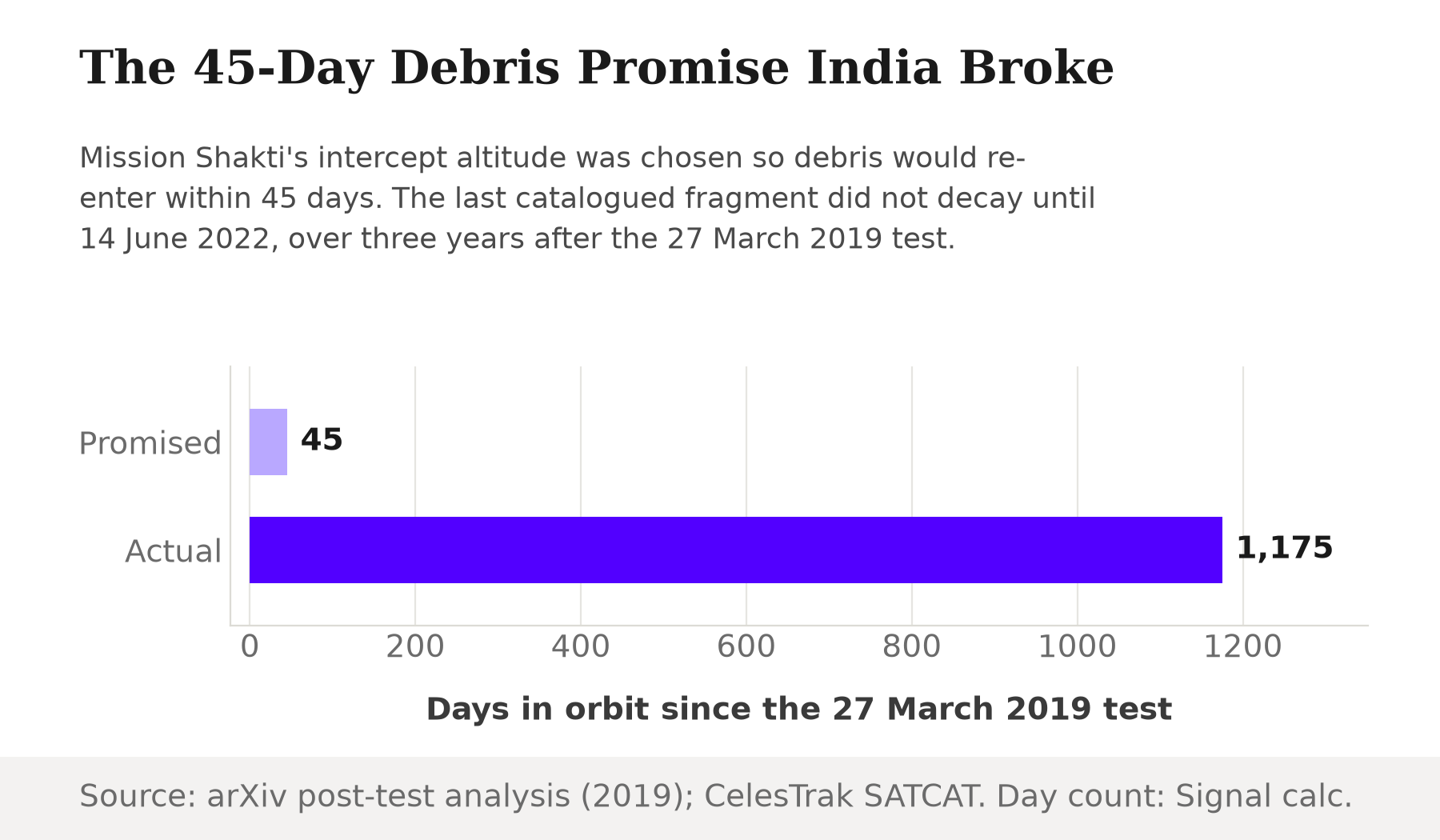
Source: arXiv preprint analysis of Mission Shakti's design (45-day debris lifetime target); CelesTrak SATCAT (last fragment's decay date). Debris lifetime is The Signal's calculation. Chart: The Signal.
It is worth taking that promise seriously before doubting it. The altitude choice was a genuine engineering decision that changed the outcome relative to earlier tests elsewhere. The place to look is not whether the debris cleared, but how long the last pieces lingered, because that tail is where a design promise either holds or breaks.
The tracking record NASA didn't like
NASA's Orbital Debris Program Office logged over 400 fragments picked up by tracking sensors in the days after the test, of which 101 entered the public satellite catalog and 49 remained on-orbit as of 15 July 2019, roughly three and a half months on. NASA Administrator Jim Bridenstine put the same event more bluntly at a town hall, saying the test created 400 pieces of debris, about 60 large enough to track, and 24 with apogees carrying them above the International Space Station's orbit then calling it "a terrible, terrible thing." NASA was not disputing India's design logic. It was pointing out that even a low, short-lived test still put working spacecraft and a crewed station at temporary risk.
Debris that overshot its own test
The 45-day figure assumed the fragments would stay close to the roughly 283 km altitude where the intercept happened, since orbital decay is fastest near the atmosphere and much slower higher up. A peer-reviewed Heliyon study tracking 57 of the fragments in NORAD's catalog found apogees reaching as high as 1,725.7 km, with perigees of 208 to 288.6 km, some of it already sitting well above where the collision took place. Higher apogee means a longer, slower fall. The same research group modelled the full debris population at about 14 fragments larger than 20 cm, 6,587 larger than 1 cm, and roughly 722,000 larger than 1 mm, a size band far too fine for any tracking network to catalog piece by piece, and correspondingly hard to ever confirm has fully cleared.
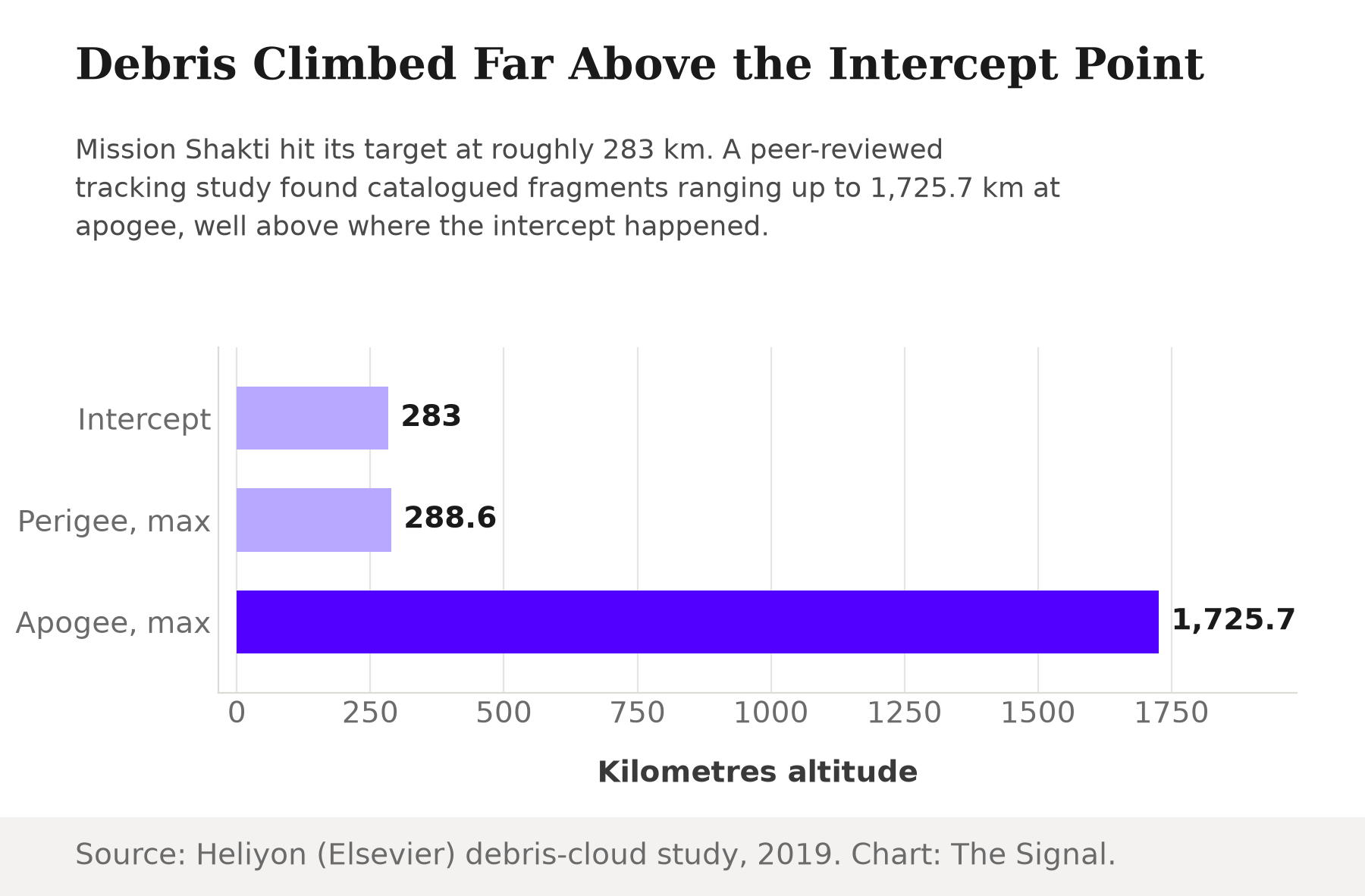
Source: NASA Orbital Debris Program Office (intercept altitude); Heliyon study, via PMC (fragment perigee and apogee range). Chart: The Signal.
The clearest number is the exit date. CelesTrak's satellite catalog records that the last piece of catalogued Microsat-R debris, object 44383, did not decay from orbit until 14 June 2022, more than three years after the test. By The Signal's calculation, that is roughly 26 times the 45-day design window, for the one fragment that outlasted every other. A fresher, government-wide count confirms the field is actually gone, not just implied by one decay date: India's Department of Space told Parliament in March 2026 that just 129 trackable debris pieces remain from all Indian satellite missions combined, an itemised tally of defunct satellites and rocket bodies with not one from Mission Shakti.
A test built to avoid China's outcome
India's low-altitude design was a direct response to how badly an earlier test went. China's 2007 destruction of its Fengyun-1C satellite, intercepted at 862 km, added more than 3,300 trackable objects to the global catalog, a 25% jump in its entire size, and at that altitude the debris barely feels atmospheric drag. Roughly 30% of close-conjunction events in today's crowded 800 km sun-synchronous band are still caused by Fengyun-1C fragments, nearly two decades on.
| China, Fengyun-1C (2007) | India, Mission Shakti (2019) | |
|---|---|---|
| Intercept altitude | 862 km | ~283 km (294 x 265 km orbit) |
| Trackable objects added | More than 3,300 | Over 400 initially tracked, 101 catalogued |
| Longest-lived catalogued fragment | Still contributing to conjunctions today, per ESA | Decayed 14 June 2022 |
Source: ESA Space Debris Office; NASA Orbital Debris Program Office; CelesTrak SATCAT.
By that comparison, the design worked: India's debris cleared in years, not the multi-decade tail China's higher test left behind. That is a real, measurable difference, and it is the strongest fact in the government's favor.
India's own fleet now shares the neighborhood
The reason the leftover years matter is that India is no longer just the country that made the debris. Its own satellites increasingly fly through what its weapon test left behind. In 2025, ISRO operated 22 satellites in low earth orbit and 31 in geosynchronous orbit, and low earth orbit is exactly the band Mission Shakti's fragments occupied.
| ISRO fleet and safety metrics, 2025 | Figure |
|---|---|
| Operational satellites, low earth orbit | 22 |
| Operational satellites, geosynchronous orbit | 31 |
| Close-approach alerts analysed for ISRO satellites | More than 150,000 |
| Collision-avoidance manoeuvres, LEO satellites | 14 |
Source: ISRO's Indian Space Situational Awareness Report 2025.
ISRO's own 2025 report links that volume of alerts and manoeuvres directly to rising congestion in low earth orbit, the same band where Mission Shakti's fragments spent their three-plus years. The report does not isolate how many of those 150,000-plus alerts trace to Microsat-R debris specifically, so the link is directional rather than a measured share. But the mechanism is not in dispute: more objects sharing an altitude band means more alerts and more manoeuvres, for every operator flying there, India included.
The honest objection
The strongest case for Mission Shakti is that the design goal was met on its own terms. Nearly all of the roughly 400 fragments NASA initially tracked were gone well within a couple of years, a sharp contrast with Fengyun-1C's fragments, some of which are still causing collision alerts nearly two decades after China's test. Choosing a low intercept altitude was the correct engineering call, and it visibly worked better than the alternative on record.
That case is real, but it does not erase the tail. A design built around a 45-day clearance goal that produces even one catalogued fragment still in orbit more than three years later is not a rounding error. It is a design assumption that failed for the piece that mattered most: the one that stayed. And the number of intact, trackable fragments was never the full picture. The roughly 722,000 fragments too small to catalog do not show up in any lifetime count at all, so no one, including ISRO, can say with precision when Mission Shakti's debris field is actually gone.
The Signal
Mission Shakti was sold as the responsible way to demonstrate an anti-satellite capability, and against the one comparison available, China's Fengyun-1C, that claim mostly holds up. What it does not survive is its own paperwork. A test engineered around a 45-day clean-up left a catalogued fragment in orbit until 14 June 2022, at altitudes reaching nearly six times higher than the intercept point, in the same low-earth-orbit band where India's own satellite fleet is now growing and logging more than 150,000 close-approach alerts a year. The capability was aimed outward, at proving India could hit a target in space. The residual risk lands at home, on India's own hardware, sharing the orbit with what its own weapon left behind. The number to watch is not whether India can do this again. It is whether ISRO's 14 collision-avoidance manoeuvres a year start climbing as the fleet it protects keeps growing into the debris field its own test created.
Reporting basis: fragment counts, tracking dates and the 45-day design rationale for Mission Shakti are from NASA's Orbital Debris Program Office and two related academic analyses published as arXiv preprints (one also appearing in Heliyon, accessed via PMC). NASA Administrator Jim Bridenstine's remarks are as reported by Space.com. The exact decay date of the longest-lived catalogued fragment is from CelesTrak's SATCAT records, compiling U.S. Space Force tracking data. The Fengyun-1C comparison is from the European Space Agency's Space Debris Office. India's 2025 satellite fleet and collision-avoidance figures are from ISRO's Indian Space Situational Awareness Report 2025. The 45-day-to-1,175-day ratio is The Signal's calculation from those figures.