On the Nifty 50's September 2, 2026 factsheet, ICICI Bank's index weight climbed to a record 9.45 percent, just 40 basis points behind HDFC Bank's 9.85 percent. The gap has been closing all year: HDFC Bank is down 29.12 percent in 2026, the worst performance among all Nifty constituents, while ICICI Bank is up 6.02 percent over the same stretch, according to BusinessToday's report of the factsheet. Read only the index page and the story looks simple: India's number two private bank is closing in on the crown.
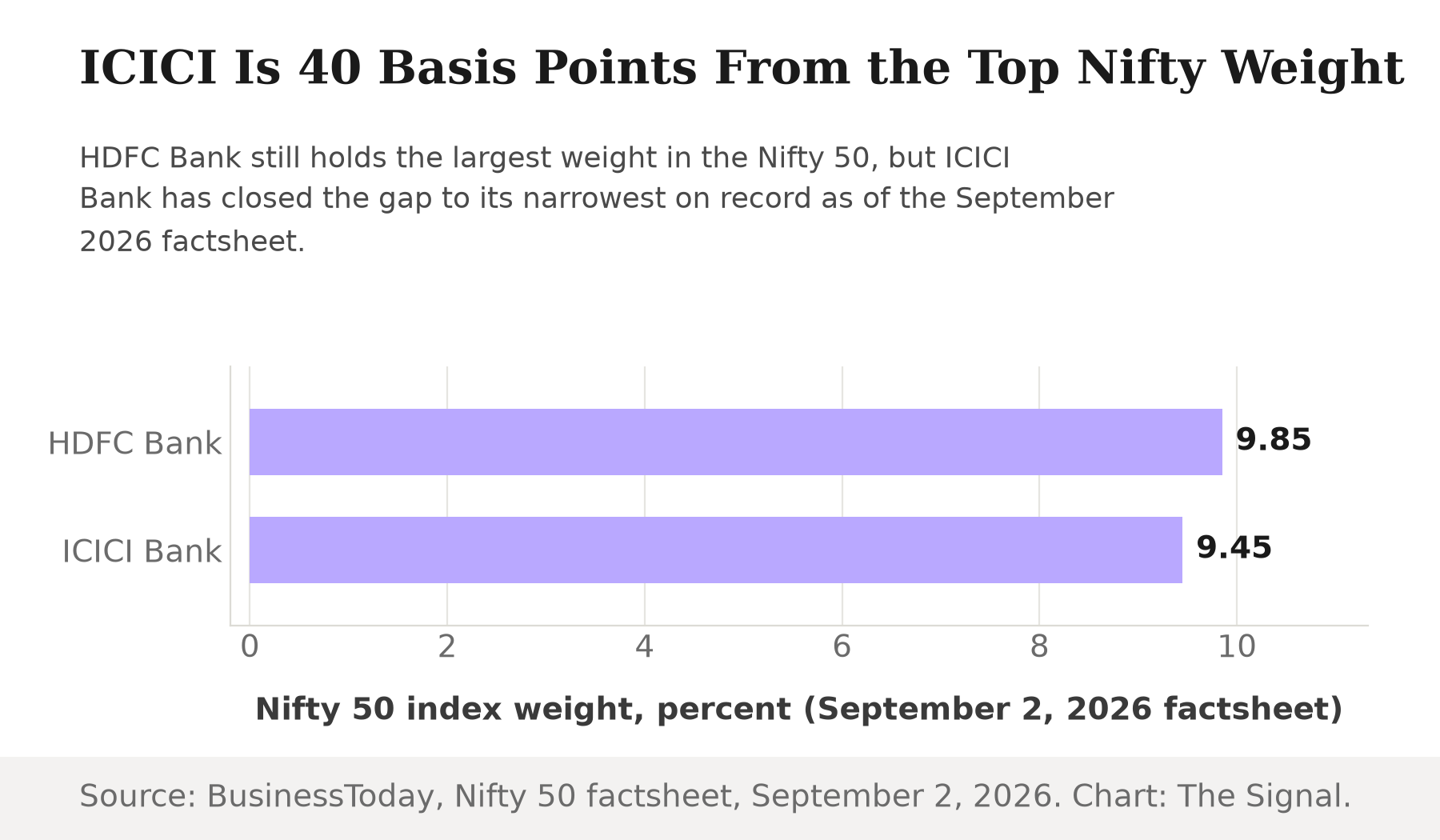
Source: BusinessToday's report of the September 2, 2026 Nifty 50 factsheet. Chart: The Signal.
It is worth slowing down on that read. A Nifty weight is a function of one thing: free-float market capitalisation, share price multiplied by shares outstanding. On its own it says nothing about which bank is actually bigger, more profitable, or better run. Strip that index math out and look at what each bank reported for the same three months, and the picture does not match the index page at all.
The quarter, side by side
ICICI Bank's profit after tax grew 15.9 percent year-on-year to Rs 14,805 crore in the quarter ended June 30, 2026, with total advances up 19.6 percent to Rs 16,31,260 crore. HDFC Bank's standalone profit after tax for the same quarter grew a slower 5.0 percent to Rs 190.6 billion, with gross advances up 15.4 percent to Rs 30,608 billion. Converted to the same unit as ICICI Bank's disclosure, HDFC Bank's Rs 190.6 billion is Rs 19,060 crore in profit, about 29 percent more than ICICI Bank reported, and its Rs 30,608 billion in advances is roughly Rs 30.6 lakh crore, against ICICI Bank's Rs 16.3 lakh crore: HDFC Bank's book is still nearly 1.9 times the size. Both figures are The Signal's calculation, converting HDFC Bank's billion-rupee disclosure into the crore unit ICICI Bank reports in.
ICICI Bank is growing faster. HDFC Bank is still bigger.
| Metric, quarter ended June 30, 2026 | ICICI Bank | HDFC Bank |
|---|---|---|
| Profit after tax | Rs 14,805 crore | Rs 19,060 crore (Rs 190.6 billion) |
| Profit growth, year-on-year | 15.9% | 5.0% |
| Advances | Rs 16.3 lakh crore | Rs 30.6 lakh crore (Rs 30,608 billion) |
| Advances growth, year-on-year | 19.6% | 15.4% |
Source: ICICI Bank's official results disclosure; HDFC Bank's Form 6-K filing, via StockTitan. Crore conversions and the size gap are The Signal's calculations.
ICICI Bank is growing faster from a smaller base. It has not caught up. Profitability tells a similar story: ICICI Bank's net interest margin for the quarter came in at 4.36 percent, up from 4.32 percent the prior quarter, against HDFC Bank's 3.26 percent on total assets (3.40 percent on interest-earning assets) for the same quarter. The two banks did not disclose their margins on an identical basis, so the gap is not precisely comparable point for point, but even the more favourable of HDFC Bank's two figures trails ICICI Bank's.
What moved the price
The price move behind the index math has an obvious trigger. HDFC Bank disclosed on August 29, 2026 that Managing Director and CEO Sashidhar Jagdishan will retire at the close of business on October 26, 2026, after deciding not to seek reappointment, with the bank saying it would fast-track the search for his successor, per Free Press Journal's report of the exchange filing. Four days later, on September 2, 2026, BusinessToday reported ICICI Bank's weight at its closest ever to HDFC Bank's.
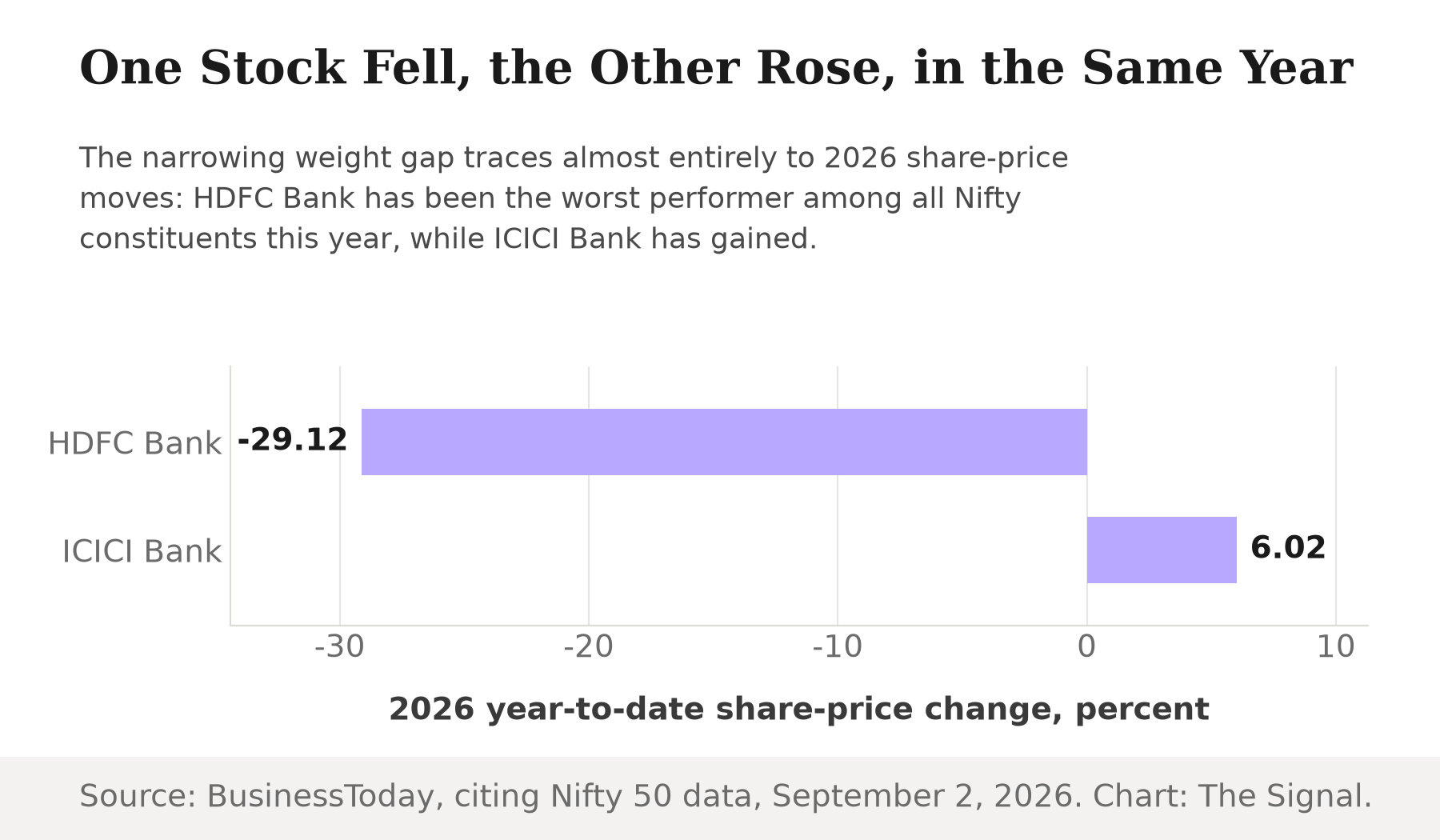
Source: BusinessToday's report of the September 2, 2026 Nifty 50 factsheet. Chart: The Signal.
A single leadership exit does not, on its own, explain a stock down 29.12 percent for the year against a Nifty constituent average that includes a rival up 6.02 percent in the same BusinessToday report. But it sharpens a question investors were already pricing: whether HDFC Bank's post-merger scale is still translating into growth, or just sitting there as size.
The convergence was not a sudden lurch after the CEO news, either. ICICI Bank's weight climbed through 2026 from 8.32 percent at the end of May to 9.01 percent in June, 9.22 percent in July and 9.45 percent in August, a steady multi-month build rather than a single post-announcement spike. Zoomed out further, that climb is part of a much longer arc: ICICI Bank's index weight has grown nearly 4.8 times from 1.96 percent in March 2009, after dipping to 4.19 percent in June 2018 amid concerns over the bank's legacy corporate bad loans. The CEO exit sharpened the story; it did not start it.
How HDFC Bank got this big
The merger of Housing Development Finance Corporation into HDFC Bank took effect on July 1, 2023, creating what was then the world's fourth-biggest bank by market value, behind JPMorgan, ICBC and Bank of America, per All India Radio's report of the merger. That merger is a large part of why HDFC Bank's loan book and profit still dwarf ICICI Bank's three years later. It also means the two are not directly comparable on growth rate alone: a freshly enlarged, merged balance sheet takes time to digest before it can compound as fast as a smaller, undiluted one.
The systemic-risk gap predates all of this
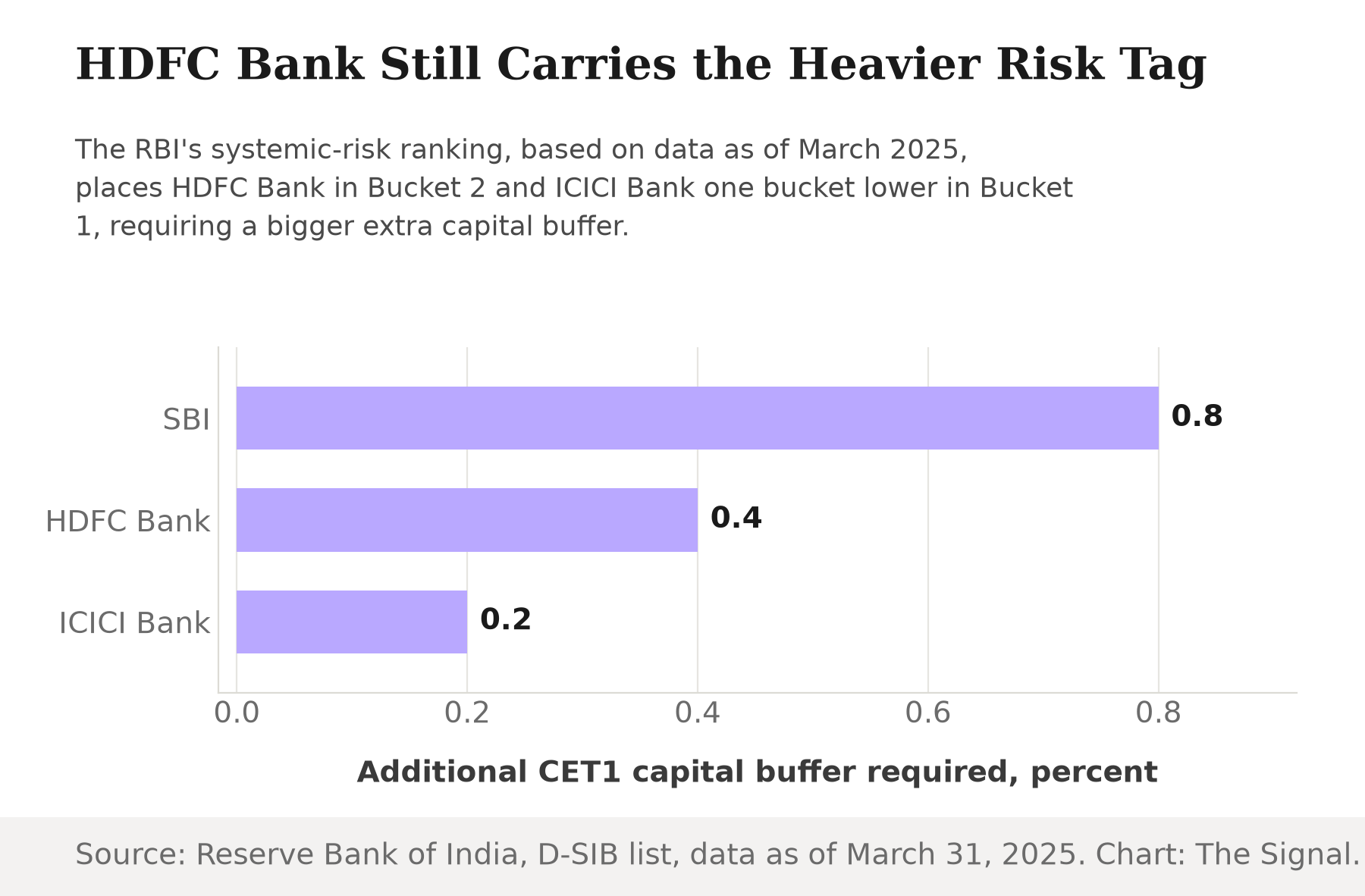
The RBI's 2025 list of Domestic Systemically Important Banks, based on data as of March 31, 2025, places HDFC Bank in the higher-risk Bucket 2, requiring an additional 0.40 percent CET1 capital buffer, while ICICI Bank sits one bucket lower in Bucket 1, at 0.20 percent. SBI alone sits in Bucket 4, the highest tier, at 0.80 percent, per the Reserve Bank of India's press release.
Source: Reserve Bank of India, 2025 D-SIB press release. Chart: The Signal.
That classification has nothing to do with 2026 stock prices or a departing CEO. It measures balance-sheet scale and interconnectedness as of March 31, 2025, more than a year before HDFC Bank's CEO announced his retirement or its stock began this year's slide. On the RBI's own systemic-scale yardstick, HDFC Bank was still the structurally bigger, more interconnected bank well before the Nifty weight gap narrowed to 40 basis points.
The honest objection
The strongest case against this reading is that markets are forward-looking, and a price is itself a claim about the future. If investors are marking HDFC Bank down and ICICI Bank up, that may be a rational bet that ICICI Bank's faster growth this quarter, 15.9 percent profit growth against HDFC Bank's 5.0 percent, and 19.6 percent advances growth against 15.4 percent, will keep compounding until the loan books and profits converge too, not just the index weight. Passive funds tracking the Nifty do not need a reason: they mechanically buy more of whatever share the index assigns, reinforcing whichever stock is already rising.
That case has merit, but it explains a re-rating, not a reversal. Closing a gap where HDFC Bank's loan book is still nearly 1.9 times ICICI Bank's size, our calculation from the two banks' disclosures for the quarter ended June 30, 2026, takes years of sustained outperformance, not one weak quarter for HDFC Bank layered onto one leadership exit. An index weight can converge in months because price reacts to a headline in days. A loan book converges only over years, because it compounds one loan at a time.
The Signal
The Nifty weight gap is now the narrowest on record between India's two largest private banks, but it is measuring the wrong thing if the question is which bank is actually ahead. HDFC Bank still runs the bigger loan book, generates more absolute profit, and carries the heavier systemic-risk tag from the RBI, a ranking untouched by this year's stock swings. What has genuinely changed is the market's confidence in HDFC Bank's near-term trajectory, dented by a CEO exit and profit growth that has slowed to a third of its rival's. Watch what happens after October 26, 2026, when Jagdishan's successor is named. If HDFC Bank's growth reaccelerates, the weight gap closes for the wrong reason. If it does not, the day the index finally does cross over will be the day the price finally catches up to a gap in scale that never actually closed.
Reporting basis: the Nifty 50 index weights and the 2026 year-to-date share-price performance are per BusinessToday's report of the September 2, 2026 factsheet. HDFC Bank's CEO retirement and its timeline are per Free Press Journal's report of the bank's August 29, 2026 exchange filing. ICICI Bank's month-by-month weight climb from May through August 2026, and its longer index-weight history back to 2009, are per a separate Free Press Journal report. The Reserve Bank of India's Domestic Systemically Important Banks classification, based on data as of March 31, 2025, is from the RBI's own press release. The 2023 HDFC-HDFC Bank merger and its immediate global ranking are per All India Radio's (Prasar Bharati) report. ICICI Bank's profit and advances figures are from its own official results disclosure, while its net interest margin is per a separate BusinessToday report of the same quarter's results; HDFC Bank's quarterly results are from its Form 6-K regulatory filing, via StockTitan. The unit conversions between crore and billion, the profit and advances gaps between the two banks, and the growth-rate comparisons are The Signal's calculations from those figures.