The Competition Commission of India has held the Trustees' Association of India, IDBI Trusteeship Services, Axis Trustee Services and SBICAP Trustee Company guilty of cartelisation for collectively fixing the minimum fees debenture trustees charge companies raising debt in India. The CCI's own press release identifies the matter as Case No. 29 of 2021, decided by an order dated 2 September 2026, and names individual officials at all four parties as personally liable alongside their organisations. Read as a headline, this looks like the system working: a regulator investigated a professional cartel in the bond market's plumbing, built a case, and won it. Bar and Bench, reporting on the same order, confirms the finding rests on the trustees' own conduct: they discussed the risk of the law catching them, and did it anyway.
It is worth slowing down on that framing. The CCI imposed a monetary penalty on none of the four parties it just found guilty. Not a reduced fine, not a warning fine. Zero, across the board.
The CCI held four parties guilty of cartelisation and fined every one of them nothing.
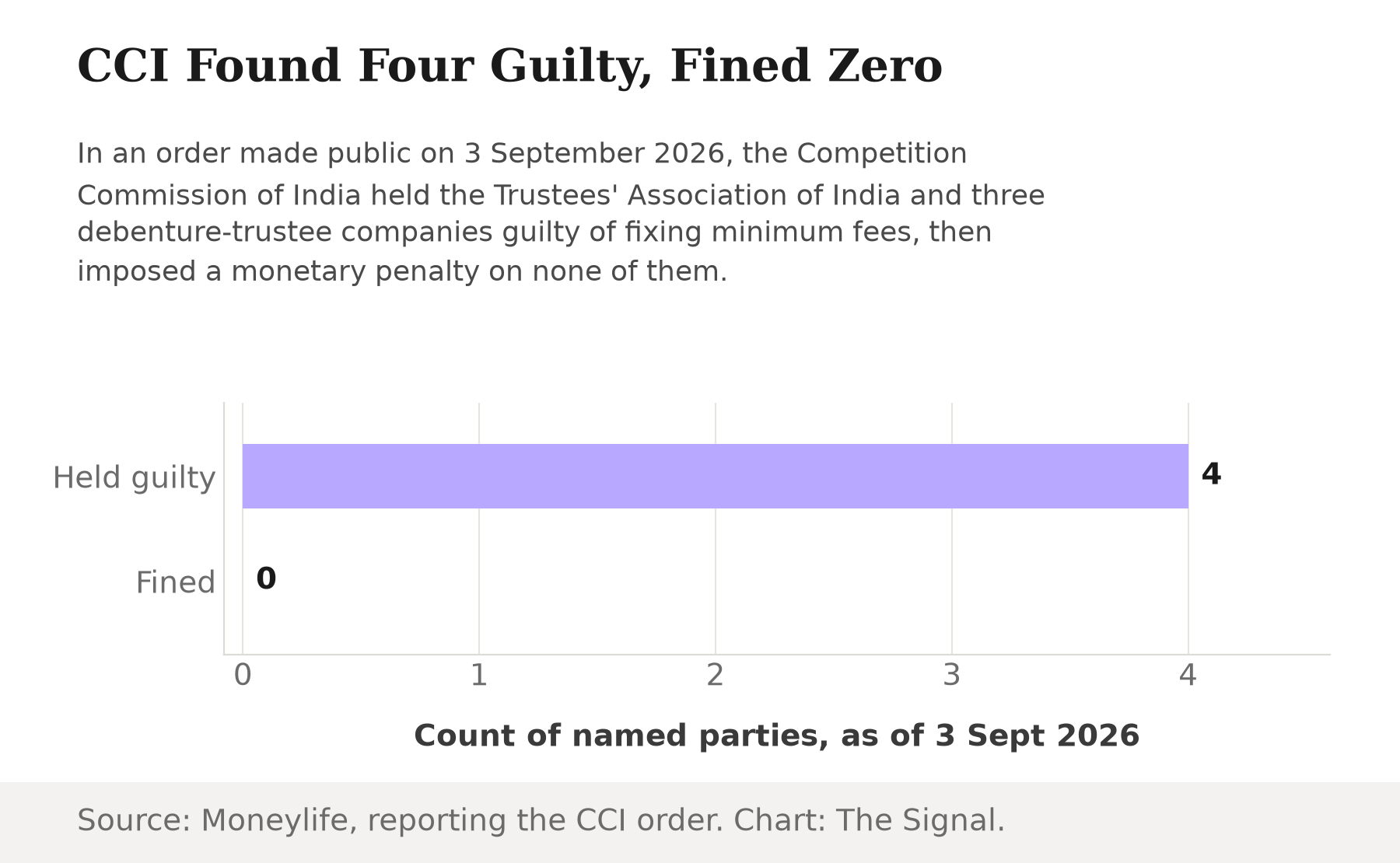
Source: Moneylife's report of the CCI order. Chart: The Signal.
What the trustees actually did
Debenture trustees are the officials who represent bondholders when a company issues debt in India, the people meant to watch the borrower on the lender's behalf. The complaint that triggered the CCI's probe alleged the trustees had raised their fee quotes by roughly 300% over previous rates, a figure that came from Muthoot Finance itself, one of the companies paying those fees. The CCI's own confidential prima facie order, issued in December 2021, found that the Trustees' Association of India had "substantially" hiked fees and stopped its members from quoting below a floor price, the mechanics of a price-fixing cartel in plain terms.
The trustees knew what they were doing. At a meeting on 6 June 2019, members of the Trustees' Association of India discussed whether jointly fixing prices could amount to cartelisation under the law, then adopted common minimum fees anyway. That is not a group that stumbled into an antitrust violation. It is a group that named the risk out loud and proceeded.
Why the fine was zero
The CCI's own reasoning for the zero-penalty outcome is on the record. It took into account that the Trustees' Association of India had no income during the period of the violation, and that the three trustee companies had charged fees below the benchmark price in several cases. Both of those are real mitigating facts on their own terms. An association with no revenue cannot easily be made to pay a percentage-of-turnover penalty, the CCI's usual yardstick. And trustees who occasionally undercut the floor they had agreed to are, in one narrow sense, weak cartelists.
But those facts explain the size of a penalty. They do not explain its absence. A cartel whose own discipline was imperfect still fixed a floor its members mostly held to, still generated a documented finding of guilt, and still followed a specific, named complaint. The CCI had a guilty verdict in hand and chose not to convert it into a cost.
The law gave it a wide range to choose from. Section 27 of the Competition Act lets the CCI fine each member of a proven cartel up to three times its profit for every year the cartel ran, or 10% of its turnover for every year of continuance, whichever is higher. That ceiling exists precisely for cases like this one, where a cartel is found to have operated for more than a year. The CCI used none of it. It moved from a guilty verdict straight to zero, with no stop in between.
A market small enough to fix from one meeting
Only 26 entities are registered with SEBI as debenture trustees nationwide. A trade body plus three of its member firms were enough to set a common fee floor for a meaningful share of that market, which is exactly the kind of concentrated, single-meeting-sized professional guild where price coordination is cheapest to organize and hardest for an outsider to detect.
Four named parties, out of 26 registered nationwide, were enough to fix the floor.
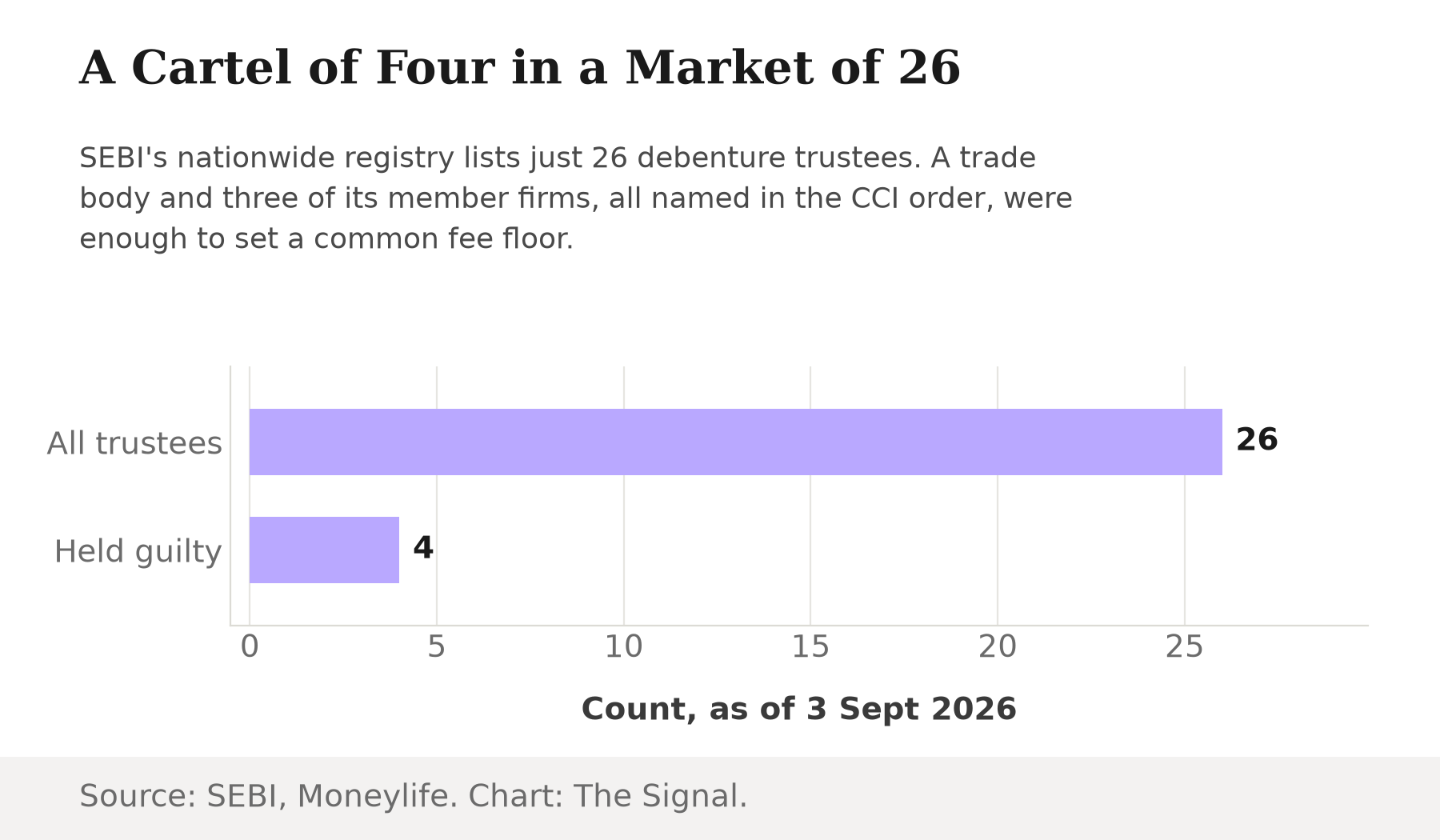
Source: SEBI's list of registered debenture trustees; Moneylife's report of the CCI order. Chart: The Signal.
The irony sits one regulation away. SEBI's own Debenture Trustees Regulations already bar a trustee from "unfair competition" and from winning another trustee's clients "on assurance of lower fees", rules written to stop trustees from undercutting each other. The cartel did the mirror image: instead of competing on price, the trustees agreed not to. That conduct needed a different regulator, the CCI, to even reach a hearing, and it took years to get there.
The years the case spent in court before it spent zero rupees
The CCI's finding did not arrive quickly. In April 2022, the Bombay High Court barred the CCI from taking any coercive action against the Trustees' Association of India and its members until SEBI concluded its own enquiry into the same complaint, citing the Supreme Court's ruling in CCI v Bharti Airtel on the risk of two regulators issuing conflicting orders on the same facts. On 27 February 2023, a Bombay High Court bench disposed of four writ petitions filed over that CCI-SEBI jurisdiction dispute, ruling that the jurisdictional question had to be settled before anything else could proceed. Years of jurisdictional litigation, over a complaint about a 300% fee hike, ended in a guilty finding that cost the guilty parties nothing.
The honest objection
The strongest defense of the zero-penalty outcome is that a fine calculated on turnover would have been arbitrary here. TAI is an industry association, not a business with revenue to tax; fining it a percentage of nothing produces nothing, or an unjustifiable flat number invented for the occasion. And "several cases" of below-benchmark pricing is a real signal that the cartel was not airtight, so treating it with the same severity as a textbook price-fixing ring would overstate the harm actually done.
That case holds for the size of the penalty. It does not hold for a penalty of exactly zero. Competition law has tools short of a turnover fine, from a binding cease-and-desist order to individual director liability. A verdict that stops at cease-and-desist, with no cost attached, is a warning letter dressed as enforcement. For the next small guild weighing whether to fix a fee floor, the lesson is not "this is illegal." It is "getting caught costs nothing."
The Signal
A cartel of four named parties in a 26-firm market got caught, on a complaint that put a number on the harm, in an order that spelled out the very meeting where they discussed and dismissed the legal risk. None of that produced a rupee of consequence. The mechanism that let a proven violation end at zero, an association with no income and a paper trail of partial compliance, is a template any small professional market can read and reuse. Watch what the CCI does the next time a trade body in a similarly small Indian market gets caught the same way: if the outcome is another guilty finding with no penalty, the deterrent effect of this case was never in the verdict. It was always going to be in the fine, and there wasn't one.
Reporting basis: the CCI's finding of guilt and its no-penalty reasoning are per Moneylife's report of the order, which quotes the order directly; the 2019 meeting discussion and the order's characterisation of the trustees' awareness of the law are per Bar and Bench's separate account of the same order. The case number and order date are per the CCI's own Press Release No. 53/2026-27. The origin complaint and its fee-hike figure are per a LiveLaw law-firm analysis by Dentons Link Legal. The CCI's December 2021 prima facie order is per The Tribune's contemporaneous account. The Bombay High Court's 2022 stay and its February 2023 disposal of the related writ petitions are per LiveLaw's first and second accounts. The debenture-trustee conduct rules and the nationwide registered-trustee count are from SEBI's own regulations and registry. The statutory cartel-penalty ceiling is per the Competition Act, 2002 itself. The market-size comparison is The Signal's calculation from those figures.