On August 13, 2026, the RBI told banks to stop taking in new dollar deposits under its special swap window two and a half weeks early. Not because the scheme was struggling. Banks had already mobilised $56.846 billion in total inflows, including $52.3 billion in FCNR(B) deposits, so far past what the RBI needed that it moved the deadline forward from September 30 to August 31. Add in the $14.14 billion weekly jump that took reserves to $707 billion in the week ended August 7, and the surface story writes itself: India's rupee defenses have never looked stronger.
It is worth slowing down on that. RBI has run this exact playbook before, in 2013, and the deposit scheme that arrives with such force is not free money. It is a liability with a clock attached. And it is arriving at a moment when the account it is meant to cushion, the current account, had already turned worse: India's current account swung to a $6.2 billion deficit in June 2026, from a $1.2 billion surplus in June 2025, a $7.4 billion reversal in one year.
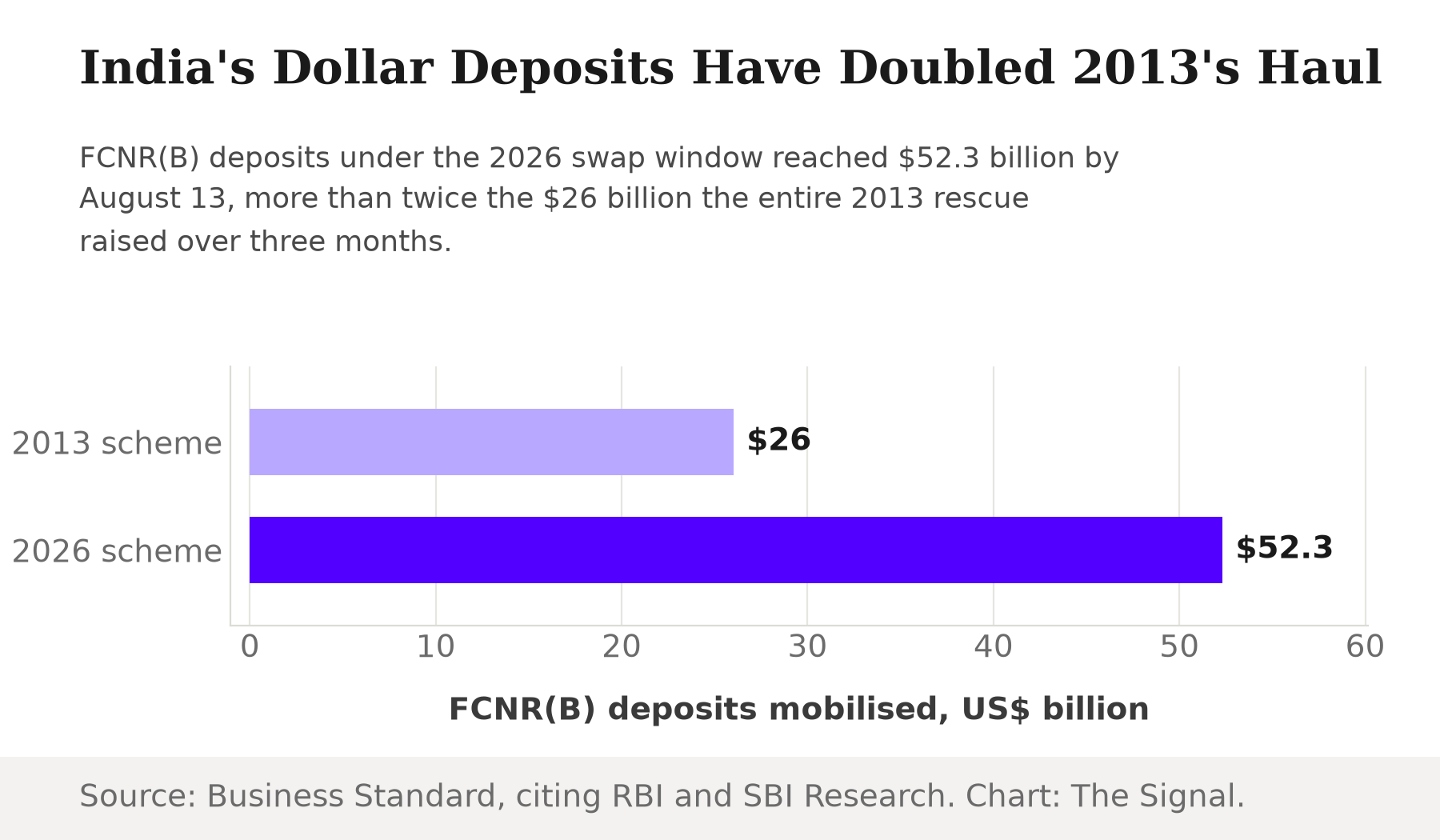
The 2026 scheme has already raised more than double the entire 2013 rescue.
FCNR(B) deposits crossed the 2013 scheme's full $26 billion haul in just 45 days, SBI Research found, and kept climbing. By the time RBI closed the window early, the $52.3 billion mobilised was already more than twice that entire 2013 total.
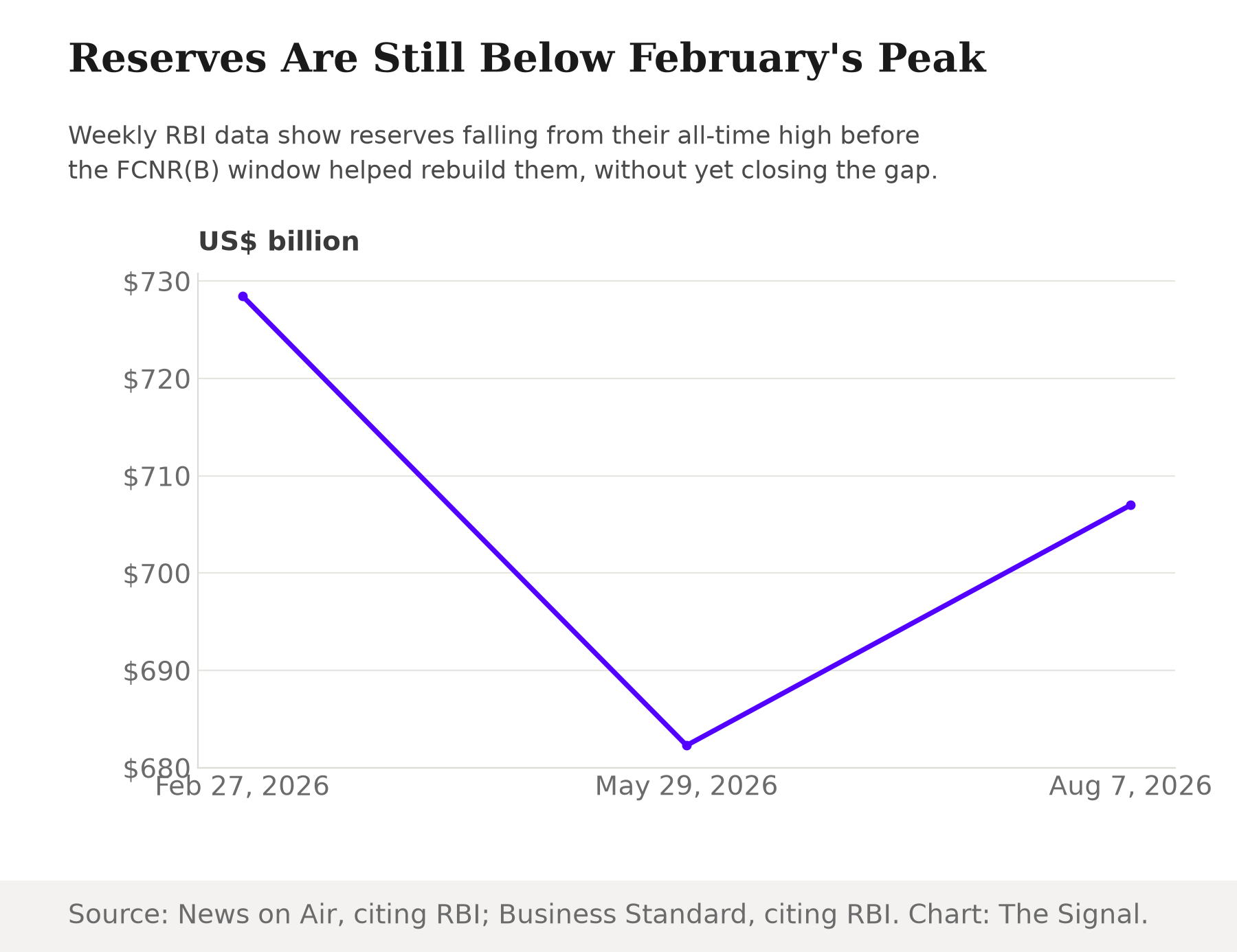
Reserves Are Rebuilding, Not at a Record
The $707 billion figure making headlines is not actually India's high-water mark. Reserves hit an all-time peak of $728.49 billion in the week ended February 27, 2026, before RBI's own intervention sales pared them back. By late May, RBI Governor Sanjay Malhotra put reserves at $682.3 billion, about 11 months of import cover, a $46.19 billion fall from February's peak. The deposit rush since then has clawed back $24.7 billion of that, reaching $707 billion by August 7, still about $21.49 billion short of February's high.
This is a hole being partly refilled, disproportionately with deposits RBI itself had to go out and solicit rather than dollars that simply arrived on their own.
The Deficit the Rescue Is Papering Over
The deposit drive did not happen in a vacuum. The same reporting window shows India's external accounts under real strain. The current account swung into deficit in June 2026, and the trade numbers behind it moved the same way: India's merchandise trade deficit widened to $86.86 billion in the April-June 2026 quarter, from $68.75 billion in the same quarter of 2025, a jump of $18.11 billion, or about 26 percent.
Both the current account and the trade gap widened in the same window.
| Measure | A year earlier | Latest print |
|---|---|---|
| Current account, net (June) | +$1.2 billion (June 2025) | -$6.2 billion (June 2026) |
| Merchandise trade deficit (April-June) | $68.75 billion (Q1 FY26) | $86.86 billion (Q1 FY27) |
Source: RBI; Ministry of Commerce and Industry, via PIB.
This is the backdrop the FCNR(B) rush is filling in. Deposit inflows are not evidence the current account is healthy. They are one of the few levers RBI has left to hold reserves steady while the current account is not.
What 2013's Fine Print Says About 2026
RBI opened the 2013 window because the rupee was in free fall. The Fed's taper-tantrum signal that year triggered capital outflows across emerging markets, and the rupee weakened from about 55 per dollar in May 2013 to almost 69 by August, a roughly 25 percent slide in three months. The scheme that followed was not a gift either. RBI's own FAQ on it set a swap cost of 3.5 percent compounded semi-annually, required a minimum three-year deposit tenor and a one-year lock-in, for deposits mobilised after September 6, 2013. The twin swap windows fetched $34 billion combined in 2013, far above the roughly $10 billion the market had expected when the window opened.
Three years later, the bill came due. Then-RBI Governor Raghuram Rajan warned in June 2016 that FCNR(B) maturities beginning that September could produce dollar outflows of around $20 billion. He was directionally right: the stock of FCNR(B) deposits fell from $44.11 billion at end-September 2016 to $20.85 billion by end-December 2016, a $23.26 billion drop in a single quarter, as the deposits matured and left. RBI managed that outflow without a crisis. It still had to find the dollars.
The 2026 window's own terms read differently. It covers fresh three- to five-year FCNR(B) deposits, carries the same one-year lock-in as 2013, and has RBI itself absorbing the hedging cost for banks rather than charging a fixed swap rate the way the 3.5 percent rate did in 2013. But a deposit scheme is structurally a deposit regardless of the rate: whatever the maturity, the dollars that came in fast in 2026 are dollars that leave again on a schedule, not reserves India earned and gets to keep.
The Honest Objection
The strongest case for not worrying is that a bigger buffer is a bigger buffer, regardless of how it was raised. Eleven months of import cover, as Governor Malhotra described the reserve position in June 2026, is real insurance against a currency shock today, and a scheme that has already out-mobilised 2013 by this margin gives RBI more room to manage any future maturity wall than it had in 2016. If the current account improves before these deposits come due, the 2013 playbook will look like a clean, repeatable tool rather than a warning.
That case holds only if the current account actually turns. It has not yet. The same June 2026 window that produced the deposit haul also swung the current account to a $6.2 billion deficit, and the same quarter widened the merchandise trade deficit to $86.86 billion, precisely the condition that made the rescue necessary in the first place. A bigger buffer bought with borrowed dollars is still a buffer with a repayment date, and the 2013 precedent shows that date does not announce itself gently. It arrives as a Governor explaining, in public, why the outflow is manageable.
The Signal
The distinction that matters is not reserves versus no reserves. It is earned reserves versus borrowed ones. India's $707 billion looks similar to the $728.49 billion peak from February only until you ask how much of the gap between them was rebuilt with deposits that carry an eventual claim against RBI's dollars. SBI Research estimates RBI had recouped about $31 billion of foreign-currency assets through the swap facility by August 7, nearly 55 percent of the $56.8 billion mobilised by then. More than half of this year's rebuild traces to a liability, not organic inflows. That liability arrived in a quarter when the current account and the trade deficit both moved the wrong way. The 2013 episode did not fail. It simply proved that this kind of rescue works by borrowing time, not by buying it outright. Watch the maturity wall these three- to five-year deposits build toward, and watch the current account print that follows. If the deficit keeps widening while this year's deposit pile approaches its own maturity wall, the next Governor may be giving the same speech Rajan gave in 2016, just with a bigger number attached.
Reporting basis: the current account and merchandise trade figures come from the RBI's own preliminary balance of payments release and the Ministry of Commerce and Industry's press release via PIB, respectively. Reserve levels are per News on Air's relay of RBI's figure for the February 2026 peak, Business Standard's account of RBI Governor Sanjay Malhotra's remarks for the May 2026 figure, and Business Standard's account of RBI's figure for the August 2026 figure. The 2026 FCNR(B) scheme's closure and its inflow totals, its published tenor, lock-in and hedging-cost terms, and the 2013 FCNR(B) comparison from SBI Research, are per Business Standard's coverage. The 2013 scheme's terms come from RBI's own FAQ; the 2013 taper-tantrum trigger, the 2013 twin-window total, Raghuram Rajan's 2016 outflow warning, and the subsequent FCNR(B) deposit pool contraction are all per Business Standard's coverage, drawing on Bloomberg reporting and RBI's own figures. The foreign-currency assets figure RBI had recouped through the 2026 swap facility is per SBI Research, carried by IANS. The dollar gaps, the year-on-year swings and the single-quarter deposit contraction are The Signal's calculations from those figures.