
On September 14, 2026, US Air Force Secretary Troy Meink told a room of defense officials at the AFA Air, Space and Cyber Conference that the country's Space Force is done pretending. DefenseScoop reports him saying the United States "now has on-orbit space control weapons capable of defending the joint force against hostile adversary actions," both offensive and defensive. The obvious read is that America has built a new kind of weapon. Space is militarized now. The arms race everyone half-expected has arrived.
It is worth slowing down on that. The hardware did not change that day. Analysts, rival militaries and arms-control watchers have long assumed Washington was already fielding exactly this kind of capability. What changed is that a sitting US official said it into a microphone, on the record, by name. The story is not the weapon. It is the sentence.
A single public sentence just ended a policy that outlasted the Cold War.
That policy has a specific birthday. The Outer Space Treaty, the foundational law governing military activity in orbit, was opened for signature by the US, UK and USSR in January 1967 and entered into force that October, per the UN Office for Outer Space Affairs. In the 58 years since, Washington's public posture on offensive orbital weapons has been silence or denial, even as its rivals built and tested their own. Meink's remark is the first time a US official has confirmed the capability exists, not hinted at it or left it to unnamed officials, but said it in a keynote with his own name attached.
Why the admission is the event
Deliberate ambiguity was itself a strategic tool. As long as no major power officially confirmed an on-orbit weapon, every government could act as though space remained the demilitarized commons the 1967 treaty era implied, while quietly building the opposite. That impression was always broader than the law actually written: Article IV of the Outer Space Treaty commits states only to not placing nuclear weapons or other weapons of mass destruction in orbit, on celestial bodies, or "in outer space in any other manner," per the treaty's full text hosted by UNOOSA. Conventional, kinetic and directed-energy counterspace weapons, exactly the category Meink just confirmed, sit outside what the treaty's text actually forbids. A declared "space control weapon" can exist without the US technically breaching the 58-year-old agreement at all. That fiction had a use: it kept the threshold for provocation high, because acknowledging a weapon in orbit invites the same acknowledgment from everyone else, and normalizes targeting one satellite as a legitimate military option rather than an unprecedented escalation.
Secure World Foundation's 2026 counterspace assessment, reported by Breaking Defense, already held that the US, Russia and China are the three states with the most significant counterspace arsenals, spanning jamming, direct-ascent anti-satellite missiles and directed-energy systems. Everyone tracking the field knew this. What none of the three had done, until September 14, was have an official say "we have deployed this" without qualification. The gap between assumed and confirmed is where deterrence signaling, treaty diplomacy and public accountability all actually live.
An orbit that was already full
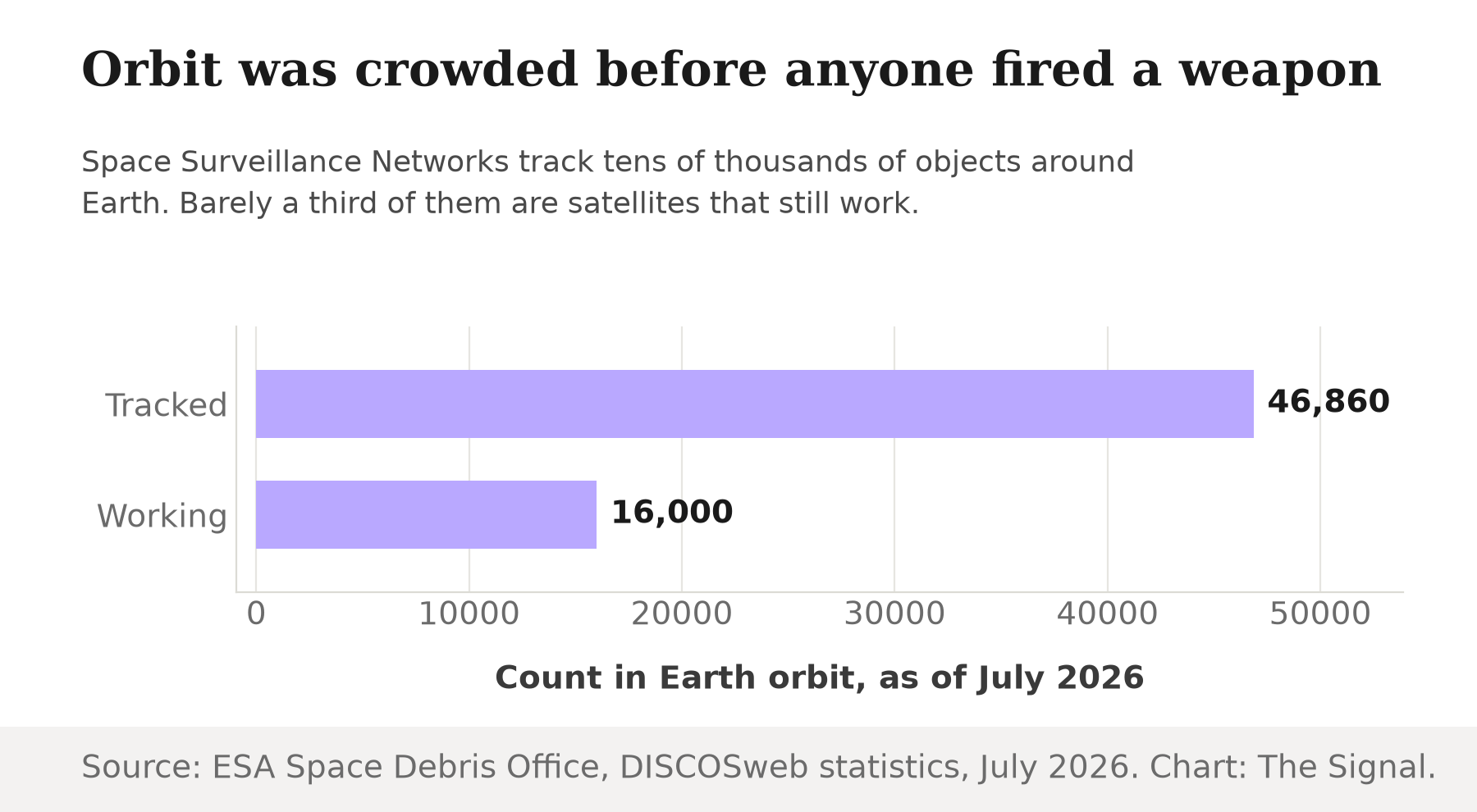
The declaration lands on an orbit that has never been busier. ESA's Space Debris Office counts about 46,860 objects currently tracked and catalogued by Space Surveillance Networks, of which only around 16,000 are still functioning satellites: barely a third of everything up there actually works. The rest is spent rocket stages, dead satellites and fragments, all moving fast enough to destroy anything they hit.
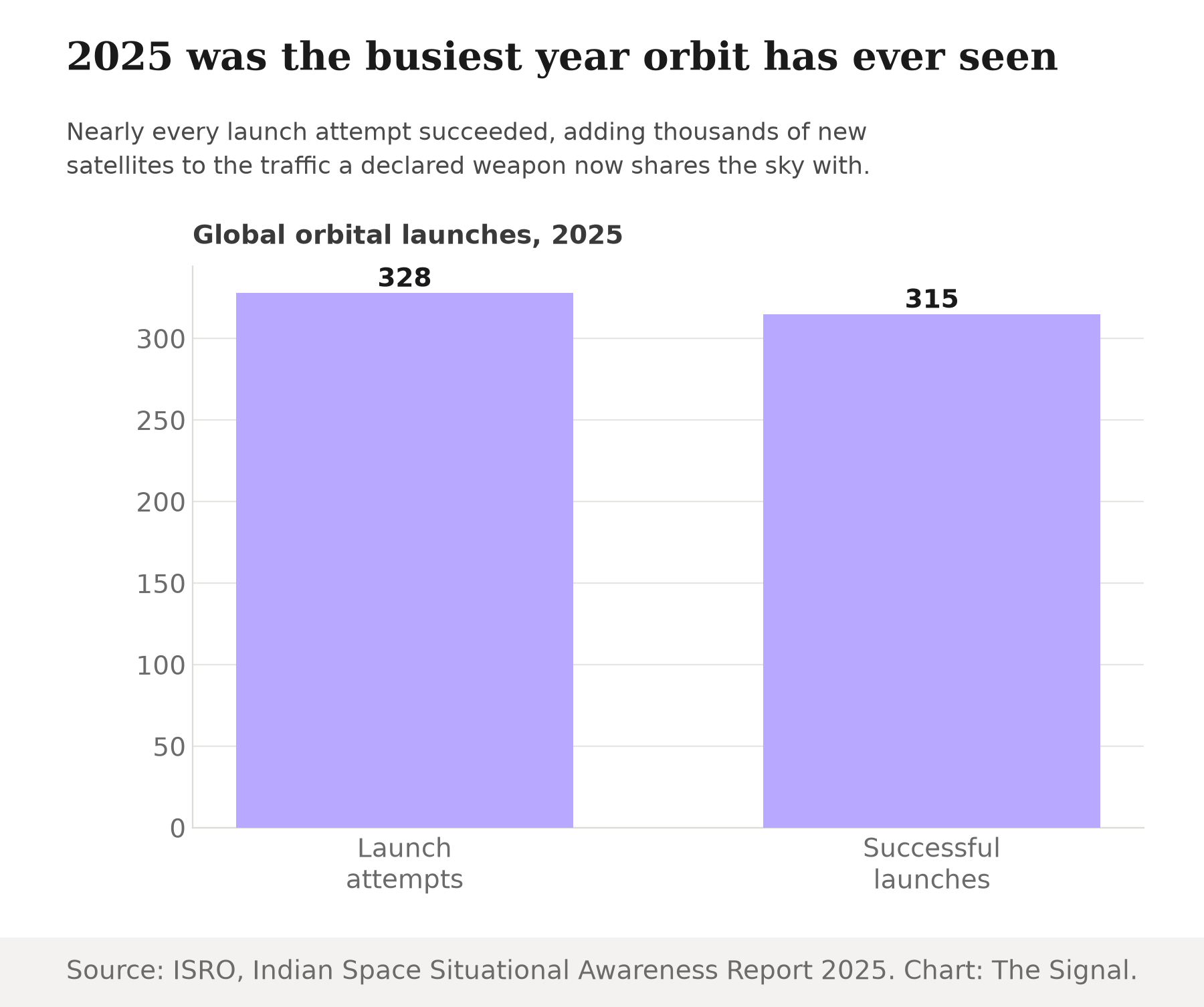
Traffic is still climbing into that congestion. ISRO's Indian Space Situational Awareness Report 2025 recorded 315 of 328 global launch attempts succeeding that year, placing 4,198 known operational satellites in orbit, a record for a single year.
One company alone is adding to that count faster than most countries can. The FCC authorized SpaceX in January 2026 to fly an additional 7,500 Gen2 Starlink satellites, bringing its total authorized constellation to 15,000: more than three times the 4,198 satellites the entire world placed in orbit in 2025's record year. A weapon confirmed to exist in this traffic is entering the busiest intersection space has ever had, not an empty range.
What a weapon actually leaves behind
The risk a confirmed space weapon adds is not hypothetical, because the world has already run the experiment twice. Russia's November 2021 anti-satellite missile test on Cosmos 1408 generated more than 1,500 pieces of trackable orbital debris, according to the US Office of Space Commerce. China's January 2007 test, which destroyed its Fengyun-1C weather satellite, created more than 1,000 pieces of debris large enough to track from Earth, per the Arms Control Association. Neither debris field has cleared. Both are still up there, five and nineteen years on, sharing lanes with working satellites.
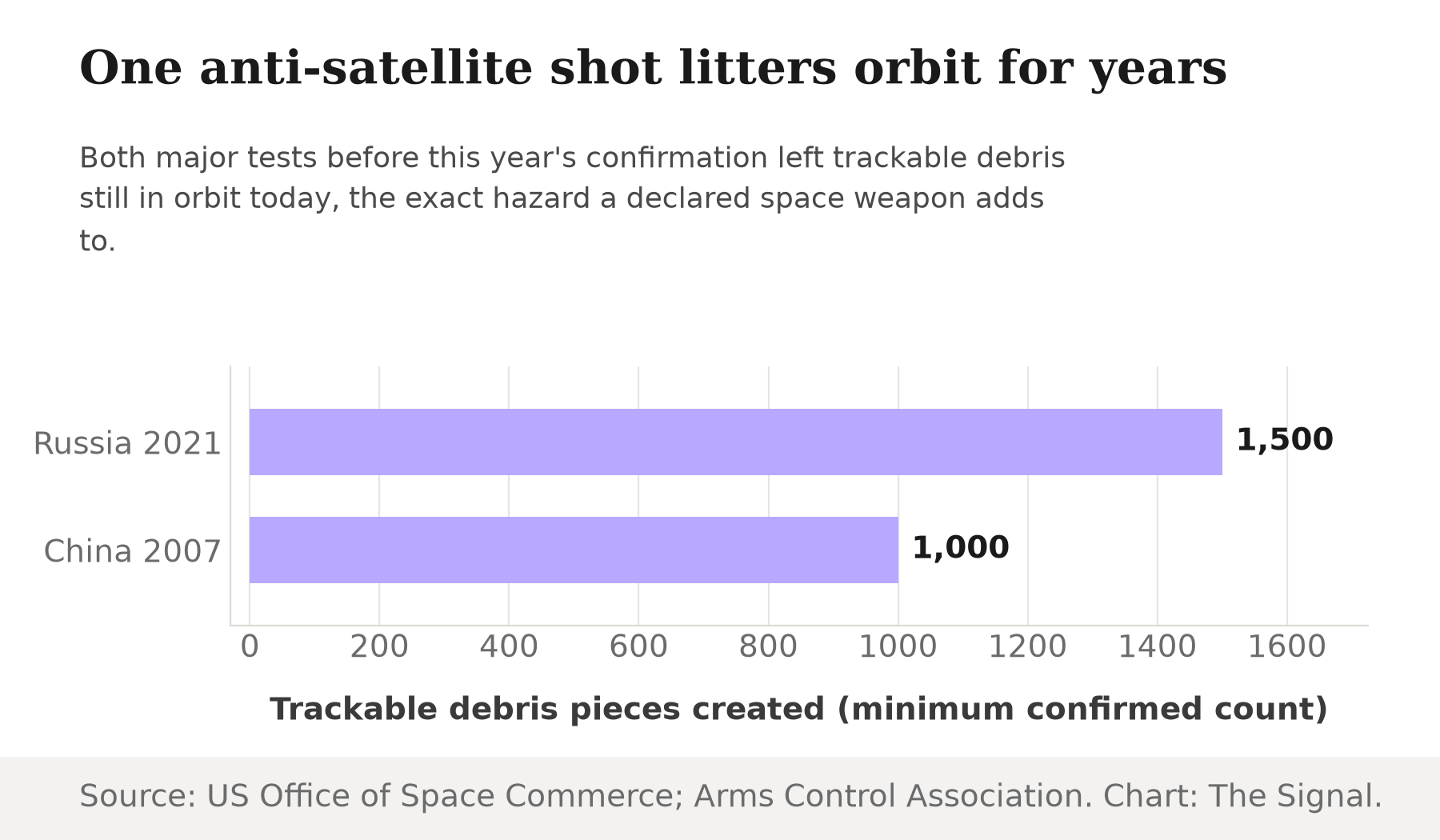
That is the mechanism the confirmation makes newly relevant. An officially acknowledged space control weapon is, by definition, a system built to disable or destroy something in orbit. Every time such a system is used, or even tested, the debris outcome above is the baseline, not the worst case. The more crowded the target environment gets, the more of that debris intersects something else.
Where India sits in this
India is not a bystander to this shift, and it is not without its own counterspace hand to watch. DRDO's Mission Shakti, carried out on 27 March 2019, used a direct-ascent hit-to-kill missile to destroy an orbiting Indian satellite in Low Earth Orbit, making India the fourth nation in the world with a demonstrated capability to defend its assets in outer space, per the Ministry of Defence. That history puts New Delhi's interest in this declaration on a different footing than a purely defensive one: it is watching a fellow tested counterspace power formalize what India itself has only ever demonstrated once. The Ministry of Defence also confirmed India launched GSAT-7R, its heaviest communication satellite to date at approximately 4,400 kg, on 2 November 2025 to strengthen the Navy's space-based communications and maritime domain awareness. A dedicated military satellite of that scale is exactly the kind of asset an acknowledged counterspace weapon puts in a different risk category. It is no longer just vulnerable to accidental collision in a crowded orbit; once major powers treat orbital weapons as declared, usable tools of state power rather than deniable programs, it becomes a plausible target in its own right. New Delhi did not build GSAT-7R to sit out an arms race it now has more reason to watch closely.
The honest objection
The strongest case against treating this as a turning point is that nothing operationally changed. Congress had already funded the Space Force at $26 billion for fiscal year 2026, matching the administration's full request, money that assumes exactly this kind of capability was already being built before Meink ever spoke. Every serious tracker of the field had already concluded the US, Russia and China all field counterspace weapons. On this view, a speech is a government catching up, rhetorically, to a reality everyone else had already priced in, not a policy shift.
That case understates what public confirmation actually does. Deterrence and arms control both run on declared capability, not assumed capability. A treaty negotiation, a hotline protocol, or a public red line only works against a capability a government has admitted exists. By naming the weapon, Washington has handed every other spacefaring power a fact it can now respond to, cite, or match on the record, where before it could only speculate. The funding proves the capability was already real. The speech is what makes it a fact other governments have to act on.
The Signal
The United States did not build a new weapon on September 14, 2026. It retired a decades-old policy of never confirming one. That is the rarer event: nations spend real effort maintaining strategic ambiguity precisely because giving it up narrows their options and hands rivals a data point. Watch what Russia and China do next, not whether they build similar weapons, since by the Secure World Foundation's own accounting they already have, but whether either follows Washington's lead and confirms it publicly. If they do, orbital weapons move from an open secret to an acknowledged fact of international life, with all the treaty and deterrence consequences that implies. Staying silent, on the other hand, would mean the US has simply given up ambiguity's cover for nothing. Either way, the debris fields from 2007 and 2021 are still up there, waiting to see how much company they get.
Reporting basis: Air Force Secretary Troy Meink's confirmation of on-orbit Space Force weapons is per DefenseScoop's report of his September 14, 2026 keynote remarks. The Outer Space Treaty's signature and entry-into-force dates are from the UN Office for Outer Space Affairs, and Article IV's text is from the treaty's full text, also hosted by UNOOSA. Orbital object and functioning-satellite counts are from the European Space Agency's Space Debris Office, DISCOSweb's July 2026 statistics. The 2025 global launch and satellite-placement figures are from ISRO's Indian Space Situational Awareness Report 2025. The assessment that the US, Russia and China hold the most significant counterspace arsenals is per Breaking Defense's report on the Secure World Foundation's 2026 Global Counterspace Capabilities report. The Space Force's fiscal 2026 budget figure is per SpaceNews' report on the defense appropriations bill. The debris counts from Russia's 2021 test and China's 2007 test are from the US Office of Space Commerce and the Arms Control Association respectively, each a single-source figure. India's GSAT-7R launch details are from the Ministry of Defence's press release via the Press Information Bureau, and the Mission Shakti test details and India's fourth-nation status are from a separate Ministry of Defence release via the Press Information Bureau. The Starlink constellation authorization is from the FCC's public order. The comparison of Starlink's authorized total against 2025's global satellite count, and the 58-year span since the treaty's entry into force, are The Signal's calculations from those figures.