India opens the 18th BRICS Summit in New Delhi on 12 and 13 September 2026, its fourth time chairing the bloc after 2012, 2016 and 2021. The story going into the summit is the joint declaration itself: as of 10 September 2026, Kremlin spokesman Dmitry Peskov said differences between Iran and the UAE were having a "negative impact" on drafting the text, and negotiators were still working to find language both sides could accept. That is a real story: a bloc that keeps admitting new members is struggling to get its existing ones to agree on a single paragraph.
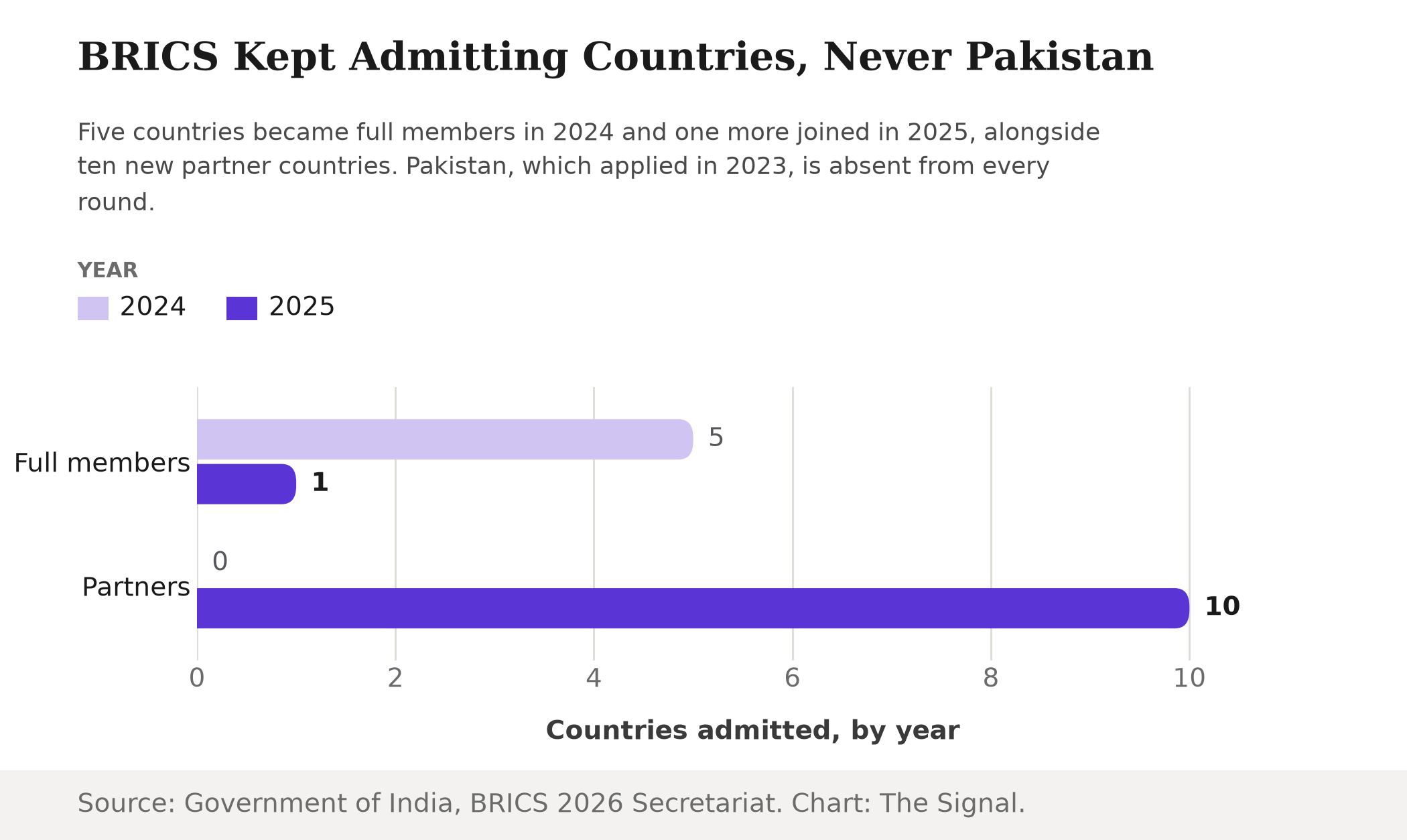
It is worth slowing down on that framing, because a second, quieter story sits underneath the summit host itself. BRICS's own presidency website counts five new full members admitted in 2024, then one more full member plus ten new partner countries in 2025, 16 countries in two years. Pakistan is not one of them, and has not been since it applied.
Everyone else got in
Pakistan had formally sought BRICS membership by November 2023. Since then, the bloc has not stood still. Egypt, Iran, the UAE, Saudi Arabia and Ethiopia became full members effective 1 January 2024, all five admitted together, all five having been invited only a few months before Pakistan's application became public. India itself said it had "wholeheartedly welcomed" the five. At its October 2024 summit in Kazan, BRICS also created a new "Partner Country" tier, a status short of full membership, for interested Global South states. By July 2025, BRICS's Rio de Janeiro Declaration confirmed Indonesia as a full member and named ten further countries, Belarus, Bolivia, Kazakhstan, Cuba, Nigeria, Malaysia, Thailand, Vietnam, Uganda and Uzbekistan, as partner countries. Pakistan appears on neither list.
BRICS admissions since Pakistan's application, by year and status.
| Year | Status | Countries |
|---|---|---|
| 2024 | Full members | Egypt, Iran, UAE, Saudi Arabia, Ethiopia |
| 2025 | Full member | Indonesia |
| 2025 | Partner countries | Belarus, Bolivia, Kazakhstan, Cuba, Nigeria, Malaysia, Thailand, Vietnam, Uganda, Uzbekistan |
Source: BRICS Kazan Declaration; BRICS Rio de Janeiro Declaration; NewsOnAir/Prasar Bharati.
An economy twice the size of a member's
Pakistan's absence is not explained by its economic weight. Pakistan's GDP was $371.7 billion in 2024. Ethiopia's GDP was $149.7 billion the same year, under half of Pakistan's, and Ethiopia has been a full BRICS member since January 2024. A bloc that had room for an economy less than half Pakistan's size had, on that measure alone, no obvious reason to leave Pakistan off the list.
Pakistan's economy outweighs a sitting BRICS member's.
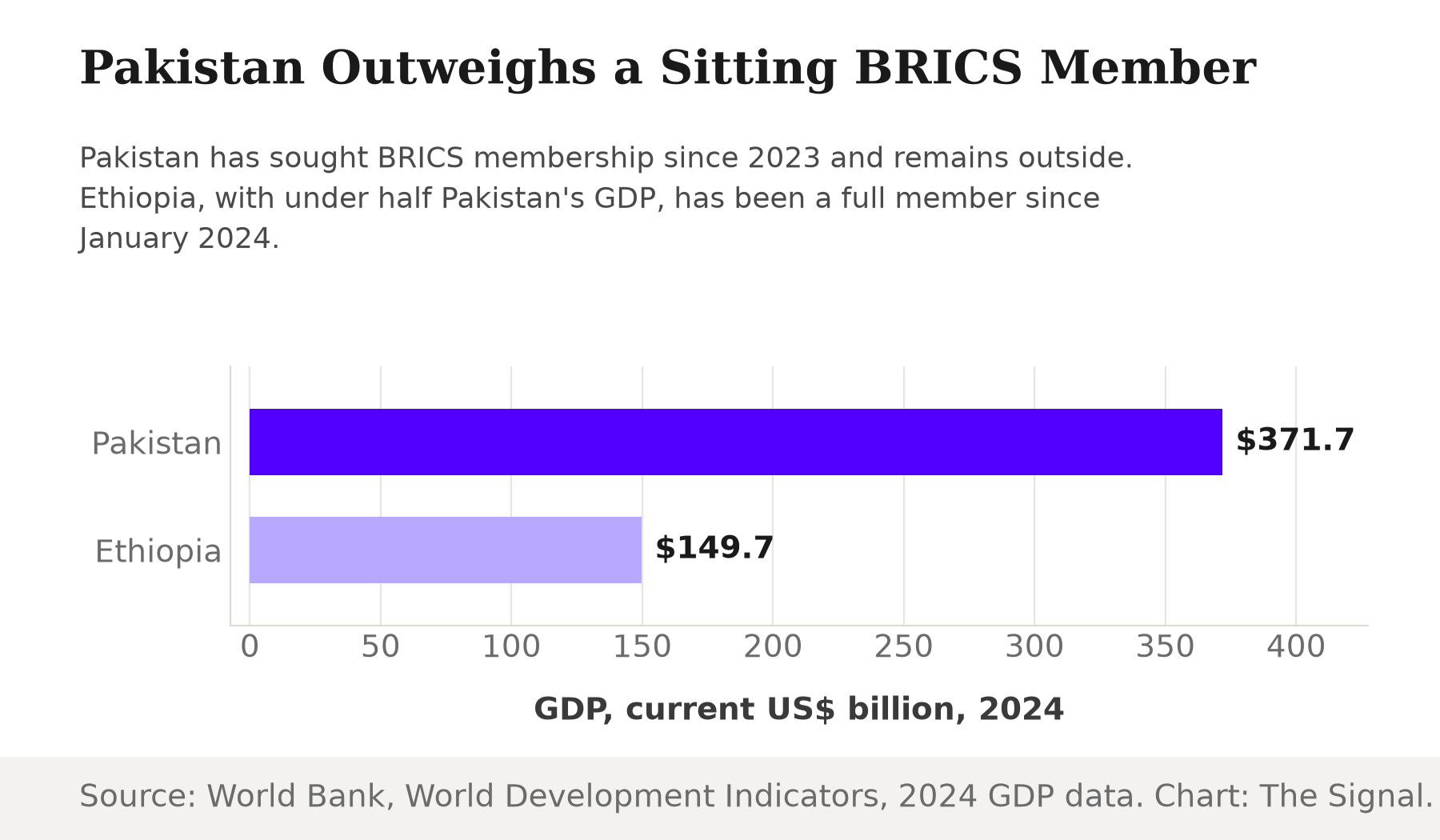
Source: World Bank, GDP (current US$), Pakistan, 2024; World Bank, GDP (current US$), Ethiopia, 2024.
Why Pakistan is missing
The mechanism that makes a single objection decisive is BRICS's own rulebook. BRICS's Johannesburg II Declaration states that the bloc's members "reached consensus on the guiding principles, standards, criteria and procedures of the BRICS expansion process", meaning expansion runs on agreement among existing members rather than a majority vote. In a consensus system, one holdout can stall a candidacy for as long as it withholds agreement, with no vote to overrule it.
Size is not the variable doing the work here. Al Jazeera reported in November 2023 that "Pakistan's case is particularly beset by Indian opposition, which could depend on the health of the India-China relationship". That reporting names India specifically, and ties Pakistan's prospects to a third relationship, India's own ties with China, rather than to anything about Pakistan's economy or candidacy on its own terms. It is a single account rather than an official Indian statement of position, and neither India nor Pakistan has put out a public tally of who supports or opposes the bid. On Pakistan's side, the application is still live: its Foreign Office said in January 2025 that "Pakistan is formally committed to our application to join BRICS. There is no change in our posture... There is no change in our policy", ruling out the alternative explanation that Islamabad itself let the bid lapse. What is not in dispute is the outcome: three years on, and 16 admissions later, Pakistan's application has produced no membership and no partner-country slot.
The honest objection
The strongest case against reading this as a targeted veto is that BRICS consensus is hard to reach even among countries already inside the bloc. The dispute over the 2026 joint declaration's wording, between two full members, Iran and the UAE, was still unresolved two days before the summit opened, months after both had a seat at the table. If agreement is this hard for members who already belong, a multi-year hold on a new applicant might just be business as usual for a bloc that moves slowly and argues often, not evidence that anyone is singling Pakistan out.
That case has real force, but it does not fit the shape of Pakistan's specific record. A joint declaration is redrafted every year and can slip by weeks. Pakistan's application has slipped by years, through two separate admission rounds that moved 16 other countries onto BRICS's membership or partner rolls, several with smaller economies and shorter diplomatic histories with the bloc, from outside to in. Slow consensus explains a delayed yes. It does not explain a yes that never arrives while the door keeps opening for everyone else who knocks.
The Signal
India chairs BRICS this week while presiding over the one membership file the bloc's own numbers show has not moved since Pakistan opened it in 2023. That is not a contradiction the summit has to resolve, chairs are not required to clear every applicant, but it is a fact the New Delhi Declaration will sit on top of without naming. Watch what happens after the summit closes: if a seventeenth country joins BRICS as a member or partner before Pakistan does, the file will look less like a queue and more like a wall. Pakistan does not need BRICS to grow. It needs one existing member to stop saying no.
Reporting basis: the new BRICS members and partner countries admitted in 2024 and 2025, and the aggregate count of 16 admissions, are per the Government of India's official BRICS 2026 presidency website, cross-checked against the BRICS Kazan and Rio de Janeiro declarations, the bloc's own primary texts, hosted by the University of Toronto's BRICS Information Centre. The January 2024 admission of Egypt, Iran, the UAE, Saudi Arabia and Ethiopia is per India's state broadcaster, Prasar Bharati. BRICS's consensus-based expansion procedure is per the Johannesburg II Declaration, hosted by South Africa's Department of International Relations and Cooperation. Pakistan's November 2023 application and the characterisation of Indian opposition to it are per a single Al Jazeera report, the only account in this piece naming who is behind the block, and no independent second source confirming that characterisation was available; Pakistan's own continued commitment to the application is per its Foreign Office, reported by Business Recorder. No official Indian government statement addressing Pakistan's candidacy specifically could be found and none is claimed here. The New Delhi summit dates and India's chairship history are from India's Press Information Bureau. The Iran-UAE dispute over the joint declaration is per a Reuters wire report carried by CNBC Africa. Pakistan's and Ethiopia's 2024 GDP figures are World Bank data. The 16-country total and the "less than half" GDP comparison are The Signal's calculations from those figures.