India's declared nuclear doctrine has not changed since the government adopted it in January 2003: No First Use, retaliation only after a nuclear attack lands, with an added reservation that a biological or chemical strike could also draw a nuclear response. Read only the doctrine and the story is restraint. A country that promises never to strike first, the argument goes, only needs as many warheads as it takes to guarantee a credible reply after absorbing the first blow, not an arsenal that keeps climbing.
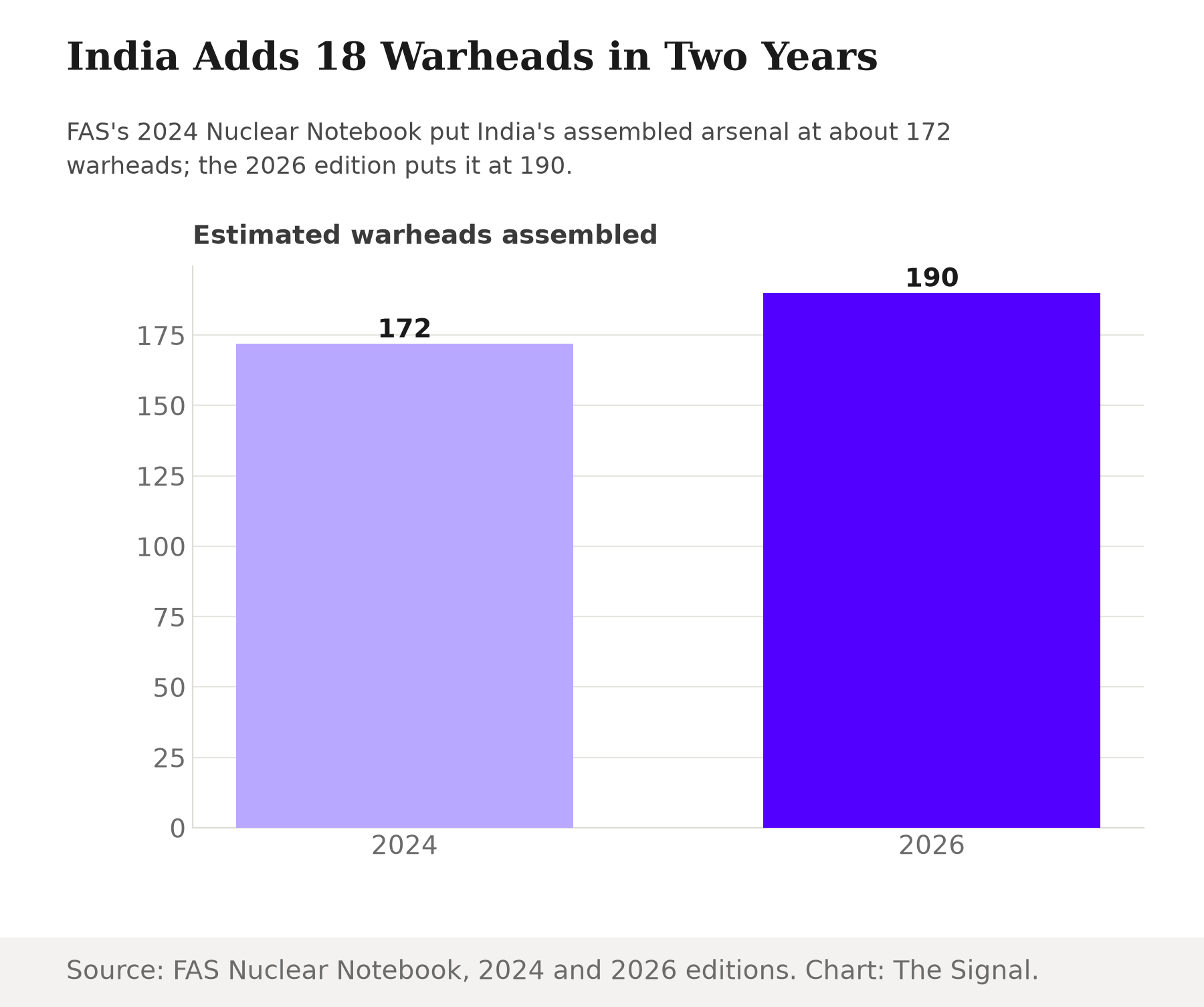
It is worth slowing down on that framing. The Federation of American Scientists' newest Nuclear Notebook, published in the Bulletin of the Atomic Scientists, estimates India has assembled around 190 nuclear warheads as of the start of 2026. Two years earlier, the FAS's 2024 edition put the figure closer to 172. That is a net gain of roughly 18 warheads in two years, from a country whose own doctrine describes the smallest force that does the job, not a growing one.
India's declared floor keeps moving upward.
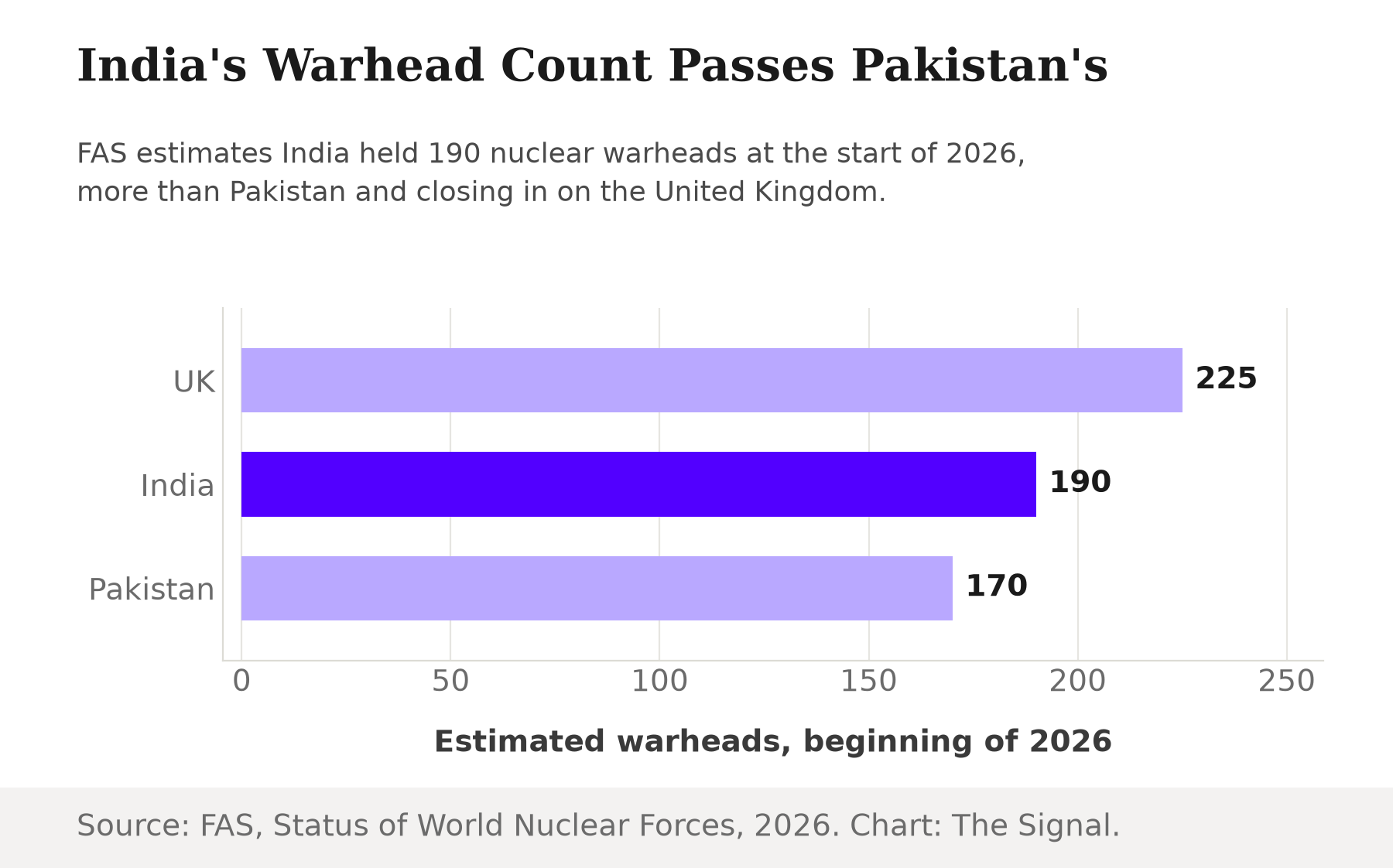
FAS's Status of World Nuclear Forces table lists India at 190 warheads as of the beginning of 2026, ahead of Pakistan's 170 and closing on the United Kingdom's 225. That single line reorders how the two arsenals are usually ranked against each other.
The lead is recent, not a longstanding gap. FAS's 2025 Nuclear Notebook on Pakistan put its stockpile at approximately 170 warheads, unchanged from its prior 2023 estimate, while India's own count rose from 172 to 190 across roughly that same window. Pakistan's total sat still while India's kept climbing, which is what actually produced the crossover, not a sudden Pakistani retreat. Widen the lens further and India's growth looks modest rather than alarming: FAS's 2026 Nuclear Notebook on China puts that country's arsenal at approximately 620 warheads, more than three times India's total and a reminder that China, not Pakistan, is the comparison India's own doctrine planners are more likely to be counting against.
What the extra warheads are for
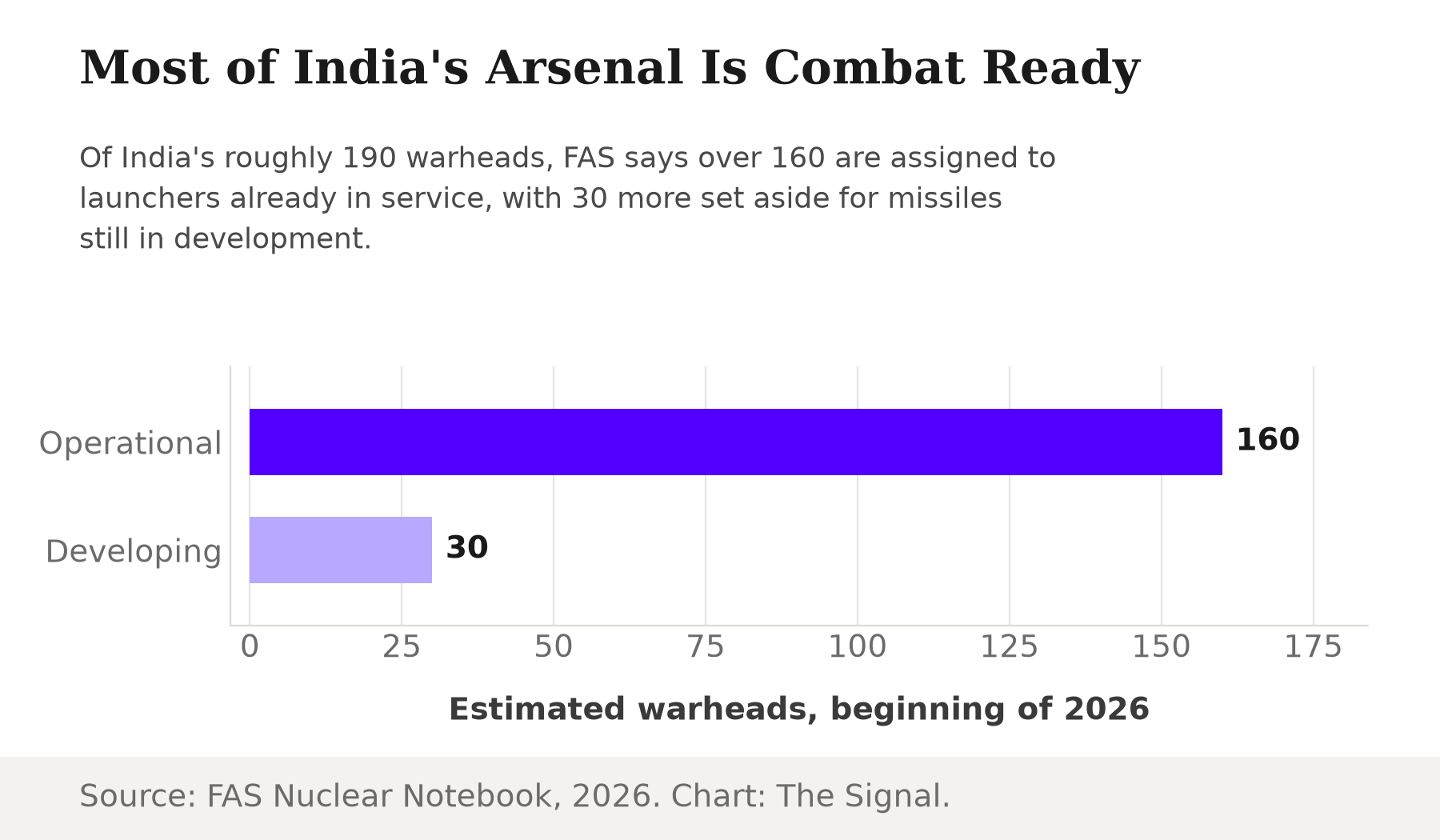
A bigger number only matters if the warheads have somewhere to go, and FAS says most of India's already do. Over 160 of India's warheads are assigned to launchers already in service, with 30 more set aside for missiles still in development. That is not a stockpile sitting in reserve. It is a force that is substantially fielded now, with a further slice already earmarked for hardware that has not entered service yet.
There is a ceiling on how far this can run without new fissile-material production. FAS estimates India has produced approximately 730 kilograms of weapon-grade plutonium, plus or minus about 170 kilograms, theoretically enough for somewhere between 140 and 225 warheads. At 190 assembled, India already sits comfortably inside that range, past its midpoint and within reach of its own upper bound. The 2026 count is not evidence of a runaway program bumping into a hard wall. It is evidence that India is spending down a stockpile it has been building for years, and that further sustained growth on this trajectory will eventually need more plutonium behind it, not just more assembly.
The delivery systems are expanding too
The warhead count is only half of what changed. India commissioned its third indigenously built nuclear-powered ballistic-missile submarine, the INS Aridhaman, on April 3, 2026, carrying eight missile tubes, twice the number on either of its first two boats. A submarine that can carry twice as many missiles as its predecessors is not a like-for-like replacement. It roughly doubles the missile capacity of a single boat in the fleet that gives India's arsenal its most survivable leg, the one meant to guarantee a retaliatory strike even if the rest of the force is destroyed first.
The land-based leg kept pace on its own schedule. India's MIRV-capable Agni-V intermediate-range missile, able to carry multiple warheads on a single missile, has now been flight-tested three years running, most recently on May 8, 2026. Three consecutive annual tests reads less like periodic maintenance of an existing system and more like a program still being pushed toward full operational status.
None of this is India's word alone. SIPRI's 2026 Yearbook independently reports that India again slightly expanded its arsenal in 2025 and continued developing new delivery systems, corroborating the FAS trend line from a separate institute. SIPRI goes a step further, saying China and India may now occasionally mount a small number of warheads on missiles even during peacetime, a hedged but pointed departure from the historic practice of storing warheads separately from the missiles meant to carry them.
| India's declared posture, by the numbers | Figure | Source |
|---|---|---|
| Doctrine adopted | No First Use, January 2003, with a reserved right to nuclear retaliation for a biological or chemical attack | Arms Control Association |
| Weapon-grade plutonium produced | Approximately 730 kg, plus or minus 170 kg, enough for 140 to 225 warheads | FAS Nuclear Notebook, 2026 |
| Newest SSBN | INS Aridhaman (S4), commissioned April 3, 2026, with 8 missile tubes | FAS Nuclear Notebook, 2026 |
| Agni-V, latest test | Third consecutive year tested, most recently May 8, 2026 | FAS Nuclear Notebook, 2026 |
| Global backdrop | Nine nuclear-armed states held roughly 12,187 warheads combined at the start of 2026 | FAS, Status of World Nuclear Forces |
The honest objection
The government's own case is not unreasonable on its face. No First Use is a promise about when India would use a weapon, not about how many it keeps, and a doctrine built around surviving a first strike arguably needs more warheads as delivery systems modernize and rivals harden their own forces, not fewer. On that reading, a bigger submarine, a more capable missile, and a larger stockpile are simply what a credible second-strike posture costs to maintain as the technology around it moves on, not a departure from restraint.
That case explains modernization. It does not obviously explain readiness. A force built only to survive a first strike and retaliate does not need warheads mounted on missiles in ordinary times, which is exactly the practice SIPRI says may now occasionally be happening. Paired with two straight years of measured warhead growth, a submarine that doubles its missile capacity, and a missile tested every year for three years running, the pattern looks less like a floor being maintained and more like a capability being built out on every leg at once.
The Signal
The doctrine and the hardware are answering two different questions. No First Use tells a reader when India says it would use a weapon. The warhead count, the submarine tubes, and the annual missile tests tell a reader what India is actually building toward, and on FAS's newest count that number now sits ahead of Pakistan's and within reach of Britain's. The next edition is the test: if the count levels off near the middle of India's own plutonium range, this was a bounded catch-up. If it keeps climbing toward the upper end of that range, toward the 225 warheads that separate India from the United Kingdom today, the restraint in the doctrine and the trajectory of the arsenal will have stopped describing the same country. A declared floor that keeps rising is not a floor. It is a target nobody has named yet.
Reporting basis: the 2026 warhead estimate, the operational and plutonium breakdowns, the INS Aridhaman commissioning, and the Agni-V test history are all from the Federation of American Scientists' 2026 India Nuclear Notebook, published in the Bulletin of the Atomic Scientists. The 2024 comparison figure is from FAS's earlier, separate 2024 Nuclear Notebook edition on India. The India-Pakistan-UK comparison and the nine-country global total are from FAS's Status of World Nuclear Forces table, a distinct FAS publication from the Notebook. India's declared doctrine is per the Arms Control Association's India factsheet, compiling the government's January 2003 Cabinet Committee on Security statement. The independent corroboration of continued 2025 growth and the note on peacetime-mated warheads are from SIPRI's 2026 Yearbook press release, a separate research institute from FAS. The eighteen-warhead two-year change is The Signal's calculation from the two FAS Nuclear Notebook editions. Pakistan's flat 170-warhead count since 2023 is from FAS's 2025 Nuclear Notebook edition on Pakistan, and China's approximately 620-warhead total is from FAS's 2026 Nuclear Notebook edition on China, both separate country-specific editions of the same Nuclear Notebook series used for India.