On September 9, 2026, Sens. Ron Wyden and Sheldon Whitehouse and Rep. Pat Harrigan sent a letter to Commerce Secretary Howard Lutnick asking the Bureau of Industry and Security to add three India based firms, Sunkissed Organic Farms (formerly Appin), BellTroX and CyberRoot, to the Entity List. The letter states that several India based cyber mercenary groups have spent more than fifteen years conducting targeted espionage against US citizens, businesses and the lawyers representing them. Read as a stand alone story, it is a straightforward accountability push: three named firms, a documented pattern, a bipartisan ask.
It is worth slowing down on the timing. The Entity List is the same export control tool the Commerce Department used earlier for the opposite purpose: taking Indian names off, not adding them. Strip that detail out and the letter reads like routine congressional oversight. Put it back in and it reads like a live argument, inside the US government, over what the list is even for.
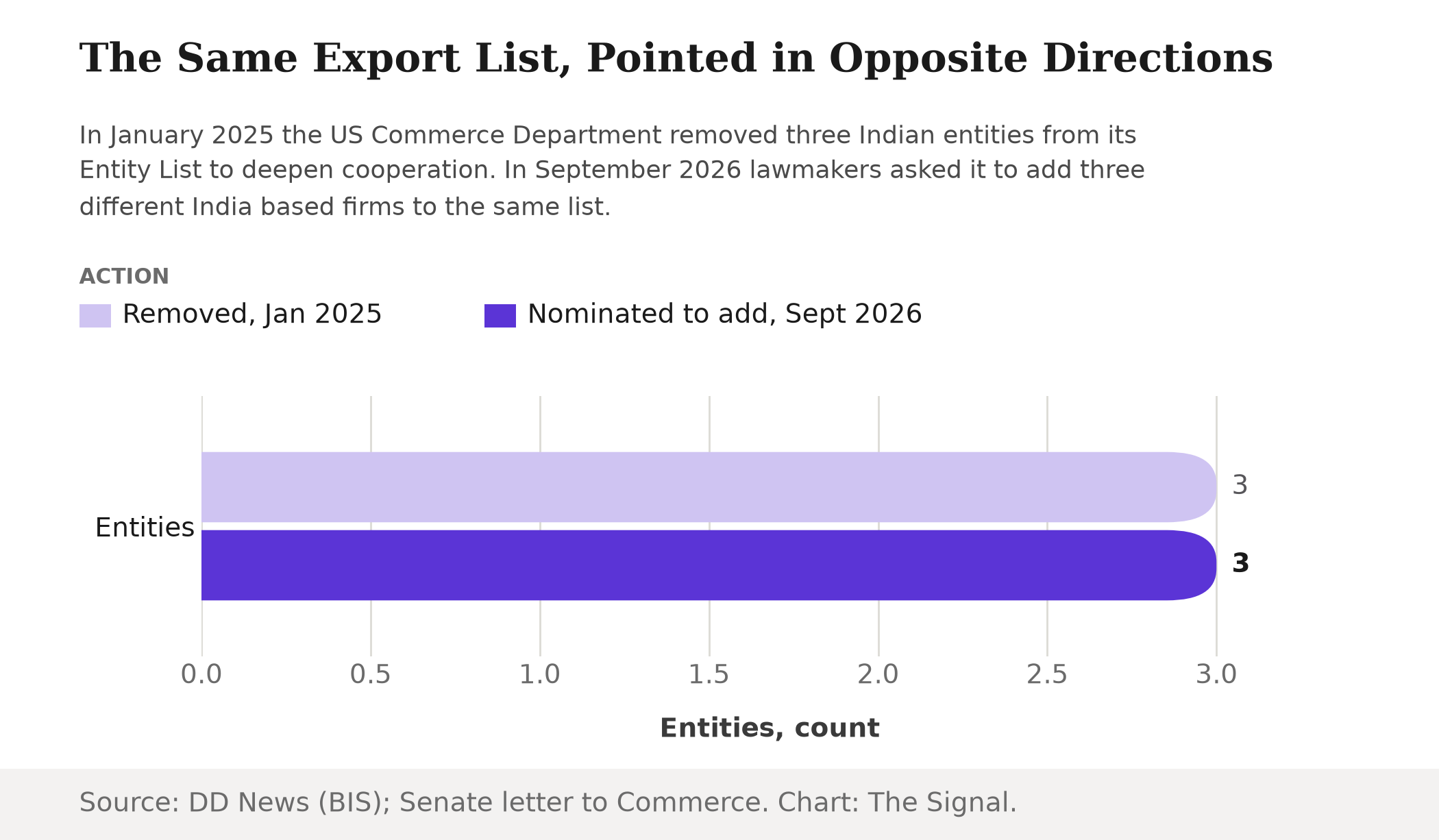
Washington used the same export blacklist to reward and, now, to punish Indian entities within about twenty months.
In January 2025, BIS removed three Indian nuclear research entities, including the Bhabha Atomic Research Centre, from the Entity List, saying the move would support shared energy security needs and joint efforts in science and technology between India and the US. About twenty months later, on September 9, 2026, three senators asked Commerce to add three different India based firms to that same list (our calculation, from the two dated actions). The count is identical: three entities off, three firms proposed on. The list itself has not changed function. What changed is which India based names Washington wants on it.
What the letter actually alleges
The senators' letter, as reported, goes well beyond a generic hacking complaint. Nextgov/FCW reports, citing the letter, that the three firms' targets included private equity firms, pharmaceutical companies and more than 1,000 attorneys across major US law firms, allegedly to manipulate ongoing litigation. That is a specific claim: not opportunistic cybercrime, but hacking aimed at tilting the outcome of US legal disputes. TechCrunch reports that the letter also states the firms operated at the behest of the Qatari government, which would make this a foreign client relationship, not a freelance operation. Both claims, if BIS accepts them, would justify an Entity List addition on their own; together they describe a commercial hacking operation with paying clients and a specific legal target list, run out of India for over a decade by the letter's own account. As of September 9, 2026, neither the three firms nor Qatar's government, which the letter accuses of directing them, had responded to a request for comment on the letter.
Not a new accusation
None of this is the senators' discovery. A 2020 Citizen Lab investigation, Dark Basin, attributed a hack for hire operation run out of India with high confidence to BellTroX InfoTech Services, one of the three firms now named in the letter. Citizen Lab found the group had targeted thousands of individuals and hundreds of institutions on six continents. That investigation is six years old. The gap between a well documented 2020 finding and a 2026 legislative ask is itself a data point: naming a firm in a well documented investigation does not automatically move Washington to act, especially against firms based in a country the US has spent the same period courting as a security and trade partner.
Reporting on this territory has also faced resistance closer to home. An Indian court's injunction forced Reuters to take down its investigation into Appin's hack for hire operations for close to a year, ruling the reporting derogatory to the entire Indian nation, until the order was vacated on October 26, 2024. Appin is the earlier name of Sunkissed Organic Farms, the first firm listed in the senators' letter. So the record here includes not just an alleged hacking campaign but a documented, court ordered effort to suppress independent reporting on it, lifted less than two years before Congress moved.
A trade relationship already under strain
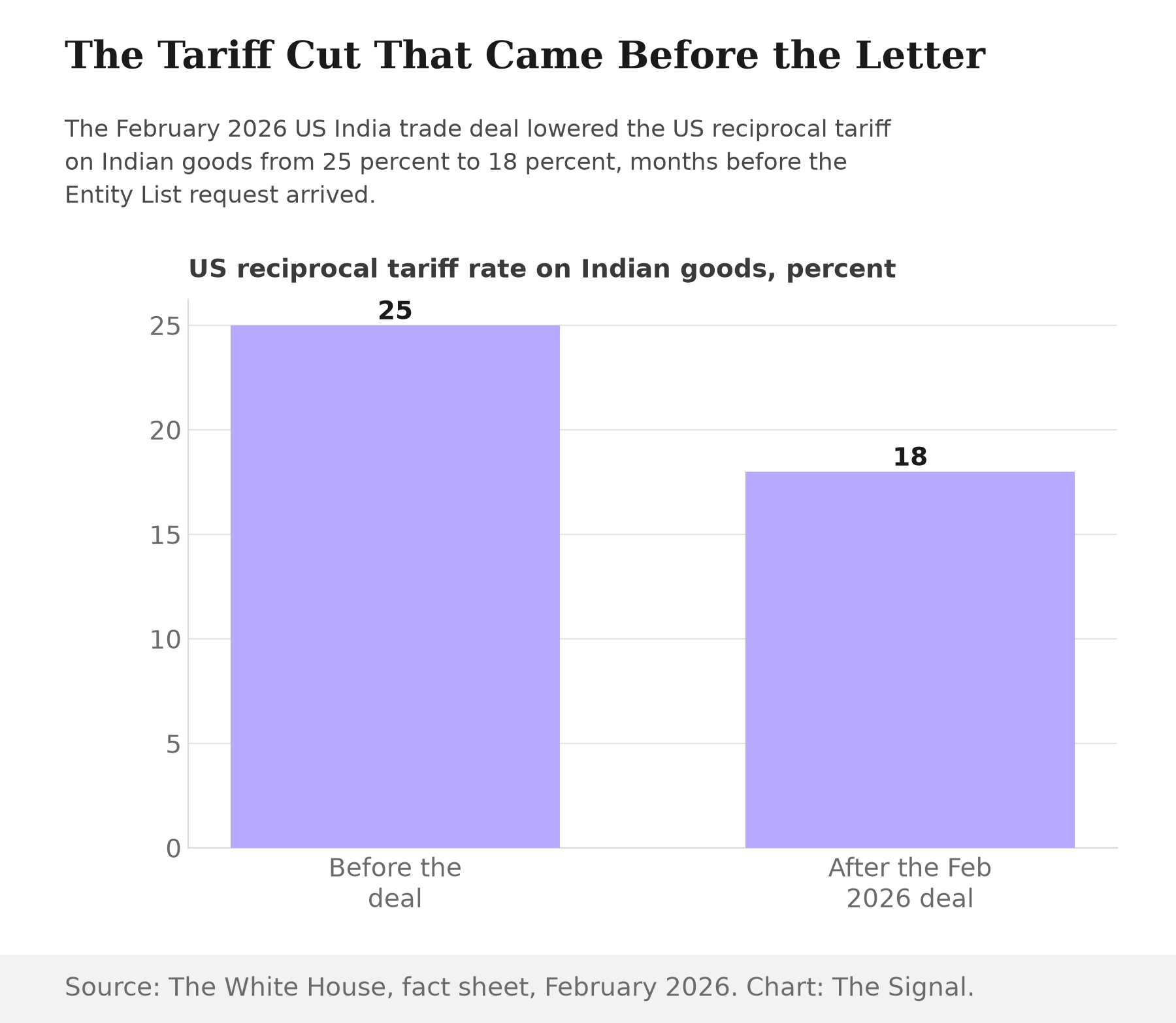
The letter also lands inside an unresolved negotiation. Under the February 2026 US India trade deal, Washington agreed to lower its reciprocal tariff on Indian goods from 25 percent to 18 percent, a concession, not a final settlement. As of September 4, 2026, Commerce Minister Piyush Goyal said India would only finalize the pending bilateral trade agreement once Washington offers tariff rates better than those given to Vietnam and Bangladesh.
On at least one tariff line, India already has what Goyal is asking for. Effective July 24, 2026, the US Trade Representative set a preferential 10 percent tariff, under a separate Section 301 action targeting forced-labor goods, for India and Bangladesh alongside fifteen other economies. Vietnam fell outside that list and pays the higher 12.5 percent rate charged to the remaining economies under the same action. That is a narrower comparison than the broad reciprocal tariff Goyal is negotiating, and it settles nothing about the wider talks, but it shows India is not uniformly behind Vietnam on the tariff lines the two countries currently pay.
Five days after Goyal's remarks, the Entity List letter arrived. Nothing in the record ties the two directly. But any government weighing an Entity List addition against three India based firms is now doing so while its own trade negotiators are still haggling over rates with New Delhi, and any Indian trade negotiator reading the letter has one more variable to price in.
The honest objection
The strongest case against reading this as tension is that the two tracks are genuinely separate, and treating them as linked risks excusing the underlying allegation. Export control decisions on named firms accused of hacking US law firms and private equity clients should rest on the evidence against those firms, not on the state of an unrelated tariff negotiation. The senators' letter cites a specific, years long pattern, not a vague grievance, and BellTroX already carries an independent 2020 finding from Citizen Lab. On this view, the trade deal's timing is coincidental, and the real story is simply that Congress is finally catching up to what researchers documented years ago.
That case is real, and it deserves to be taken at face value. But it does not erase the fact that the Commerce Department itself removed three Indian entities from the Entity List in January 2025, explicitly framing that removal around cooperation rather than merit alone. A tool used once to signal goodwill does not stop being a signal the second time it is invoked against the same country's firms, whatever the underlying facts turn out to be. The letter asks Commerce to be a law enforcement instrument, but the list's own recent history shows the agency has used it as a diplomatic one too.
The Signal
A congressional letter is not an Entity List addition. BIS decides those on its own timeline, and nothing here obligates the agency to act by any date. But the senators' letter is now on the record, aimed at three specific India based firms with a documented history stretching back to the 2020 Dark Basin findings. It arrives five days after India's own commerce minister set a public condition for finishing the trade deal. Watch what BIS does next, not what the senators wrote: if Commerce adds the three firms while trade talks continue, the agency will have shown the Entity List still functions as pure enforcement even when it complicates an active negotiation. Months of inaction on the request, on the other hand, would say just as much about how much weight a bipartisan letter carries against a deal Washington still wants to close.
Reporting basis: the senators' letter to Commerce Secretary Howard Lutnick, naming Sunkissed Organic Farms, BellTroX and CyberRoot, is per the letter as published by Sens. Wyden's office. The claim that the firms targeted private equity firms, pharmaceutical companies and more than 1,000 attorneys is per Nextgov/FCW's reporting of that letter; the claim that the firms operated at the behest of the Qatari government is per TechCrunch's separate reporting of the same letter. That neither the firms nor Qatar's government had responded to a request for comment as of September 9, 2026 is per CyberScoop's reporting. BellTroX's earlier exposure is from Citizen Lab's 2020 Dark Basin investigation, an independent origin from the 2026 letter. The January 2025 removal of three Indian nuclear entities from the Entity List, including the Bhabha Atomic Research Centre, is per India's DD News, citing BIS. The Reuters injunction history is per MuckRock's reporting. The tariff reduction is per a White House fact sheet, and Commerce Minister Piyush Goyal's September 2026 remarks are per the Free Press Journal. The July 2026 forced-labor tariff rates are per the US Trade Representative's Federal Register notice for India and Bangladesh's 10 percent rate, and per Global Trade Alert, a University of St. Gallen trade-policy monitoring initiative, for Vietnam's 12.5 percent rate. The twenty month interval between the January 2025 removal and the September 2026 letter is The Signal's calculation from those two dated actions.