India's fighter procurement machine looks, on paper, like it is finally working. In September 2025, the Ministry of Defence signed a contract with Hindustan Aeronautics Limited for 97 LCA Mk1A fighters worth over Rs 62,370 crore, deliveries starting 2027-28. Months earlier, the Defence Minister had approved an AMCA Programme Execution Model opening India's fifth-generation stealth fighter to competitive bids from private industry for the first time, after the Cabinet Committee on Security approved five AMCA prototypes at an estimated development cost of Rs 15,000 crore. Read only those headlines and India's air power looks like it is compounding.
The IAF's basic trainer has taken longer to reach first flight than the stealth fighter took to reach a signed execution plan.
It is worth putting a number next to that impression. The aircraft a new IAF pilot flies first, before any fighter, is not the LCA or the AMCA. It is the HTT-40, a basic trainer the government approved for development in 2011. As of October 2025, nearly 15 years later, the HTT-40 was still not inducted into service, and HAL's own promise to deliver the first aircraft by September 2025 had already slipped because Honeywell could not supply engines on time. The most advanced thing India is building moved from approval to an execution model in about a year. The simplest thing it is building has taken a decade and a half and still has not landed a single trainer with a squadron.
The trainer at the bottom of the pipeline
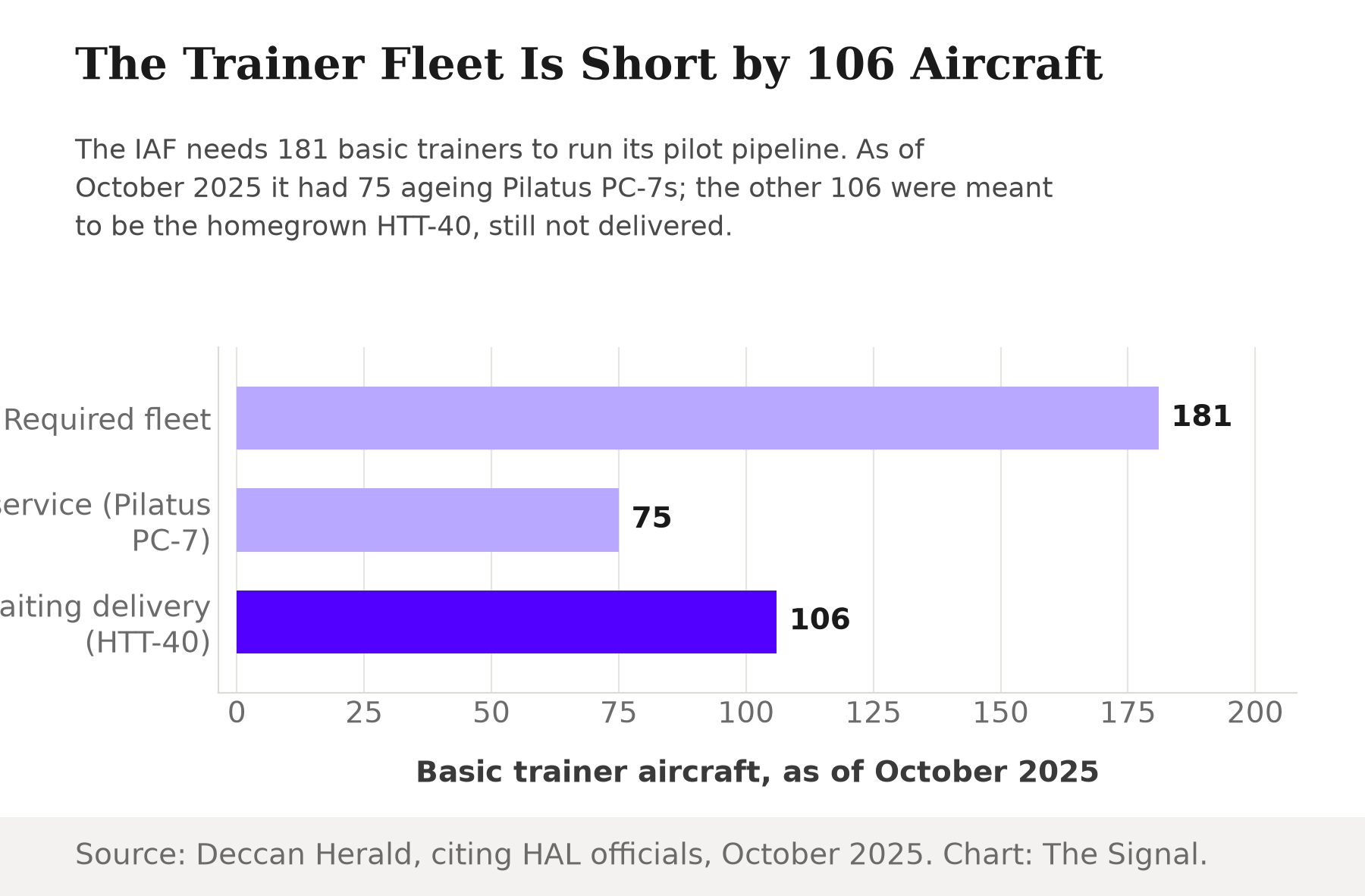
The scale of the shortfall is concrete. The IAF requires 181 basic trainer aircraft but as of October 2025 had only 75 Pilatus PC-7s in service, with the remaining 106 meant to be filled by the HTT-40. In March 2023, the Ministry of Defence signed a contract with HAL for 70 HTT-40s at over Rs 6,800 crore, to be supplied over six years with about 56 percent indigenous content. Two and a half years after that contract, the aircraft had flown but had not been handed over. This is not a program that stalled only in 2025. It has been late at every stage since its inception.
The CAG's own audit confirms the pattern is structural, not one missed deadline. Report No. 15 of 2024, presented in Parliament, found that induction of 106 Basic Trainer Aircraft and 73 Intermediate Jet Trainers, both meant to be indigenously developed by HAL, could not materialise because of certification delays and design issues. That finding predates the HTT-40's first flight by roughly ten months, and describes exactly the aircraft category still short today.
The fighter side moves faster, and still slips
The LCA Mk1A fighter contract is more than nine times the size of the HTT-40 trainer contract.
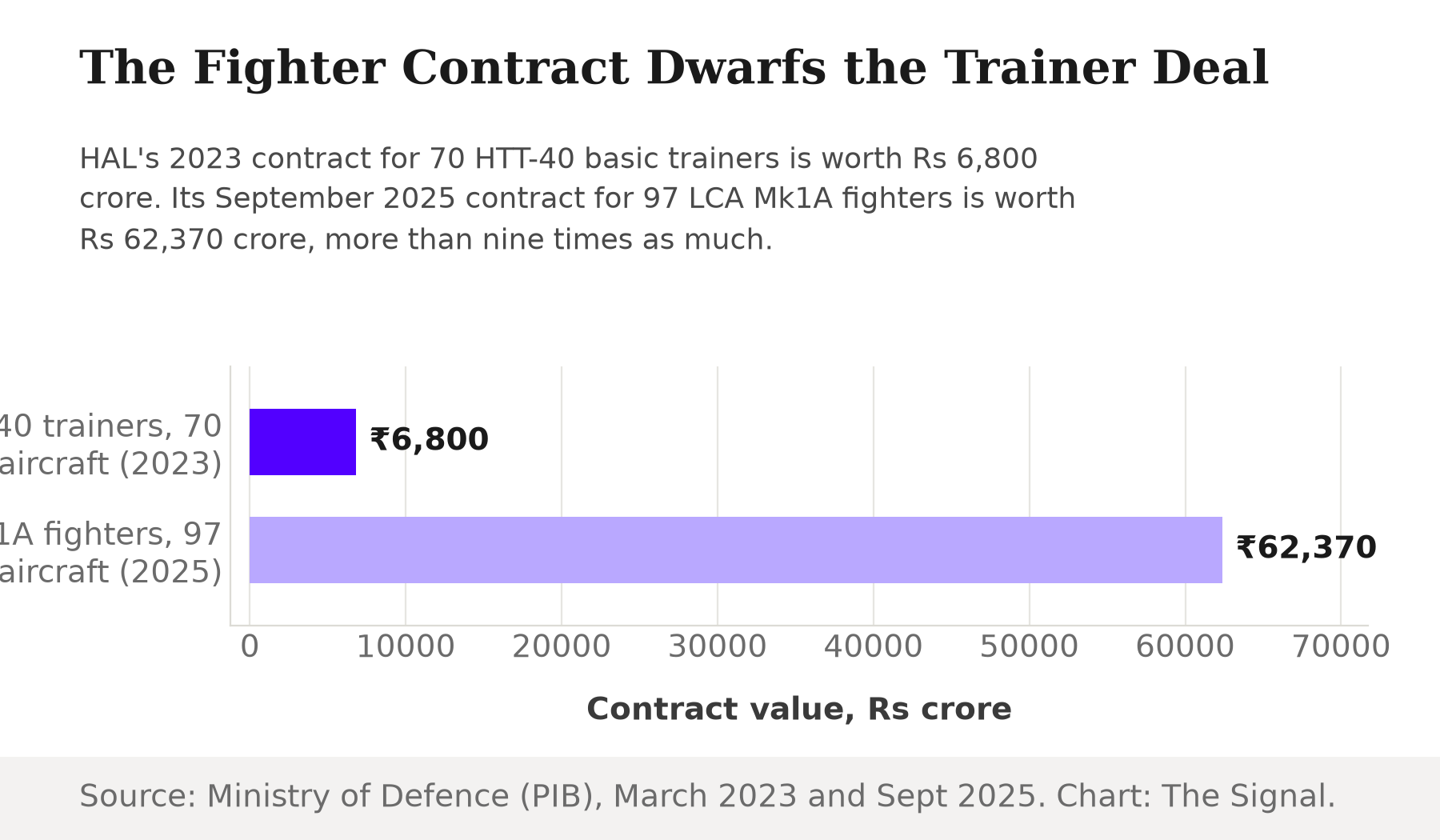
Money and attention both flow toward the fighter end of the fleet: nine times as much for barely more aircraft. Even the fighter side is not immune to the same failure mode that dogs the trainer, though. The IAF's earlier 83-aircraft LCA Mk1A contract, worth Rs 45,696 crore, was due to begin deliveries from March 2024 but did not, because General Electric failed to supply F404 engines on time. The Chief of the Air Staff, Air Chief Marshal A P Singh, put it bluntly at the CII annual business summit: not a single major defence project he could think of had been completed on time.
That is the honest complication. A foreign engine supplier failing to deliver, General Electric for the earlier LCA Mk1A order, Honeywell for the HTT-40, is the mechanical cause of both delays. On that reading, India's problem is a single-point dependency on foreign propulsion, not special neglect of trainers. But the comparison does not hold once you weigh what each program can absorb. A fighter program with Rs 62,370 crore in committed funding and a squadron shortage driving political urgency keeps moving despite an engine delay. A trainer program with a tenth of that money and none of the attention does not: its 2011 approval date means it has now missed not one supplier's schedule but a decade and a half of its own, as the still-pending induction as of October 2025 shows.
Why the bottom of the pipeline matters at the top
The fighter fleet fell below its own sanctioned benchmark in the same year the trainer gap persisted.
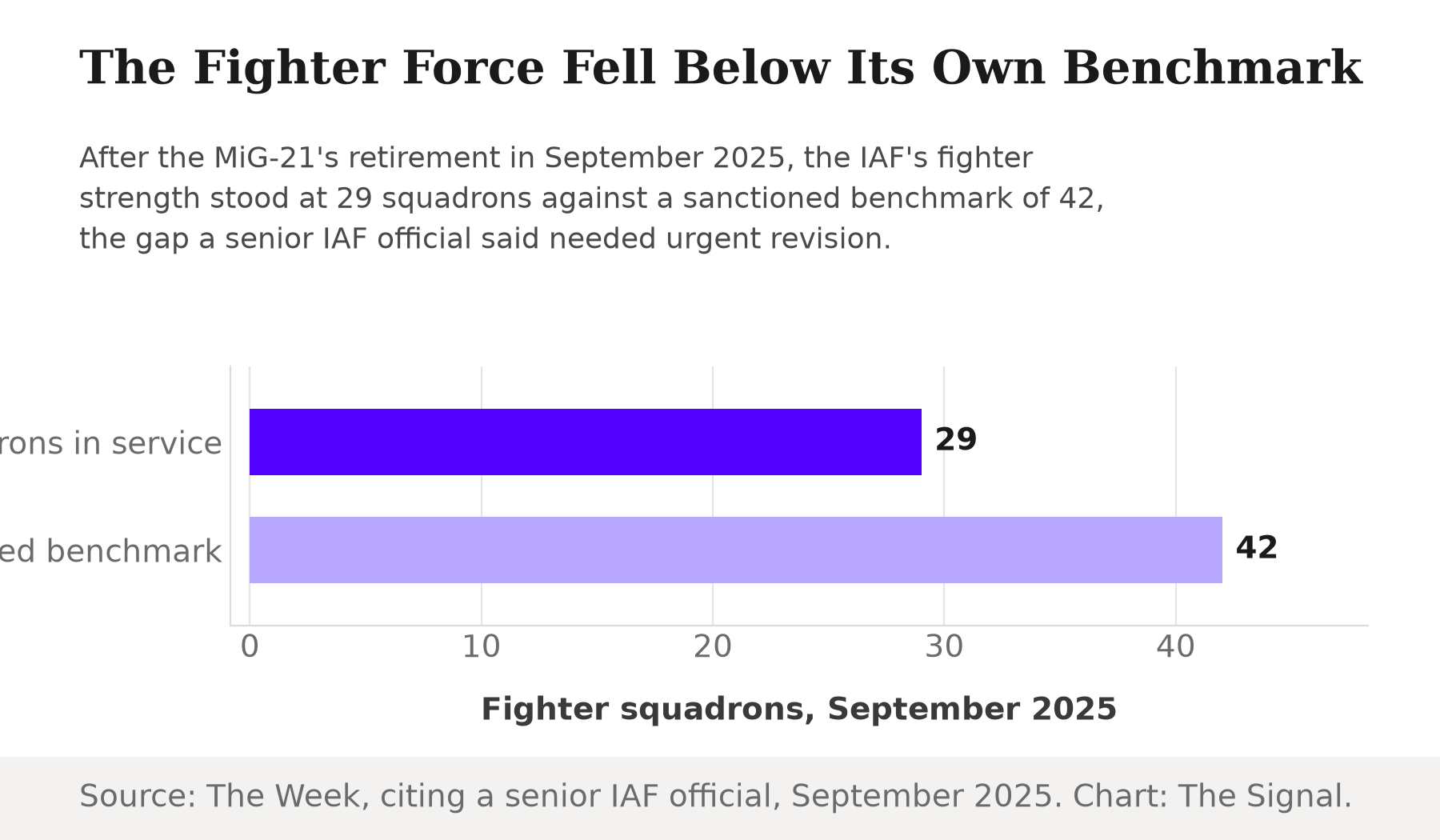
The stakes are not abstract. After the MiG-21's retirement, the IAF's fighter squadron strength stood at 29 in September 2025, against a longstanding sanctioned benchmark of 42, a gap a senior IAF official said needed urgent revision. Closing it requires more fighters, which the LCA Mk1A and eventually the AMCA are meant to supply. But every fighter cockpit needs a pilot who trained on a basic trainer first: a shortfall of 106 trainers is not separate from a shortfall of 13 squadrons, it is the entry point of the same pipeline. The IAF has been here before with worse consequences than a paperwork delay. Its previous basic trainer, the HPT-32 Deepak, was grounded after a fatal 2009 crash, by which point it had been involved in 17 crashes that killed 19 pilots and cost the force more than Rs 160 million. The HTT-40 exists to replace that aircraft. Sixteen years after the HPT-32's grounding, its replacement still has not fully arrived.
The programs compared
| Program | Aircraft type | Contract or approval | Units | Value | Status |
|---|---|---|---|---|---|
| HTT-40 | Basic trainer | Contracted March 2023 | 70 (106 needed overall) | Rs 6,800 crore | Not yet inducted as of Oct. 2025 |
| LCA Mk1A (new) | Fighter | Contracted Sept. 2025 | 97 | Rs 62,370 crore | Deliveries to start 2027-28 |
| LCA Mk1A (earlier) | Fighter | Contracted 2021 | 83 | Rs 45,696 crore | Deliveries due March 2024, delayed |
| AMCA | Stealth fighter | CCS approval, execution model 2025 | 5 prototypes | ~Rs 15,000 crore (development) | Prototype stage |
Sources: PIB, HTT-40 contract; PIB, LCA Mk1A 97-aircraft contract; Deccan Herald, earlier LCA Mk1A contract and delay; News on AIR, AMCA prototypes; PIB, AMCA execution model; Deccan Herald, HTT-40 status.
The honest objection
The strongest case against reading this as neglect of trainers specifically is that Indian defence procurement is slow across the board, for reasons that have nothing to do with an aircraft's complexity: a single certifying agency, HAL's role as both designer and sole manufacturer, and dependence on foreign engines for the humble trainer and the advanced fighter alike. On that view the HTT-40 is not uniquely mismanaged, it is one more casualty of a system that misses deadlines on everything it touches, and the AMCA will very likely slip its own timeline once prototypes move toward production.
That case is real, and the General Electric and Honeywell engine failures show the system-wide weakness plainly. But it does not explain the gap in degree. A fighter program can absorb a missed engine delivery because it carries Rs 62,370 crore in funding and a squadron crisis that keeps political pressure on it. A trainer program with a tenth of that money and none of that visibility does not recover the same way: one program has gone from a 2011 approval to a 2025 first flight, still short of induction, while the other moved from Cabinet approval to a signed execution model within about a year. The system delays everything. It delays the unglamorous things longer.
The Signal
The stealth fighter is not the bottleneck in India's air power buildup. The basic trainer is, and it always was: every fighter pilot has to pass through it first, and 106 of the aircraft meant to do that job were still not in service as of October 2025, nearly 15 years after the government approved the program. Watch what happens once the first Series Production HTT-40s actually reach a training squadron, not just a test flight. If deliveries then hold to schedule, the AMCA's own promise of a faster program execution model might mean something for how India builds aircraft going forward. If the trainer slips again, the lesson is that India can approve an ambitious jet faster than it can finish a simple one, and the ambitious jet will eventually run out of pilots trained to fly it.
Reporting basis: the HTT-40's 2023 contract terms and the LCA Mk1A's 2025 contract terms are from Press Information Bureau releases by the Ministry of Defence, as is the AMCA execution model. The CAG's finding on basic and intermediate trainer delays is from its Report No. 15 of 2024, presented in Parliament. The HTT-40's current fleet status, the 181-aircraft requirement, and the 75 Pilatus PC-7s in service, and the earlier LCA Mk1A contract's delay and the Air Chief's remarks, are as reported by Deccan Herald. The AMCA prototype count and development cost are per Defence Minister Rajnath Singh's remarks, via Prasar Bharati's News on AIR. The 29-versus-42 squadron comparison is as reported by The Week, citing a senior IAF official, and the HPT-32's crash record is as reported by Deccan Herald, citing a parliamentary statement by then Defence Minister A K Antony. The nine-times contract-value comparison and the programs table are The Signal's calculations from those figures.