On 31 August 2026, Delhi's Chief Electoral Officer published the draft roll for the Special Intensive Revision (SIR) of the capital's electoral rolls. Of 1,45,10,299 registered electors, enumeration forms could not be collected for 47,56,722 of them, so the draft kept only about 97,53,577 names, Akashvani News reported, citing the Delhi CEO's office. The excluded electors were classified under the Election Commission's Absent, Shifted, Dead, Duplicate and Others categories, and came to about a third of the pre-SIR electorate, Business Today reported. Within days, a study by the Sabar Institute found that those deletions exceeded the 2025 Assembly election's winning margin in 68 of Delhi's 70 seats, and in 36 seats exceeded the winner's entire vote total, Scroll.in reported. That is the number driving the coverage, the petitions and the political argument over SIR.
It is worth slowing down on that framing. SIR did not create the first gap in Delhi's rolls this cycle. Election Commission data show that nearly 1.1 million names were deleted from Delhi's electoral rolls between January 2025, when the rolls froze before the Assembly election, and June 2026, just before SIR began, DNA India reported. That is 7.07% of the 2025 electorate and 11.32% of the pre-SIR 2026 roll. It happened without the court petitions, the named study or the national coverage that met the SIR draft six weeks ago.
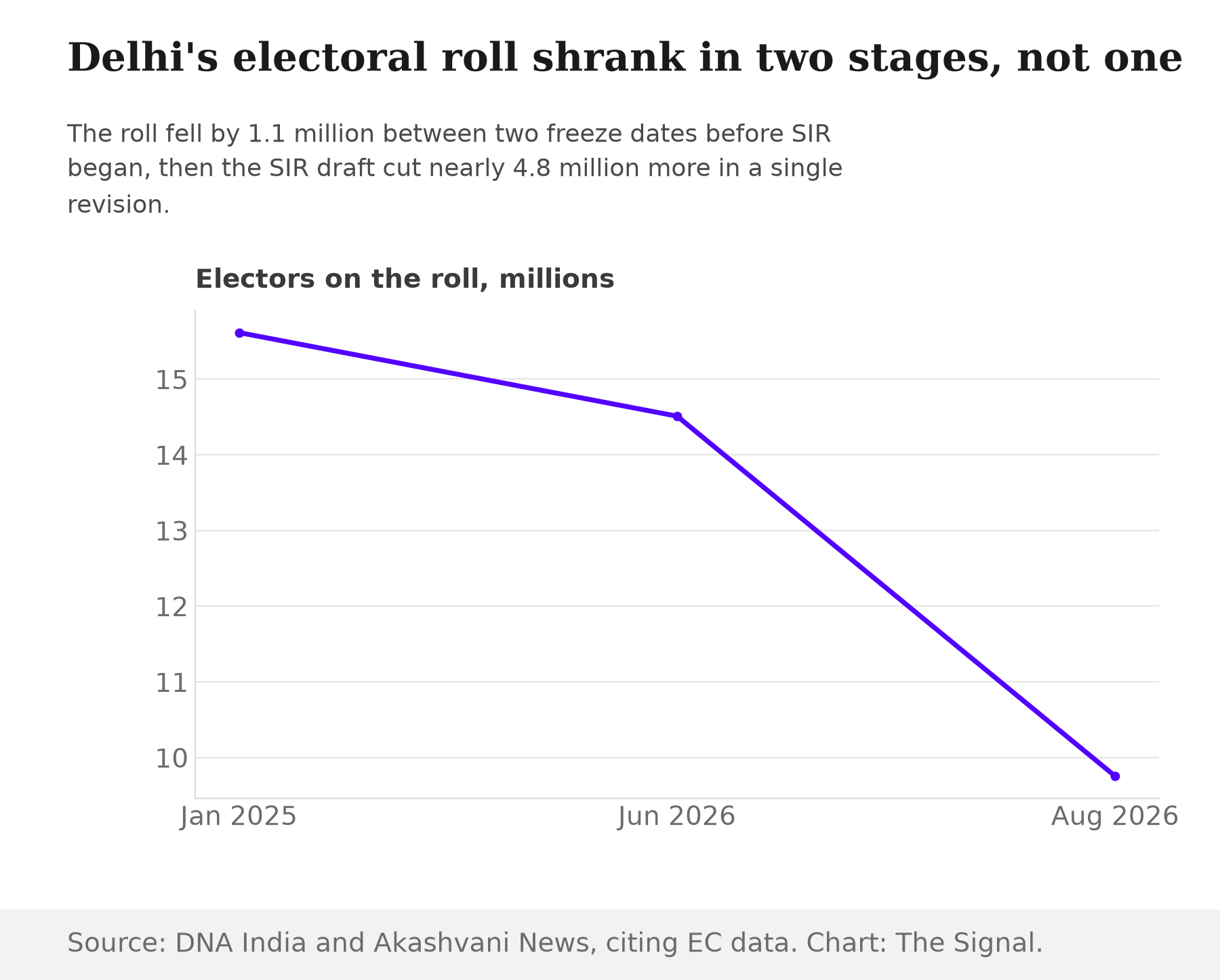
Close to 1.1 million names came off Delhi's rolls before SIR ever gave voters a list to check against. The electorate fell from 15,614,000 in January 2025 to 14,510,299 in June 2026, per Election Commission data reported by DNA India, before SIR then cut a further 47,56,722 names from the roll in one revision.
Two cuts, one roll
Line the two episodes up and the contrast is not really about size. It is about which one came with a published list before the names were removed.
The quieter cut ran for a year and a half with no comparable public list; the loud one drew a court challenge and a correction window.
| Deletion episode | Period | Voters removed | Share of the roll |
|---|---|---|---|
| Routine revision (pre-SIR) | January 2025 to June 2026 | Nearly 1.1 million | 7.07% of the 2025 electorate; 11.32% of the pre-SIR 2026 roll |
| SIR draft roll | Published 31 August 2026 | 47,56,722 | About one-third of the pre-SIR electorate |
Source: DNA India, citing Election Commission and Delhi CEO data; Business Today, citing Election Commission SIR classifications.
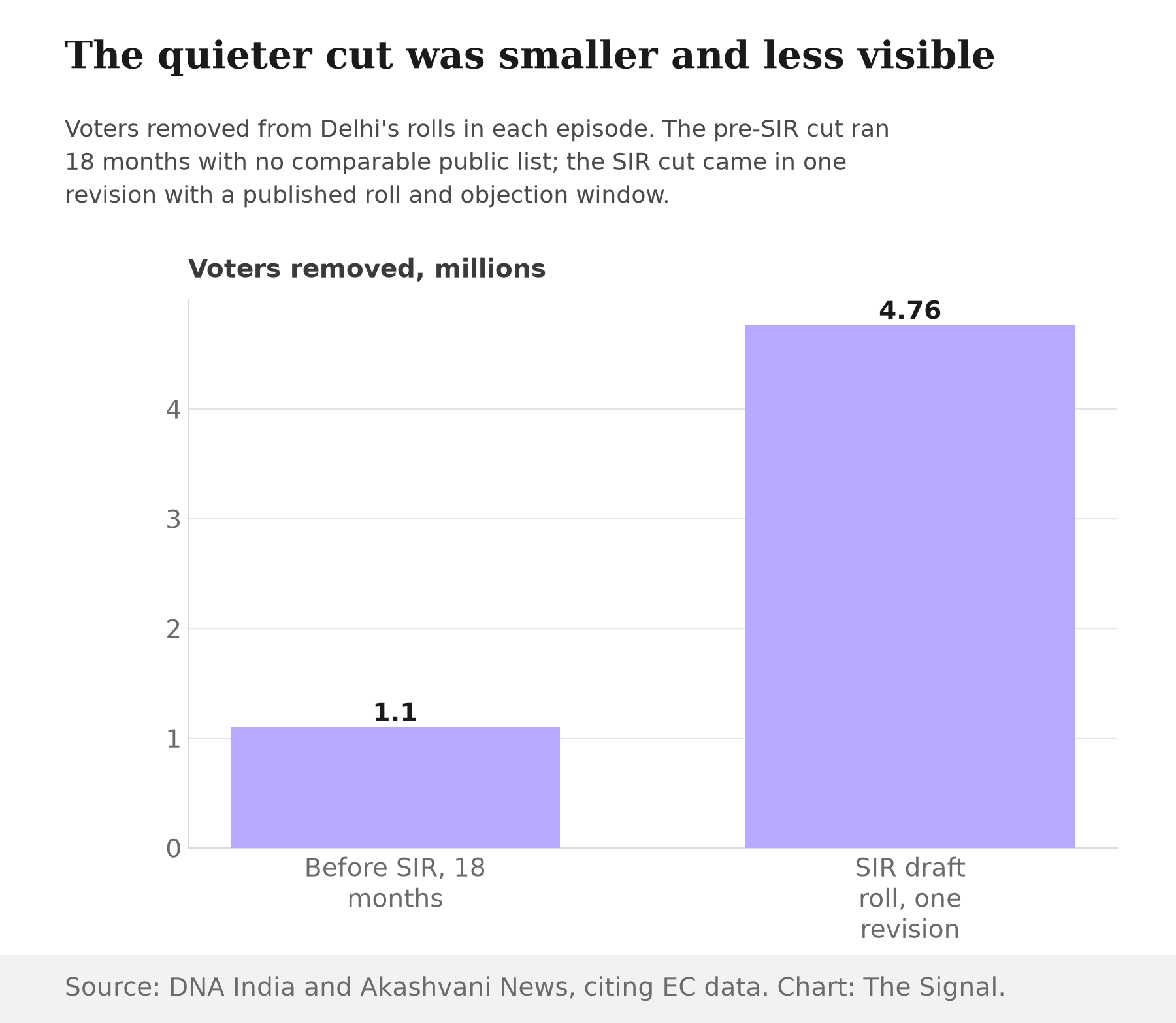
The SIR cut is larger in absolute terms. It is also the one with a name, a published roll, a Supreme Court challenge and, as the next section shows, a formal window to contest it. The pre-SIR cut ran through the Election Commission's ordinary revision cycle, the kind that happens between elections without a comparable draft-and-challenge event, and it took over a million names off the rolls with far less scrutiny attached to the number itself.
What the SIR draft still has to resolve
The 47.7 lakh already excluded is not the end of the counting. Nearly 34% of Delhi's electors face potential additional scrutiny because of enumeration-form anomalies, such as name mismatches, age discrepancies or family-detail inconsistencies, separate from the electors already excluded, The Quint reported. The process is not closed: claims and objections against the draft roll are open until 30 September 2026, with the final roll due 4 November 2026, per the Election Commission's published schedule. Anyone wrongly dropped from the draft has a dated, public channel to be added back before the roll is finalised. The 1.1 million names removed before SIR began had no equivalent public list attached to their removal for a comparable challenge window.
The margins in question
The Sabar Institute's comparison only means something against a real baseline. In the February 2025 Delhi Assembly election, the Bharatiya Janata Party won 48 of the 70 seats and the Aam Aadmi Party won 22, Akashvani News reported the Election Commission's declared result.
BJP's 2025 win was decisive in seat count. The margins inside individual seats were not, which is exactly what the deletion comparison was measured against.
| Party | Seats won, February 2025 |
|---|---|
| Bharatiya Janata Party | 48 |
| Aam Aadmi Party | 22 |
Source: Akashvani News, reporting the Election Commission's declared result.
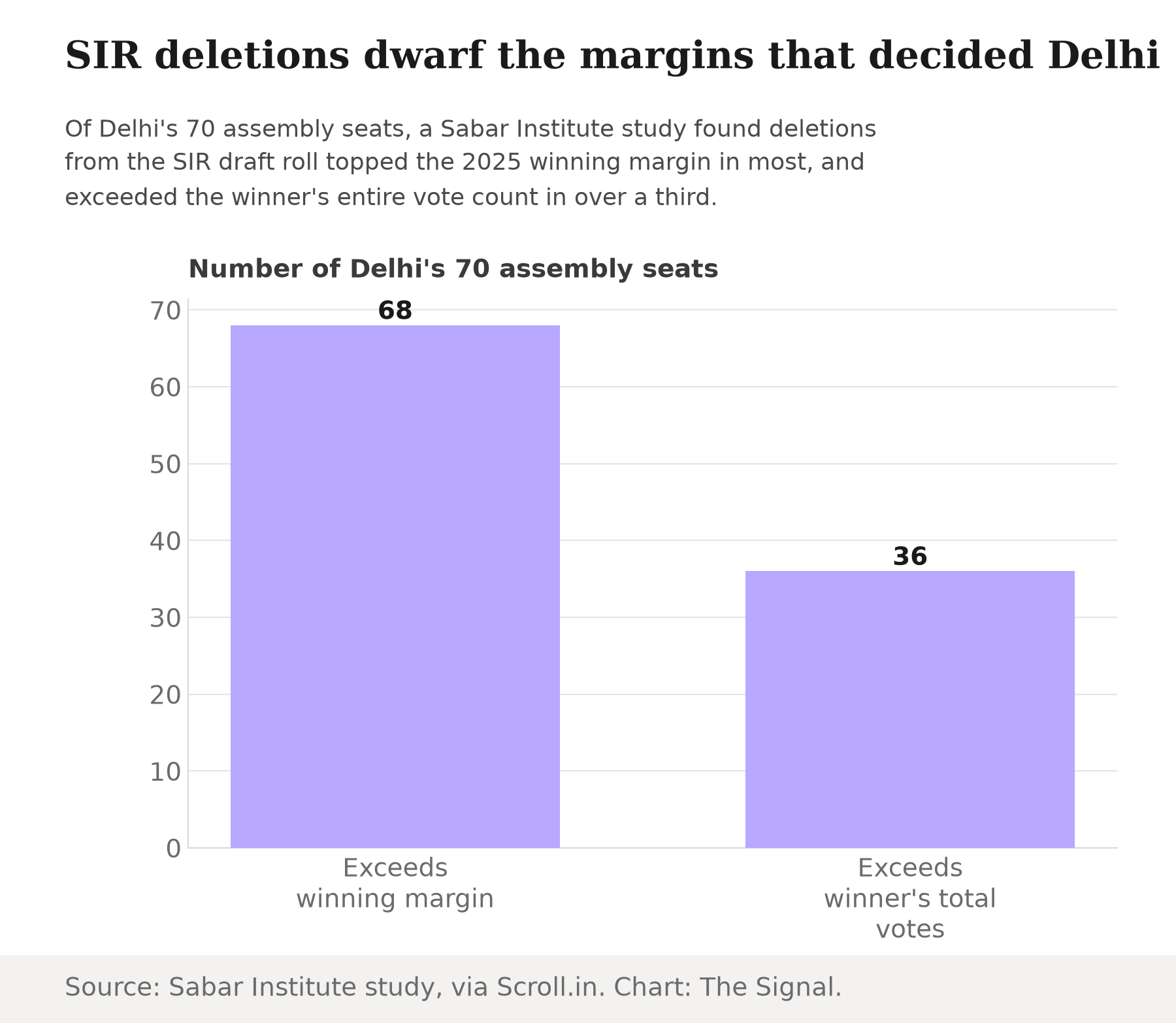
A seat-by-seat margin is a smaller number than a citywide vote share, which is precisely why the study's 68-of-70 finding matters, Scroll.in reported: a deletion count that would barely register against Delhi's roll of 1.45 crore electors can still dwarf what separated a winner from a runner-up in most individual constituencies. Critics of the drive point to that comparison as evidence the SIR cut is large enough, seat by seat, to matter electorally in a way a citywide percentage disguises.
Named seats make the scale concrete. In Matiala, the BJP's 2025 margin over AAP was 28,723 votes; the SIR draft roll left out 1,05,645 names there, more than three times that margin, a Newslaundry analysis of Election Commission data found. Burari and Okhla show the same pattern at even higher exclusion rates: Burari's 1,67,885 missing names came to 39.4% of its 2025 electorate against a 20,601-vote AAP margin, and Okhla's exclusions equalled 43% of its 2025 electorate against a 23,639-vote AAP margin, the same analysis found. In each of these three seats, a single constituency's exclusions were several times larger than the vote count that decided who represents it.
The honest objection
The Election Commission's defenders have a real case, and it rests on more than convenience. In May 2026, a Supreme Court bench of Chief Justice of India Surya Kant and Justice Joymalya Bagchi ruled that the Special Intensive Revision falls squarely within the Election Commission's statutory authority and functions as an essential safeguard for electoral integrity, The Week reported, holding that periodic and even intensive revisions are necessary to keep the rolls accurate and the democratic process trustworthy. The court also held that exclusion from the rolls does not, by itself, determine a person's citizenship, narrowing the stakes of a wrongful deletion to a voting-rights question rather than a status question. On this reading, a roll that sheds a third of its names in one pass is not a scandal. It is what a genuine clean-up looks like after years of accumulated dead, duplicate and shifted entries, and the published draft, the claims window and the 4 November deadline are the due process critics say is missing from the quieter cut.
That case is real, and the Supreme Court's ruling means SIR proceeds with the highest court's backing. But it settles whether SIR is lawful, not whether a deletion count that exceeded 2025's winning margin in 68 of Delhi's 70 seats was large enough to change outcomes. And the roughly 1.1 million names removed before SIR began were never tested against a court or a published list at all.
The Signal
Two numbers, not one, describe what happened to Delhi's electoral roll in 2025 and 2026. The 47.7 lakh figure has a Supreme Court ruling behind it, a named institute's count as well, and a challenge window still running against it, open until 30 September 2026 with the final roll due 4 November 2026. The 1.1 million figure has none of that apparatus: only a roll-count comparison that DNA India had to compile itself. A deletion with a published list and a challenge process is, by definition, the more accountable kind. The one to watch is the one that never had to publish a list at all.
Reporting basis: the pre-SIR deletion figures and Delhi's roll counts for January 2025 and June 2026 are Election Commission data, as reported by DNA India. The SIR draft roll's enumeration and ASDDO-exclusion figures are Delhi Chief Electoral Officer's office data, reported separately by Akashvani News and Business Today. The finding that SIR deletions exceeded 2025 winning margins in 68 of 70 seats, and winners' full vote totals in 36, is from a Sabar Institute analysis, as reported by Scroll.in. The Matiala, Burari and Okhla seat-level margins and exclusion figures are from a Newslaundry analysis of Election Commission SIR draft-roll and 2025 result data. The February 2025 Assembly result is the Election Commission's declared count, reported by Akashvani News. The Supreme Court's May 2026 ruling on SIR is reported by The Week. The SIR schedule and the form-scrutiny share are per the Election Commission's published timeline, reported by The Quint.