
On August 20, 2026, Pakistan's National Assembly and Senate passed the Defence Forces Act 2026 alongside the National Command Authority (Amendment) Bill 2026, giving statutory force to a unified command over the Army, Navy and Air Force. The government's own account of the bill was administrative. The Federal Cabinet's draft, approved the same day, described the law as continuing the 27th Constitutional Amendment and settling the administrative powers and headquarters of the new Chief of Defence Forces office. Read that way, parliament spent a Thursday session on organizational plumbing: which headquarters runs what, and how three services report upward.
It is worth slowing down on the amendment this law says it continues. That amendment did more than draw an org chart. Passed on November 13, 2025, the 27th Amendment rewrote Article 243 of Pakistan's constitution to create the post of Chief of Defence Forces and concentrate tri-service military authority in the army chief. Sitting in the same article of the same amendment is a second, sharper clause.
Pakistan's constitution now shields four offices from ever being arrested, sued or prosecuted.
Article 243(9) of the amended constitution grants the President, the Field Marshal, the Fleet Admiral and the Air Force Marshal lifetime immunity from arrest and from all criminal and civil proceedings. Army Chief Asim Munir currently holds two of those titles himself: he is the constitutionally shielded Field Marshal, and, as of the Defence Forces Act, the officer the new law puts in sole command of the Navy and Air Force as well as his own service. A reform sold as tidying up a headquarters also wrote one serving officer permanent legal cover.
That clause, specifically, is what drew the sharpest outside criticism, separate from the broader argument over the amendment's judicial provisions. The International Bar Association's Human Rights Institute said the immunity grant "mocks accountability and the principle of equality before the law for all citizens", naming the lifetime shield itself, not just the amendment's other changes, as the problem.
Three moves, ten months, one officer
The immunity clause and the unified command did not arrive as separate reforms years apart. They landed inside a single ten-month run that also reset how long Munir keeps the job.
One officer received a historic promotion, a personal immunity clause and a five-year mandate within ten months.
| Date | Instrument | What changed |
|---|---|---|
| May 20, 2025 | Field Marshal promotion | Asim Munir was promoted to Field Marshal, becoming only the second officer in Pakistan's history to hold the rank, 66 years after Ayub Khan's 1959 promotion to the same title |
| November 13, 2025 | 27th Constitutional Amendment | Created the Chief of Defence Forces post and concentrated tri-service authority in the army chief; gave Munir a fresh five-year term as Chief of Defence Forces running through November 2030, on top of his role as Chief of Army Staff; and granted lifetime immunity from arrest and all criminal and civil proceedings to the President, Field Marshal, Fleet Admiral and Air Force Marshal |
| August 20, 2026 | Defence Forces Act 2026 and NCA (Amendment) Bill 2026 | Passed by the National Assembly and Senate, giving statutory force to a unified tri-service command; the Cabinet's own draft framed it as settling the administrative powers and headquarters of the new Chief of Defence Forces office |
Source: The News International; JURIST; Arab News; The Express Tribune; Radio Pakistan.
None of these three moves needed the other two. A unified command can exist without a personal immunity clause. A promotion can exist without a five-year contract attached. Pakistan wrote all three for the same officer within the same ten-month stretch.
A command built on a fraction of the regional budget
The institution Munir now runs single-handedly is not, on paper, an especially large one next to India, the rival it is routinely measured against.
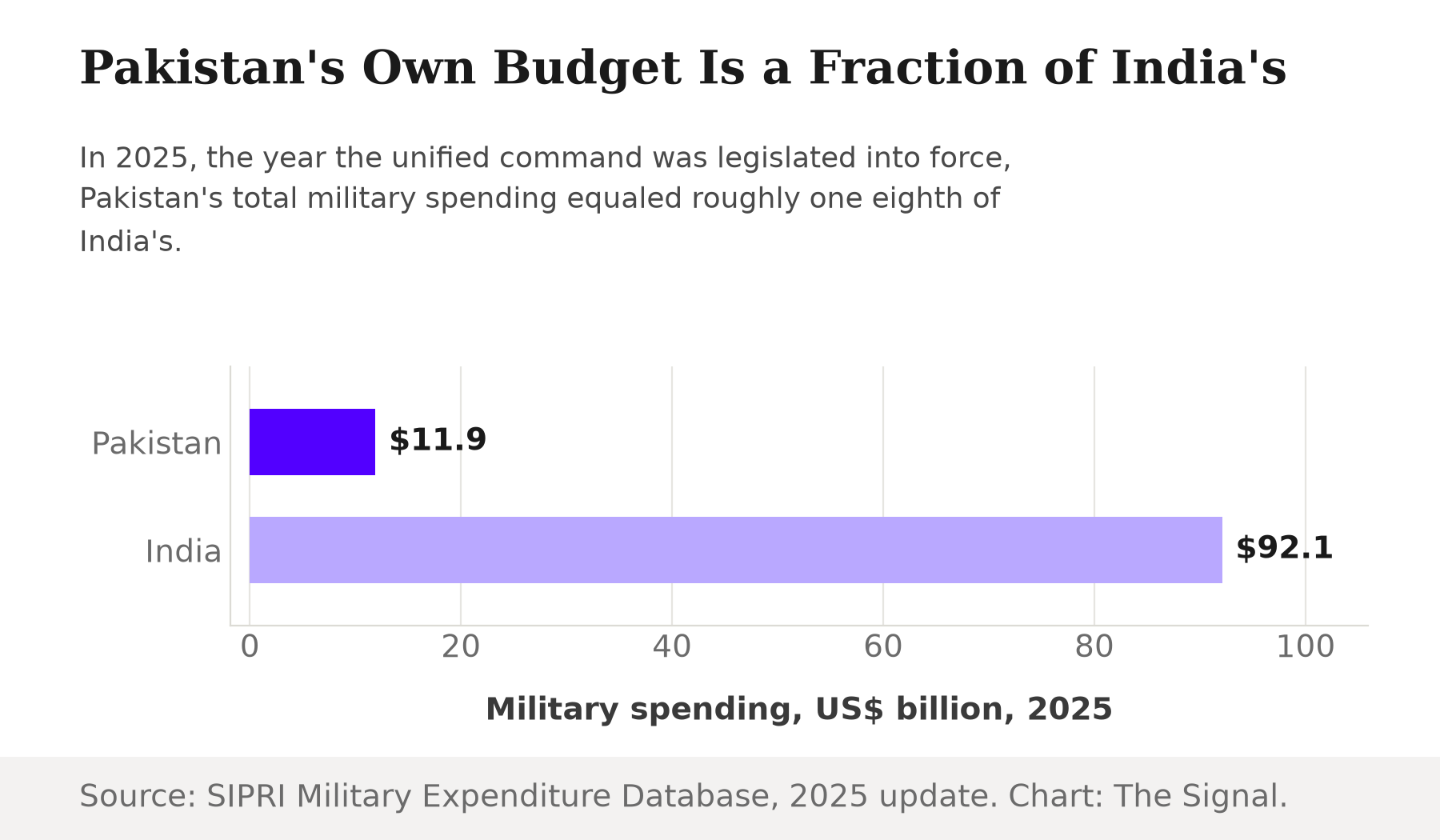
Pakistan's military spending rose 11 percent to $11.9 billion in 2025, while India's rose 8.9 percent to $92.1 billion in 2025: Pakistan's total is roughly one-eighth of India's. Both countries' higher 2025 outlays are linked by SIPRI to the two countries' May 2025 armed conflict, which pushed new orders and budget lines on both sides of the border.
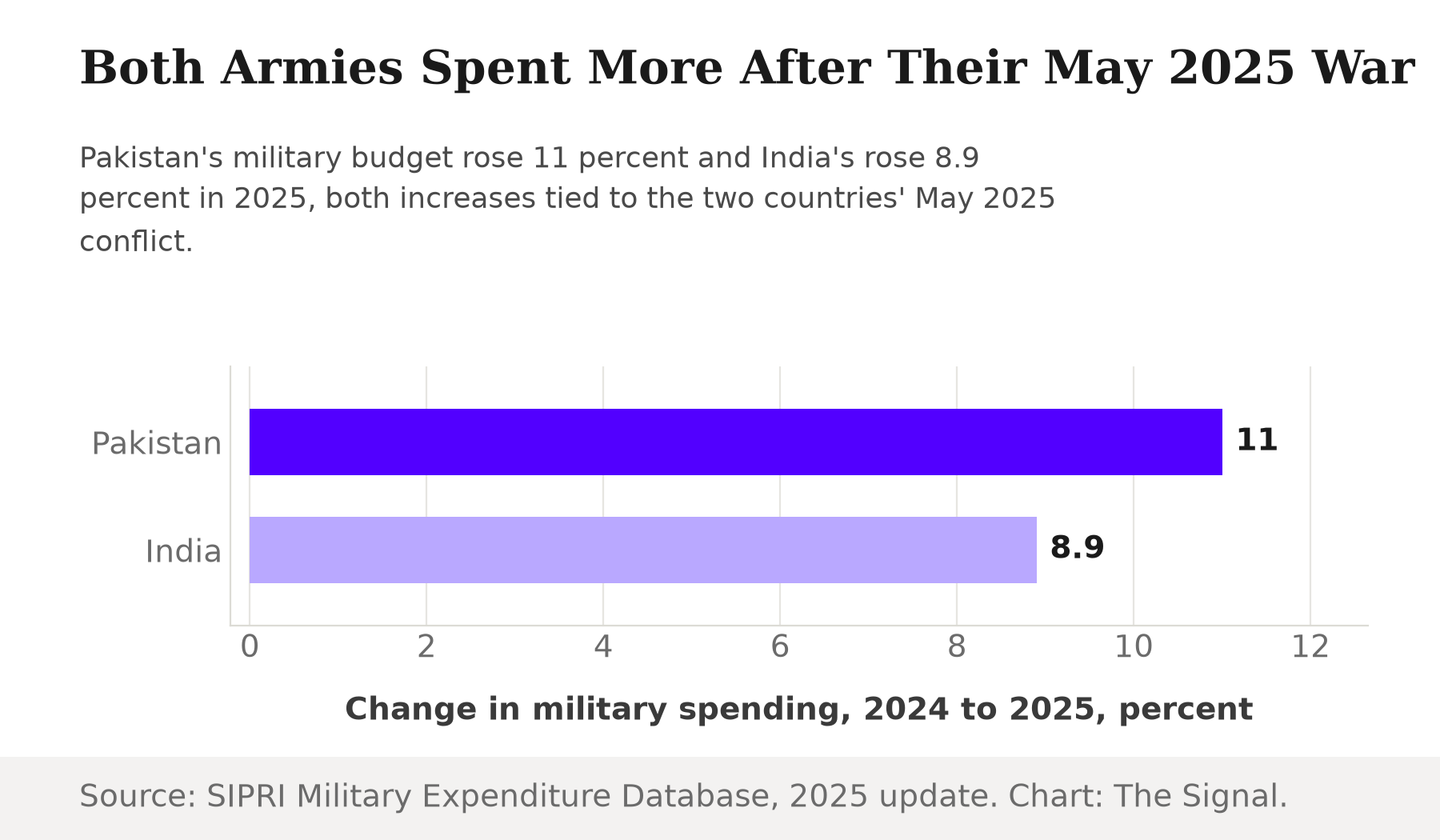
The two militaries grew their budgets by similar single-digit percentages after the same conflict. What changed on the Pakistani side was not the size of the force. It was the officer who now answers for all of it.
The burden that kept shrinking
If the unified command were being built to match a growing defense budget, Pakistan's own numbers do not support that story either.
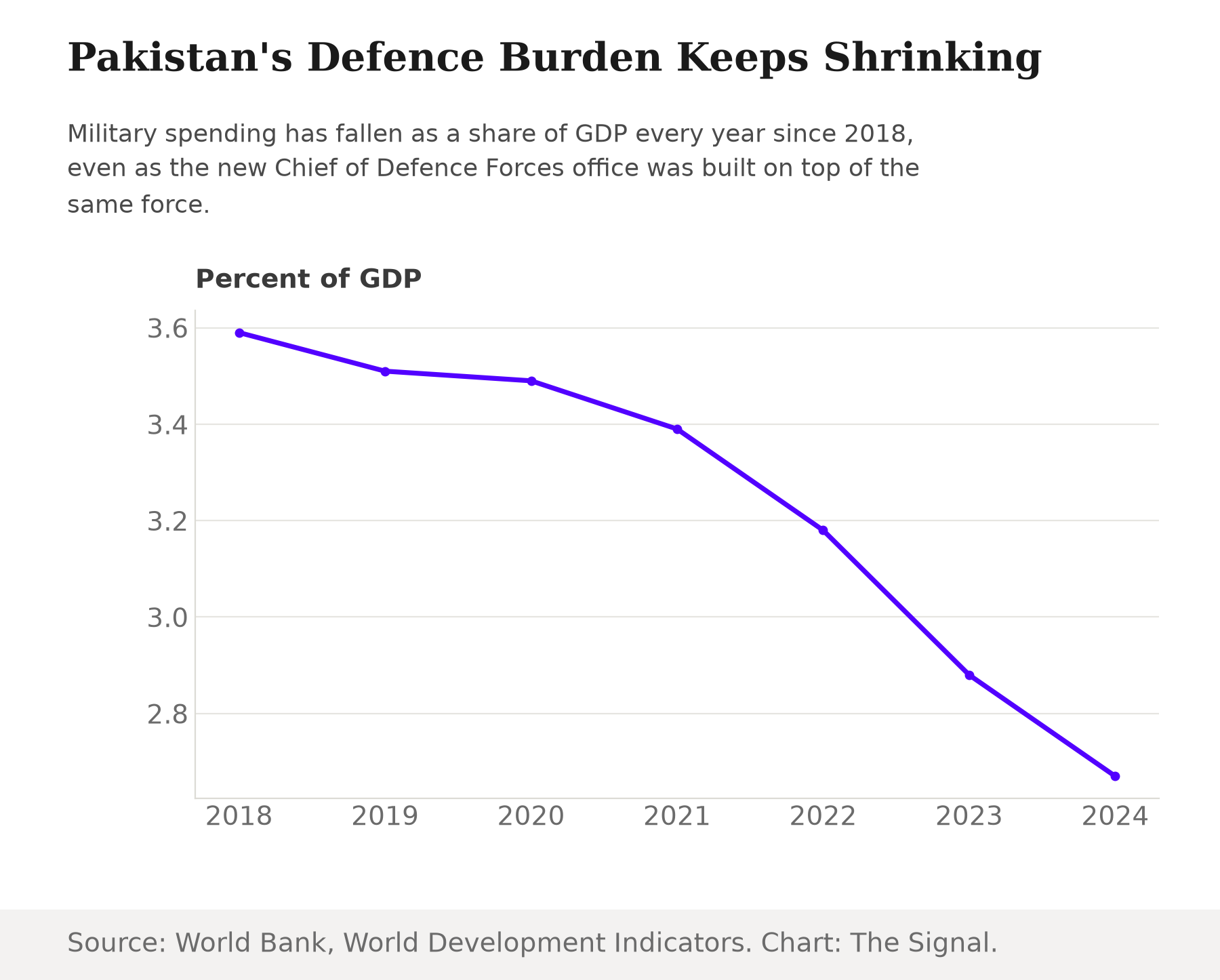
Pakistan's military expenditure fell as a share of GDP every year from 3.59 percent in 2018 to 2.67 percent in 2024, the latest year the World Bank has published. The office consolidating command over that force grew more powerful across the same period its claim on the national economy shrank.
The rupee figures behind that shrinking share still went up. Pakistan's federal defence allocation rose from Rs2.55 trillion in FY2025-26 to Rs3 trillion in FY2026-27, a 17.65 percent nominal increase, the same two budget cycles that carried the unified command into law. The GDP-share decline and the rupee-figure rise describe the same budget from two different angles: it is shrinking against the size of Pakistan's economy while growing in the currency the Chief of Defence Forces actually spends.
The honest objection
The strongest case for reading this as ordinary modernization, not personal entrenchment, is that a single tri-service commander is not exotic. Three services planning and budgeting against three separate chains of command is slower and more duplicative than one; militaries reorganize into a unified command for exactly that operational reason, no matter which officer holds the post.
That case explains why a Chief of Defence Forces office might exist at all. It does not explain why the same amendment that created the office also wrote a named individual's immunity into the constitution and handed him a five-year contract that runs three years past his own promotion's precedent. A structural fix does not require protecting the specific officer from arrest, or fixing his term through a specific month five years out. Pakistan's law bundled all three, for one man, inside ten months.
The Signal
Strip out the immunity clause and the personal tenure extension, and what remains is a defensible efficiency reform: one commander for three services, on a budget still a fraction of the neighbor it watches closest. Add them back in, and the reform reads as something else: institutional language spent on a single career. The number to watch is November 2030, when Munir's Chief of Defence Forces term is due to end. The law is not silent on that moment so much as narrow about it: the tenure-reset clause added to the Army Act ties its language explicitly to "the first appointment" of the officer holding the combined Chief of Army Staff and Chief of Defence Forces post, without separately spelling out tenure or succession terms for whoever holds the post next. Should the unified command and its immunity clause survive a transition to a different officer, Pakistan built an institution. If they do not outlast the man they were written for, the law was a biography wearing a statute's clothes.
Reporting basis: the August 20, 2026 passage of the Defence Forces Act 2026 and the National Command Authority (Amendment) Bill 2026 is per The Express Tribune. The Federal Cabinet's own framing of that draft is per Radio Pakistan, Pakistan's state broadcaster, reporting the government's own official action. The 27th Constitutional Amendment's creation of the Chief of Defence Forces post and its Article 243(9) immunity clause are per a JURIST dispatch. Asim Munir's five-year Chief of Defence Forces term is per Arab News. His May 2025 promotion to Field Marshal, and its standing as only the second such promotion in Pakistan's history, is per The News International. The 2025 military-spending figures and growth rates for Pakistan and India are from SIPRI's Military Expenditure Database. Pakistan's military expenditure as a share of GDP, 2018 through 2024, is World Bank data. The one-eighth comparison between Pakistan's and India's 2025 budgets is The Signal's calculation from those two SIPRI figures. The FY2025-26 to FY2026-27 rupee defence-budget figures are per Dawn. The IBAHRI's characterization of the immunity clause is per its own published statement. The Army Act's "first appointment" tenure-reset wording is per Dawn's reporting on the bill's presidential assent.