Days ago, on August 30, Russia submitted a cost proposal to India for five additional S-400 air defence squadrons, a formal tender response to a request India had put out earlier this year. The timing writes its own headline. During Operation Sindoor in May 2025, India's Air Force chief said the S-400 had achieved at least five confirmed fighter-jet kills and engaged one large aircraft, an ELINT or AEW&C plane, at a distance of about 300 km, which The Tribune reported as the largest recorded surface-to-air kill of its kind. A system that performs like that in a real war is exactly the system a country wants more of.
It is worth slowing down on that reading. The five squadrons Russia has now quoted a price for would sit on top of an order India already placed. In October 2018, India signed its original contract with Russia for five S-400 squadrons at a cost of roughly $5.5 billion. Almost eight years later, that first order is still not complete.
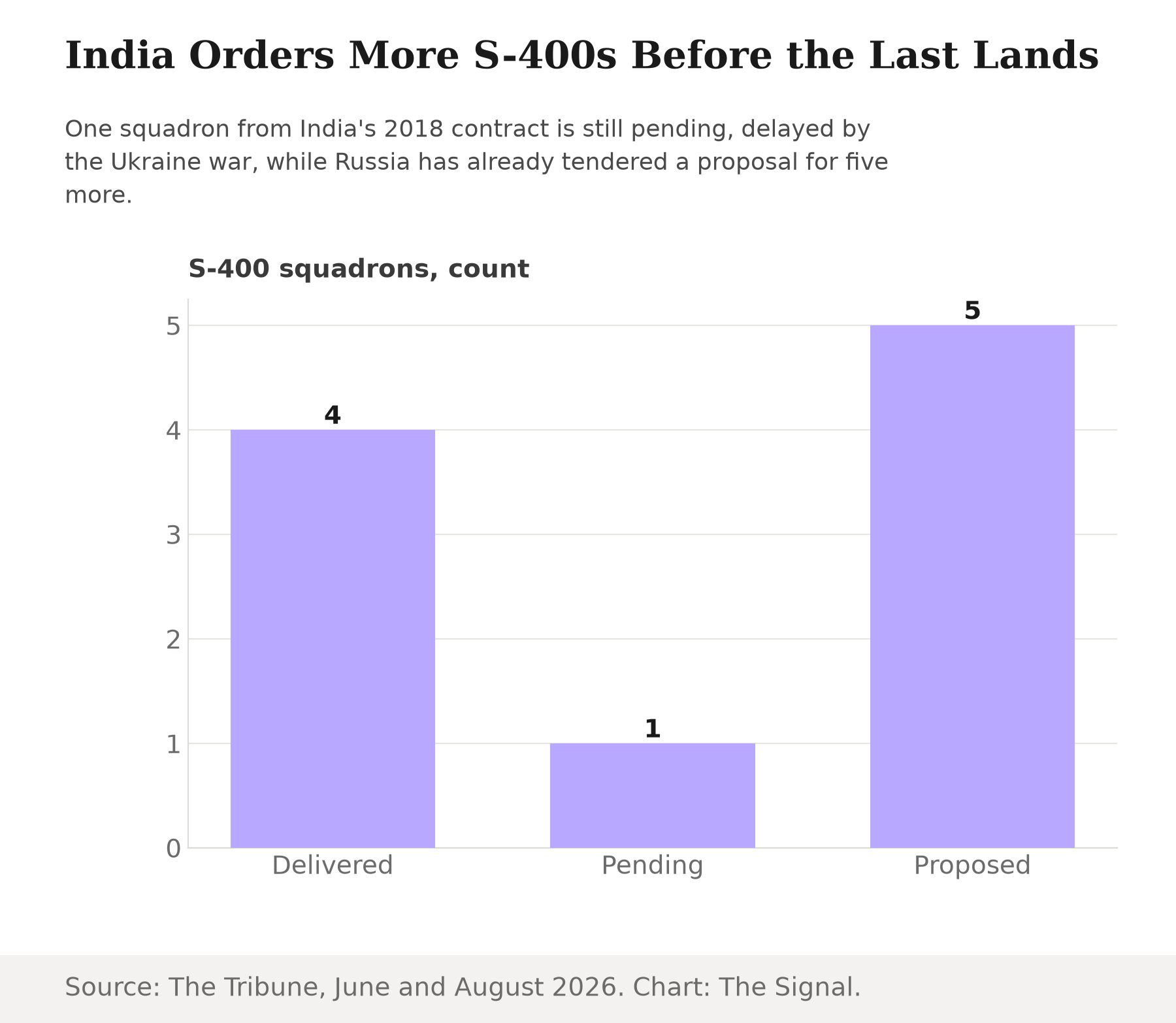
One squadron from 2018 has not arrived yet.
Four of the five squadrons from that original contract have reached India, with the fifth delayed by the Russia-Ukraine war and now expected only by the end of 2026. That is not a new or minor slip. Delivery of the remaining squadrons had already fallen roughly two years behind an originally promised 2024 completion, a delay The Defense Post attributed in March 2024, citing Asian News International, to the war in Ukraine. India is proposing to buy five more units of a system it is still owed one of.
Why the wait is not political, it is structural
The mechanism behind that delay has not gone away, and it explains why the new order carries the same risk as the old one. SIPRI's arms-transfers data shows Russia's total arms exports fell 64 percent between 2015-19 and 2020-24, a decline the institute attributes mainly to Moscow prioritizing arms production for its own armed forces over exports since 2022. SIPRI adds that India is among the few states, alongside Iran and Saudi Arabia, still owed major pending deliveries from Russia. A factory building interceptors for its own air defence during an active war has less capacity left over for an export order, whichever government is asking.
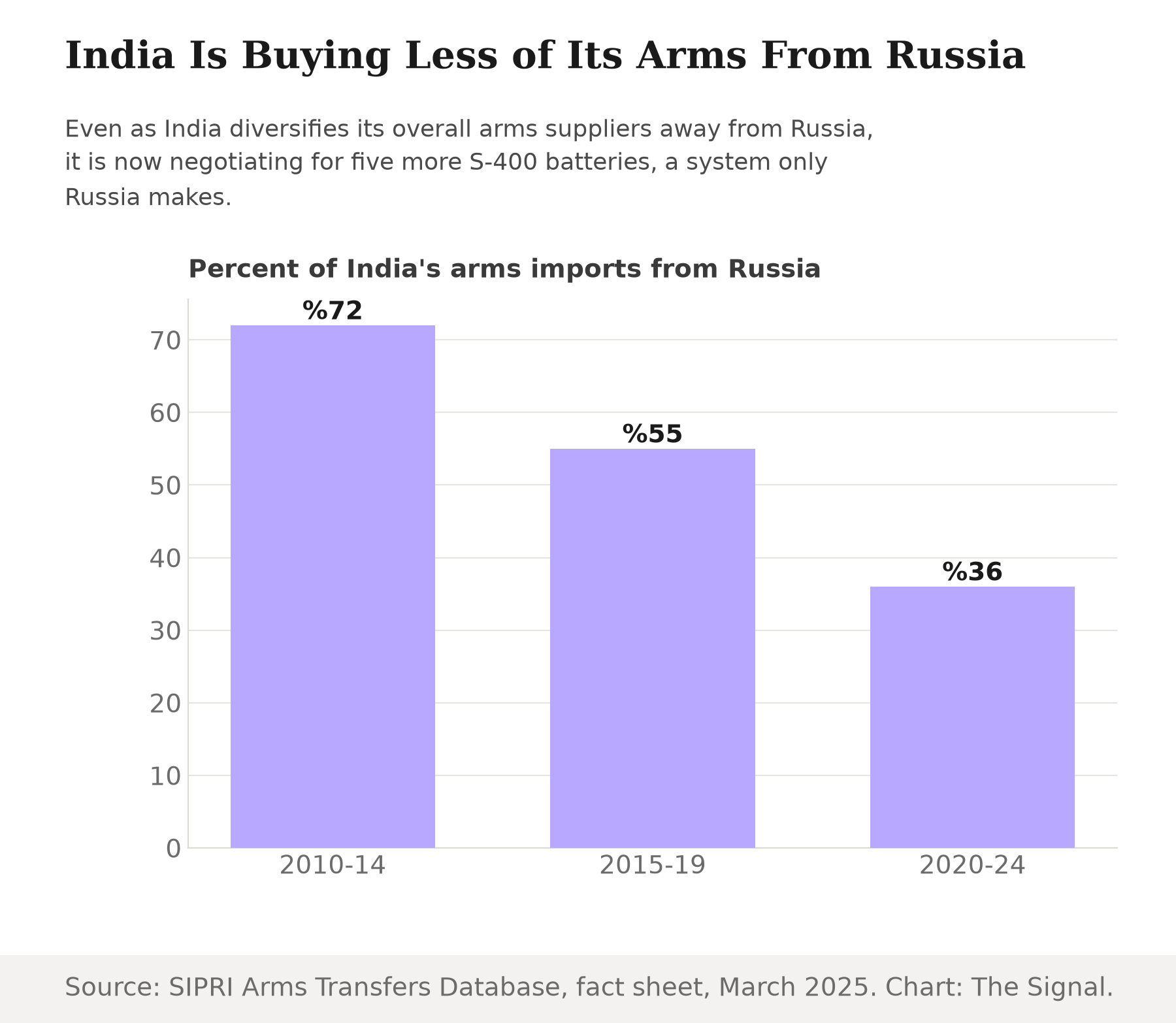
That mechanism sits underneath a real paradox. Russia's share of India's arms imports has fallen from 72 percent in 2010-14, to 55 percent in 2015-19, to 36 percent in 2020-24, as India has spread its purchases across France, the United States, Israel and its own domestic industry. India is diversifying away from Russia in aggregate even as it deepens its reliance on Russia for one specific, exquisite capability that nobody else builds.
The new order is small money, in a very large budget
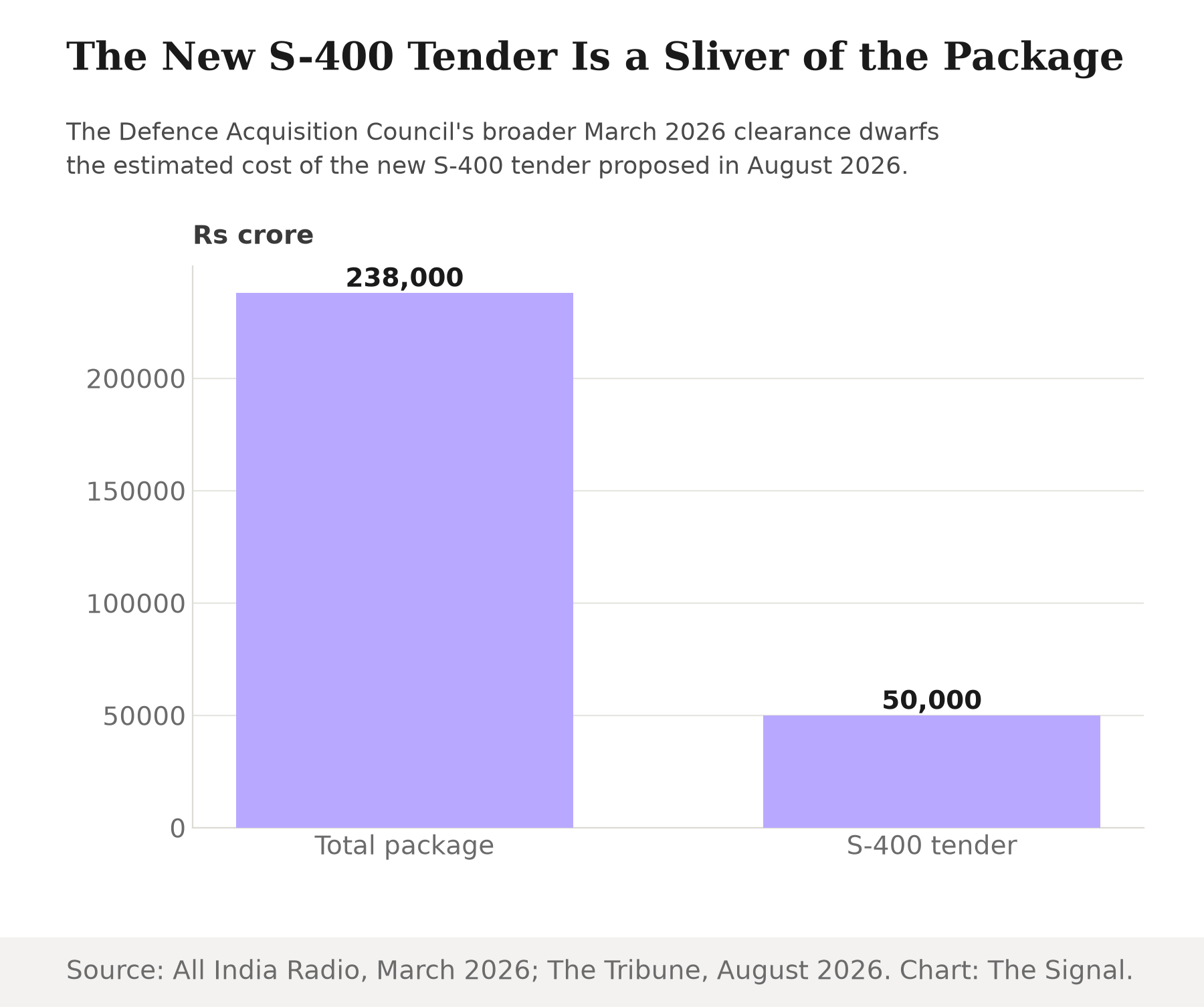
The S-400 tender is not the story financially. On 27 March 2026, India's Defence Acquisition Council, chaired by Defence Minister Rajnath Singh, granted Acceptance of Necessity for a package that included the S-400 system alongside medium transport aircraft and remotely piloted strike aircraft, worth about Rs 2.38 lakh crore in total. The new S-400 order alone is estimated to cost over Rs 50,000 crore, a fraction of that wider clearance.
The same pattern has played out twice now: order, delay, reorder.
| Date | Event |
|---|---|
| October 2018 | Original contract signed for 5 S-400 squadrons, worth roughly $5.5 billion |
| 27 March 2026 | Defence Acquisition Council clears a package including S-400, worth about Rs 2.38 lakh crore |
| June 2026 | Fourth squadron arrives; fifth expected by year-end 2026 |
| August 30, 2026 | Russia submits proposal for five additional S-400 squadrons |
Source: Army Recognition; All India Radio's News on Air; The Tribune, The Tribune.
The sanctions question is not new either
A single-supplier air defence relationship with Russia carries a second exposure that has nothing to do with delivery schedules: the threat of American sanctions under CAATSA, the law that penalizes significant transactions with Russia's defence sector. This is not a new worry Operation Sindoor created. In July 2022, the US House of Representatives passed, by voice vote, an amendment from Rep. Ro Khanna urging the Biden administration to grant India a CAATSA waiver in recognition of India's reliance on Russian-built weapons systems. Washington has had to legislate around this exact dependency before, four years before this year's tender.
The honest objection
The strongest case against reading this as a fresh risk is that the 2018 order, delays and all, still worked. Four of five squadrons have arrived, the fifth has an expected delivery date, and the system performed exactly as advertised in the one war it has actually fought. On that view, Russia's wartime production squeeze is a scheduling problem, not a supply failure, and a Defence Acquisition Council that is comfortable clearing Rs 2.38 lakh crore in a single sitting is not a buyer that is nervous about the relationship.
That case understates how structural the constraint now is. The delay on the first order had already run to about two years before this new tender was even proposed, and that happened before Russia had fully reoriented its arms industry around its own war. SIPRI names India as one of the states still waiting on major pending Russian deliveries, alongside Iran and Saudi Arabia. A factory at war does not free up capacity because a customer's air force performed well with what it already has. If anything, a proven S-400 kill record makes Delhi more willing to wait for the next batch. It does not make Delhi less exposed to the wait.
The Signal
Operation Sindoor answered the question of whether the S-400 works. It did nothing to answer the question of whether Russia can build and ship five more of them on any predictable timeline. The one data point India has on that question is its own 2018 order, and that order has already run two years slower than promised. The number to watch next is not the size of the new tender. It is whether the fifth squadron from 2018 actually lands by the end of this year, on schedule for once. If it does not, the newest order is buying the same wait as the last one, just with better proof that the wait will be worth it.
Reporting basis: the original 2018 contract value is per Army Recognition's reporting. The status of the 2018 order's deliveries, and the new proposal's estimated cost, are per The Tribune, reporting in June and August 2026 respectively. The Ukraine-war delay attribution is per The Defense Post, citing Asian News International. The March 2026 Defence Acquisition Council clearance is per All India Radio's News on Air, a Government of India outlet. The Operation Sindoor combat account is per The Tribune, citing the Indian Air Force chief. Russia's falling arms-export share and India's shifting import mix are drawn from SIPRI's Arms Transfers Database, as published in its March 2025 fact sheet. The 2022 US House vote is per the press release of Rep. Ro Khanna's congressional office. No figure in this piece is The Signal's own calculation.