On 26 September 2025, the Indian Air Force retired the MiG-21, the aircraft that had been its first supersonic fighter, in a ceremony at Chandigarh marking more than six decades of service. The natural read is a fleet in transition: an old jet stood down, newer aircraft moving in to take its place.
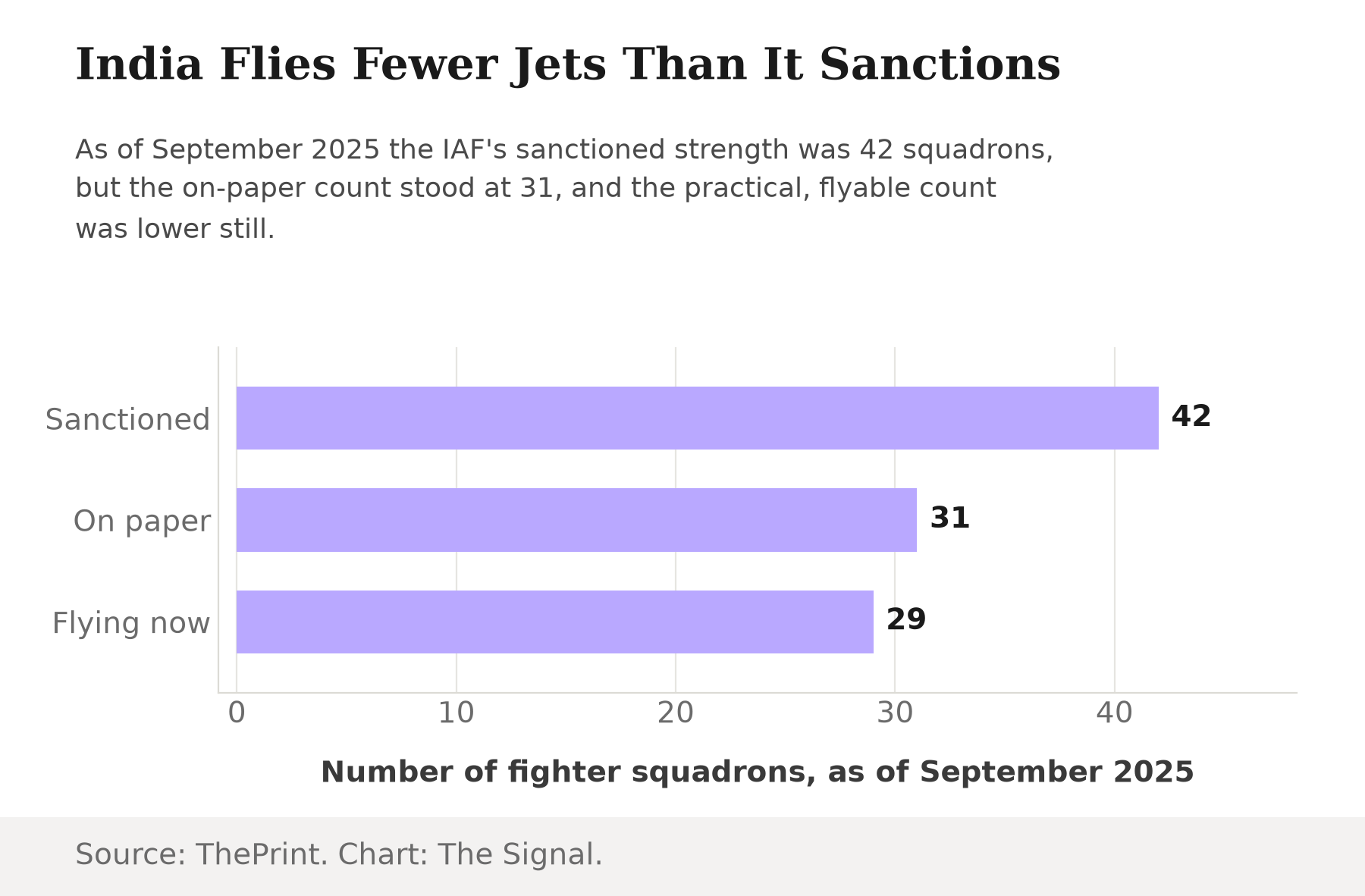
It is worth slowing down on that. The same month the MiG-21 flew its last flight, the IAF's own fighter squadron strength stood at 31 on paper and effectively 29 in practice, against a sanctioned strength of 42, and the service was looking to seek government approval to raise that sanctioned ceiling itself. Retiring an old jet did not coincide with a new one arriving to cover the gap. It coincided with a force that was already short of its own target.
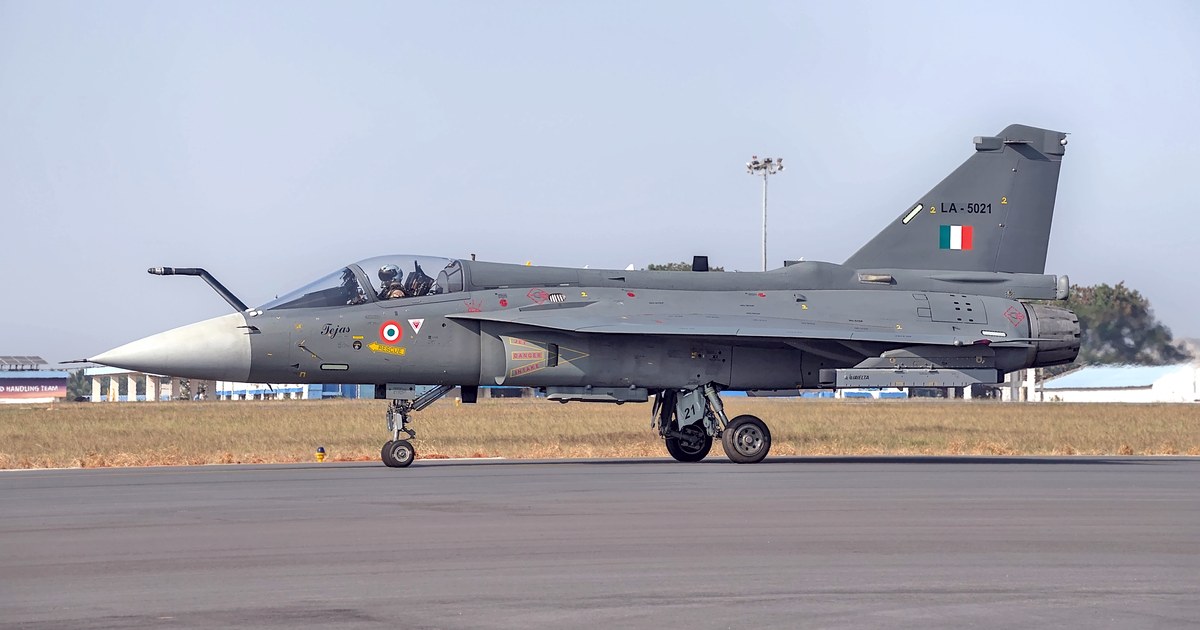
The explanation for that shortfall sits in a different report entirely. As of 5 February 2026, HAL confirmed that five completed Tejas Mk-1A fighters were fully ready for delivery but could not reach the Air Force because they were still awaiting GE F404 engines from the United States, having received only five engines from GE to date. Built airframes are sitting on the ground, and the bottleneck is the imported part, not the assembly line.
A project that already missed this deadline once
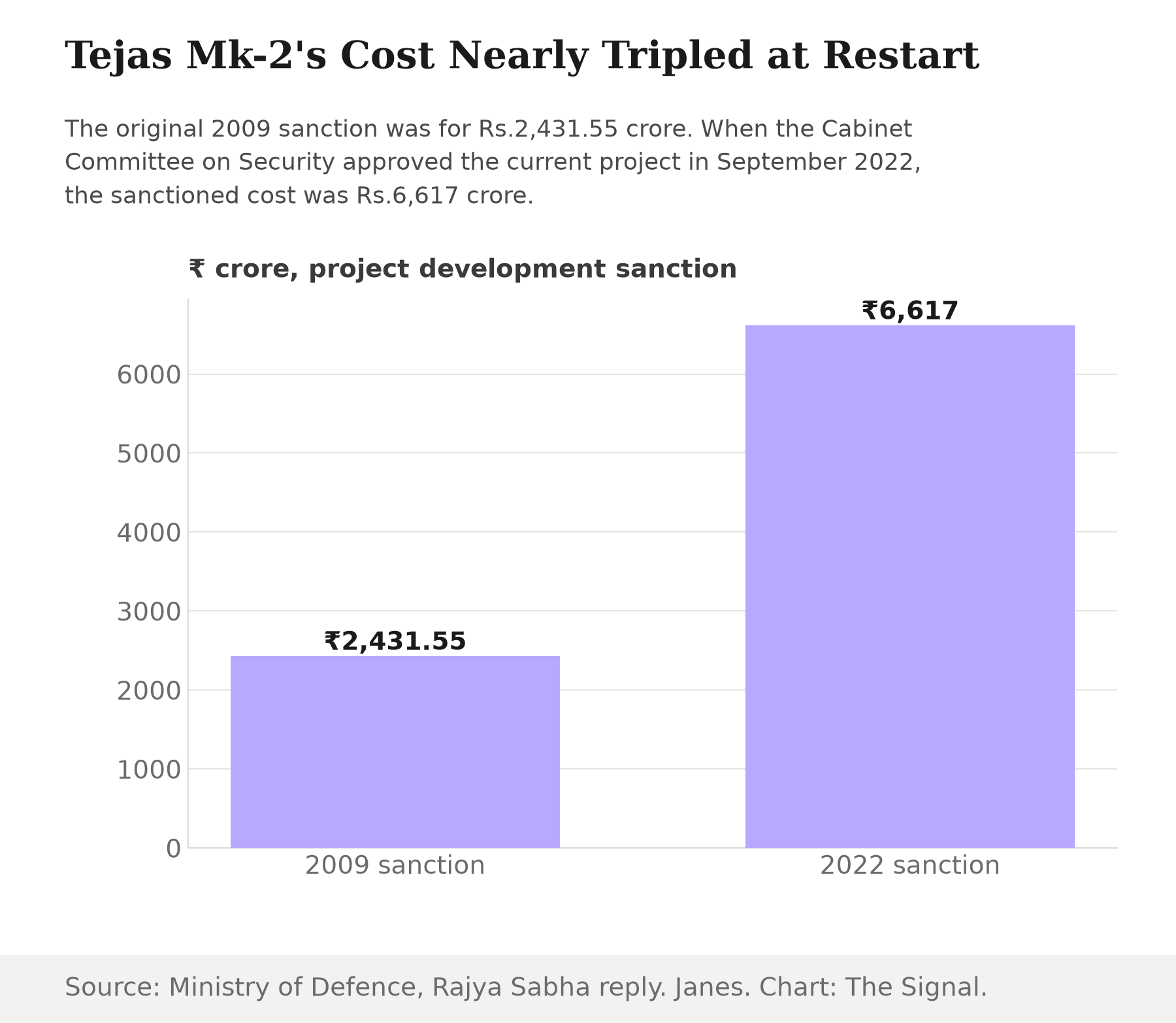
That bottleneck has a long history, one that predates the aircraft HAL had parked on its tarmac as of February 2026. The Tejas Mk-2 project was first sanctioned in November 2009 at a cost of Rs.2,431.55 crore, with a target completion date of December 2018 and a first prototype flight expected by December 2019. That timeline never got going: delays in finalising the engine contract meant the project could only start in December 2013, four years after it was approved.
By 2022, that original project no longer existed in any recognisable form. On 1 September 2022, the Cabinet Committee on Security approved what is, in effect, a new Tejas Mk-2 programme, sanctioning INR66.17 billion, about $827 million, for development, flight-testing and certification, with the aircraft not expected to reach the Air Force before 2029-30. That is roughly Rs.6,617 crore against the original Rs.2,431.55 crore sanction, close to three times the size, for a programme restarting from very near where the first one stalled.
This is also not the programme's first time trading substance for a deadline. India's Comptroller and Auditor General found that Tejas Mk-1 reached Initial Operational Clearance in December 2013 only with 53 permanent waivers and concessions that considerably reduced its operational capability and survivability. The same audit found that the aircraft's indigenous content, which the Aeronautical Development Agency had estimated at 70 percent, actually worked out to about 35 percent as of January 2015. Meeting a date and meeting the original spec have not always been the same thing on this programme.
The bridge aircraft is stuck on the same part
Rather than wait on the Mk-2, India's near-term answer has been the Tejas Mk-1A. On 13 January 2021, the Cabinet Committee on Security approved procurement of 73 Tejas Mk-1A fighters and 10 trainers, at a cost of Rs.45,696 crore plus Rs.1,202 crore for design, development and infrastructure, close to Rs.48,000 crore in total, with delivery of all 83 aircraft to be completed within eight years of that approval, putting full delivery around 2029.
Five years into that eight-year clock, the finished-and-delivered count is nowhere near 83. As of February 2026, five jets sat built and ready, undelivered for want of the same imported GE F404 engine that had already slowed the original Mk-2 project a decade earlier. Different aircraft, different contract, same choke point.
There is a stated schedule for closing that gap. On 2 April 2026, HAL's chairman, D.K. Sunil, said the company then had five F404 engines with a sixth ready for pickup, and that GE Aerospace had assured 20 more F404-IN20 engines in the second half of the year, between June and December. That would be a five-fold jump in supply inside eight months, on a programme whose engine contract has already slipped once.
| Programme | Approved | Scale | Cost | Status |
|---|---|---|---|---|
| Tejas Mk-1 | IOC granted December 2013 | Initial fleet | Not in this matrix | 53 waivers to reach IOC; indigenous content about 35 percent against a 70 percent estimate |
| Tejas Mk-1A | CCS approved 13 January 2021 | 73 fighters, 10 trainers | About Rs.48,000 crore | Five aircraft built and ready, undelivered as of February 2026 for want of GE F404 engines |
| Tejas Mk-2 (current) | CCS approved 1 September 2022 | Development and certification | INR66.17 billion, about $827 million | Not expected before 2029-30; first prototype flight targeted March-July 2027 |
Three generations of the same aircraft, one recurring constraint.
Source: Ministry of Defence (Rajya Sabha reply) and PIB releases; Comptroller and Auditor General, Report No. 17 of 2015; Janes; News on AIR.
The same engine problem, one generation later
The Mk-2 depends on a different, larger GE engine, the F414, and here too the schedule runs through an American supplier as much as through Bengaluru. On 13 April 2026, GE Aerospace vice president Rita Flaherty said the hardest part of talks to co-produce roughly 99 F414 engines in India, an estimated $1 billion deal with about 80 percent technology transfer, had been concluded, but the formal contract was not expected to be signed until the end of December 2026.
Despite that open item, at the 2026 Farnborough International Airshow, HAL's chairman and managing director said assembly of the Tejas Mk-2's first prototype is on track, with a first flight likely between March and July 2027. A 2027 first flight would already be seven to eight years past the first prototype flight the original 2009 project had promised for December 2019, on an aircraft that, by the 2022 sanction's own account, is still not expected in Air Force service before 2029-30.
The honest objection
The strongest case for patience is that the F414 co-production deal, with its roughly 80 percent technology transfer, is a different kind of fix than anything that came before it. A straightforward import contract just moves a delivery date; a localisation deal of that scale is meant to remove the dependency altogether once it is actually running. Judged against a decade of sequential import delays, a program that has reached "the hardest part of talks concluded" on a genuine local-manufacturing deal looks like progress, not a repeat.
That case is real, but it rests on a contract that, as of the April 2026 remarks, was not yet signed and was not expected to be until the end of December 2026, a full nine months after the "hardest part" was said to be resolved. A signed co-production deal still has to become a running production line before it can supply an aircraft, and the Mk-2 has to fly its first prototype before that engine question even applies to it. The Mk-1A shows what a signed and sanctioned programme can still look like in practice: an eight-year delivery clock, five years in, with finished jets sitting on the ground for an engine that has not arrived. A localisation deal changes the story once it is producing engines. Until then, it is one more date on a chart that has moved before.
The Signal
Strip away the programme names and one constraint runs through all three: Tejas Mk-1 was late because of the engine contract, Tejas Mk-1A was, as of February 2026, delivered but grounded for the same imported engine, and Tejas Mk-2 restarted in 2022 specifically because the version sanctioned in 2009 never got past that identical problem. Squadron strength keeps falling in the meantime, already short of its own sanctioned ceiling the same month the fleet's oldest jet went out. Two concrete, dated markers now sit on the calendar: whether GE and HAL actually sign the F414 co-production contract by the end of December 2026, and whether the Mk-2's first prototype flies in the March-to-July 2027 window HAL has named. Both are checkable against public statements already on record. An engine, unlike a fighter jet, cannot be announced into existence.
Reporting basis: the original 2009 Tejas Mk-2 sanction and its missed 2013 start date are from a Ministry of Defence written reply to the Rajya Sabha. The 2022 restart of the Tejas Mk-2 project, its cost and its 2029-30 timeline are as reported by Janes. The 2013 Initial Operational Clearance concessions and the indigenous-content shortfall are from the Comptroller and Auditor General's Report No. 17 of 2015, a single audit covering both figures. The Tejas Mk-1A's January 2021 procurement approval and the MiG-21's September 2025 decommissioning are from Ministry of Defence press releases via the Press Information Bureau. The squadron-strength figures are as reported by ThePrint. The five undelivered Mk-1A aircraft and the GE engine shortfall are from HAL's clarification as reported by News on AIR (All India Radio). The near-term engine delivery schedule is from on-record remarks by HAL Chairman D.K. Sunil, as reported by The Tribune. The Tejas Mk-2 first-flight timeline is as reported by FlightGlobal, from an on-the-record interview with HAL's chairman and managing director at the 2026 Farnborough Airshow. The GE Aerospace F414 co-production terms are as reported by Swarajya, citing an on-record GE Aerospace executive. The cost comparison between the 2009 and 2022 Tejas Mk-2 sanctions is The Signal's calculation from those two figures.