In the last week of July 2026, Prime Minister Narendra Modi urged his Cabinet colleagues to engage more actively with young people through Instagram reels, and BJP ministers responded with a visible surge of their own reel activity in the days after. Days later, the payoff arrived. Modi's own three Instagram reels, posted between July 23 and July 26, 2026, generated an estimated 836.38 million views, 64.58 million engagements, and a campaign reach of about 0.96 billion. Read as a headline, it looks like proof the call worked: a Prime Minister posts, and within days the numbers dwarf anything a rival party could match organically.
It is worth slowing down on that reach figure. India's entire Instagram user base was 481 million people in late 2025, the largest Instagram audience of any country in the world. Three reels posted over four days reportedly reached about 0.96 billion, nearly double the number of people who use Instagram in India at all. That is not a population any single India-only campaign can reach organically, because it does not exist as a population: a "reach" figure that exceeds the whole national user base is counting impressions and repeat views, not distinct people. The number is less a measure of how many Indians saw Modi's reels than of how hard the underlying distribution machine was pushed.
Modi's three-reel campaign reach reportedly topped India's entire Instagram user base.
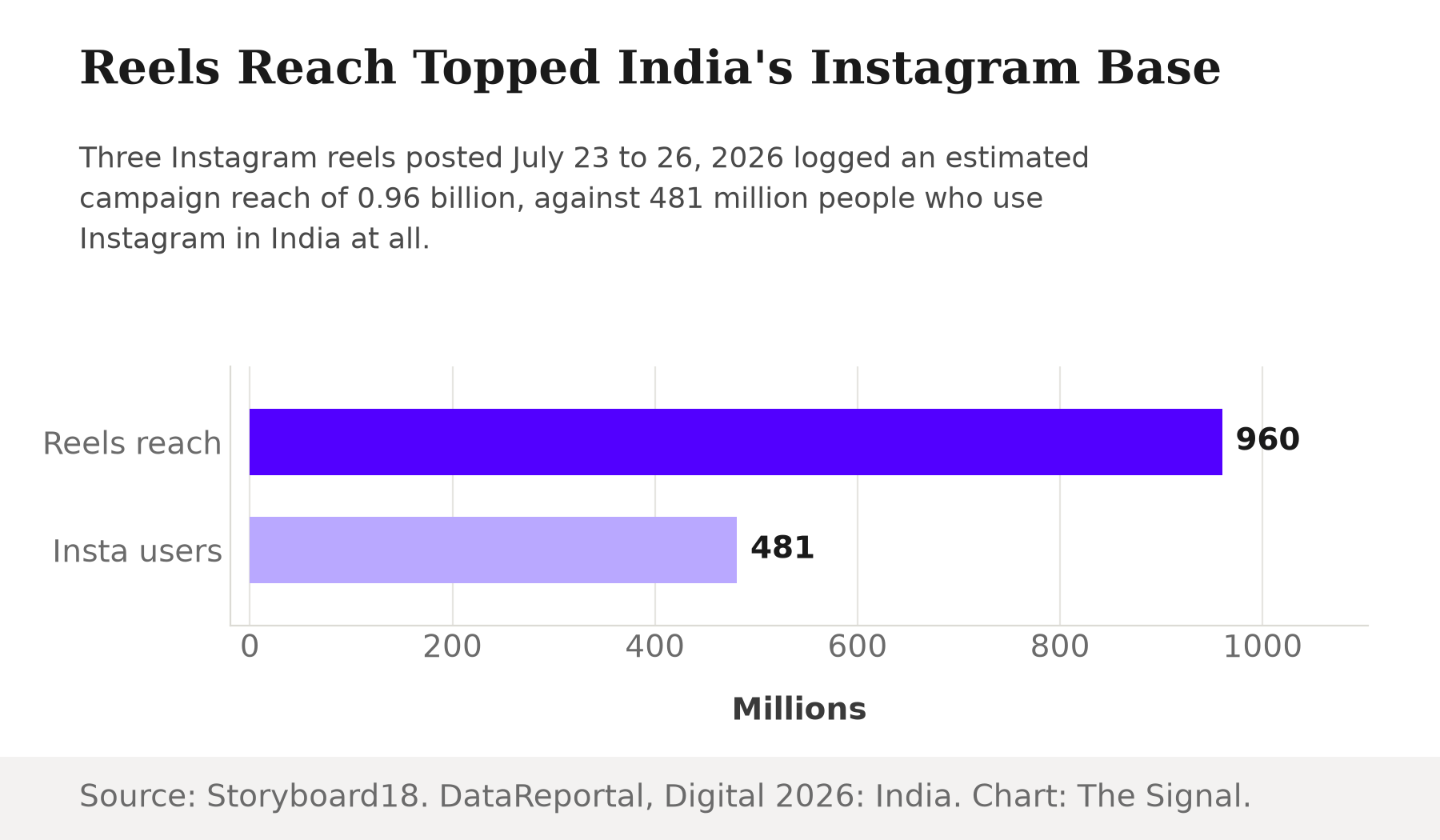
Source: Storyboard18; DataReportal, Digital 2026: India. Chart: The Signal.
The machine behind the message
That distribution machine did not appear in July 2026. It was already the largest in the country. An Association for Democratic Reforms analysis of Meta's Ad Library data shows the BJP's national Facebook and Instagram page spent nearly Rs 194 million, on 43,455 political advertisements, between March 8 and June 6, 2024, the single largest outlay of any party. Over roughly the same run-up to the 2024 Lok Sabha election, BJP was also the top advertiser on Google, spending around Rs 8.8 crore on more than 73,000 ads between March 1 and April 9, 2024. By the time Modi asked his ministers to post more reels, BJP had already spent two years establishing itself as the biggest single buyer of reach on both of the platforms that matter most.
A budget that outgrew every rival
That buying power kept growing after the election was over. BJP's advertising and publicity expenditure rose to Rs 2,257 crore in FY25, from Rs 1,193 crore in FY24, an 89 percent jump in a single year. Total advertising spending across all Indian political parties rose 76 percent year on year to Rs 3,124 crore in FY25. Put those two FY25 numbers together and BJP alone accounted for about 72 percent of every rupee India's political parties spent on advertising in FY25, our calculation from the two filings-based figures. A party that already commands nearly three of every four rupees spent on political advertising is not building an Instagram presence from nothing when it turns its attention to reels. It is redirecting a machine it already owns.
BJP's ad budget nearly doubled in FY25, and already dwarfed every other party's spend.
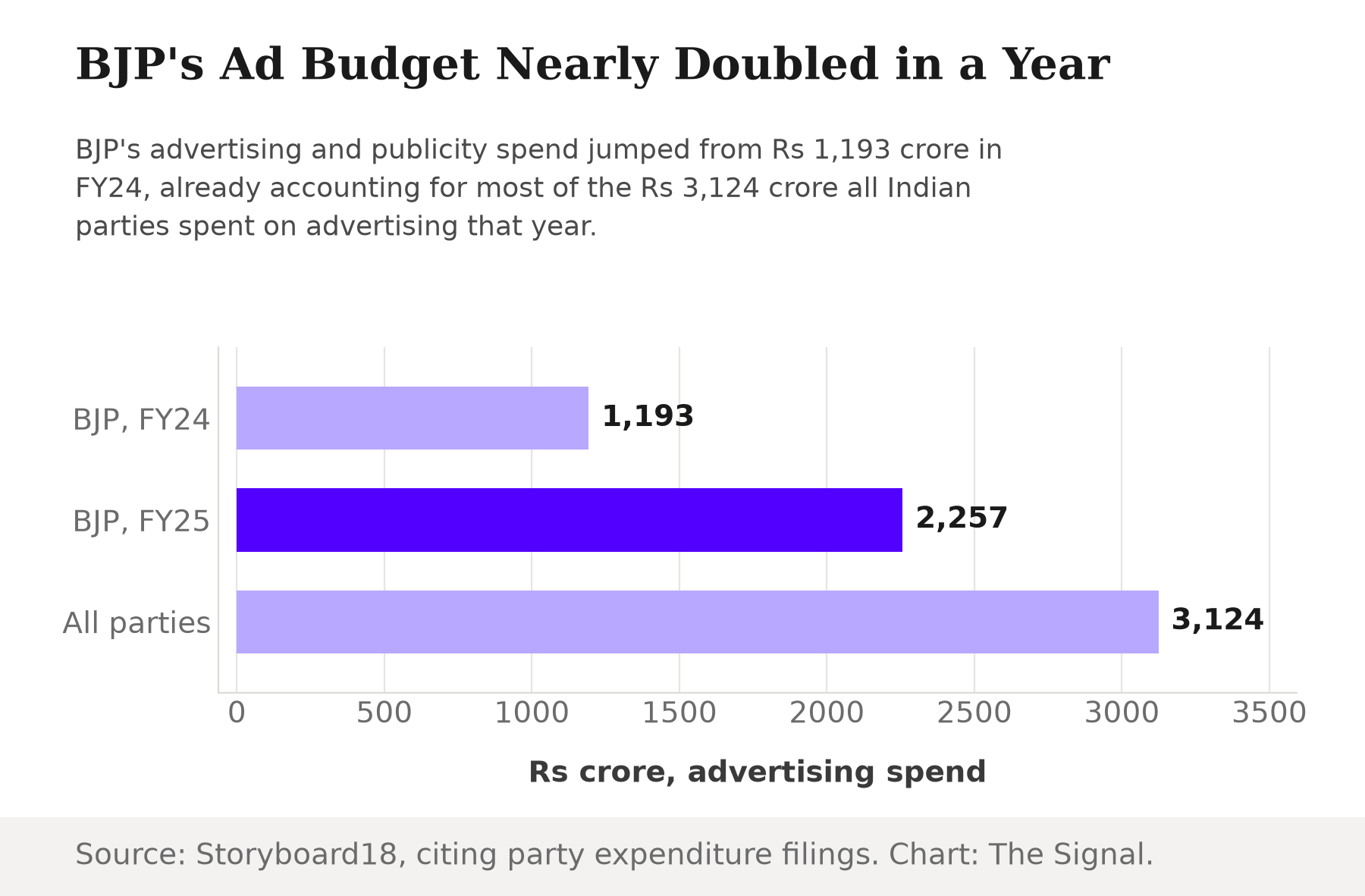
Source: Storyboard18, citing party expenditure filings. Chart: The Signal.
Why Instagram, why now
The platform choice is not incidental. India carries the largest Instagram user base of any country on earth, and the voters BJP most wants to reach through reels are disproportionately young. Election Commission figures published via News on Air counted around 1.8 crore first-time voters aged 18 to 19, alongside 19.74 crore voters aged 20 to 29, on India's rolls for the 2024 Lok Sabha election. That is a cohort measured in hundreds of millions, and the infrastructure to reach it on a phone keeps expanding: India's total internet subscriber base grew 1.54 percent year on year to 969.10 million by March 2025, up from 954.40 million a year earlier, driven mainly by broadband growth.
India's digital base, by the numbers that make an Instagram-first push rational.
| Measure | Figure | As of |
|---|---|---|
| Instagram users in India | 481 million | Late 2025 |
| Internet subscribers in India | 969.10 million | March 2025 |
| First-time voters aged 18-19 on rolls | 1.8 crore | 2024 Lok Sabha election |
| Voters aged 20-29 on rolls | 19.74 crore | 2024 Lok Sabha election |
Source: DataReportal, Digital 2026: India; DD News, citing TRAI; News on Air, citing Election Commission figures.
The honest objection
The strongest case against reading any of this as uniquely a BJP story is that paid, undisclosed political content on social media is not a one-party habit. In the run-up to the 2024 election, an anonymous content creator told Gulf News they had made five sponsored anti-BJP posts, earning about $180 for each, with handlers asking that the sponsorship stay undisclosed. That is real, and it means influencer payments for political content, not always disclosed, cut across the spectrum.
That case is real, though the gap between the two is one of scale and structure rather than kind. A creator earning $180 a post is invisible in any spending filing; BJP's Rs 2,257 crore FY25 advertising budget is filed, disclosed, and dwarfs anything a scattered creator economy can spend. Undisclosed influencer payments are a real and murky layer of Indian political messaging. They are not the layer moving hundreds of crores or driving reach figures that outrun the national user base. That is the disclosed, institutional machine, and it belongs to whichever party can afford to keep feeding it.
The Signal
The story in July 2026 was never that Modi discovered Instagram. It is that a party already spending more on political advertising than every rival combined, on Meta and Google alike since at least the 2024 campaign, pointed that same machine at reels and produced a reach number that cannot be a count of distinct Indian viewers because it exceeds the country's entire Instagram population. Whether that inflated reach converts into anything durable with the tens of crores of young voters BJP is chasing is a separate question from whether the campaign apparatus behind it is real. It is real, it was already the biggest in the country, and it just got a new target. Watch the next spending filing, not the next reel: if BJP's advertising share of the total keeps climbing past 72 percent, the Instagram push was never a departure from the strategy that built its WhatsApp and Google dominance. It was the same strategy, pointed at a new app.
Reporting basis: BJP's 2024 Meta and Google ad spend figures are from the Association for Democratic Reforms' analysis of Meta's Ad Library and from Business Today's reporting of Google's Ads Transparency Report, respectively. BJP's FY24 and FY25 advertising and publicity expenditure, and the all-party FY25 total, are per Storyboard18's reporting of party expenditure filings, as is the estimated reach and engagement of Modi's July 2026 Instagram reels, a figure that rests on that single outlet's report and has not been independently corroborated. India's Instagram user base is per DataReportal's Digital 2026: India report. India's internet subscriber count is per DD News, citing TRAI. First-time and young voter counts are per News on Air, citing Election Commission of India figures. The Instagram outreach directive is per Telangana Today's reporting. The anonymous creator's payment for anti-BJP posts is per Gulf News. BJP's approximate 72 percent share of all-party FY25 advertising spend is The Signal's calculation from the Storyboard18 figures.