On 7 August 2026, Saudi Arabia, Turkiye and Pakistan signed the Mecca Joint Defence Agreement, a mutual-defence pact, formalising military ties between the three governments. Four days later, on 11 August 2026, India's Ministry of External Affairs said it was examining the pact's implications for national security and regional stability, with spokesperson Randhir Jaiswal declining to go further than that. The obvious read is a new bloc taking shape on India's western flank, and a cautious New Delhi watching it form.
It is worth slowing down on that read, because the pact's text is thin on specifics. The more interesting numbers sit one layer down, in what SIPRI's arms-transfer data already show about how Pakistan is armed, by whom, and how that compares with India's own position.
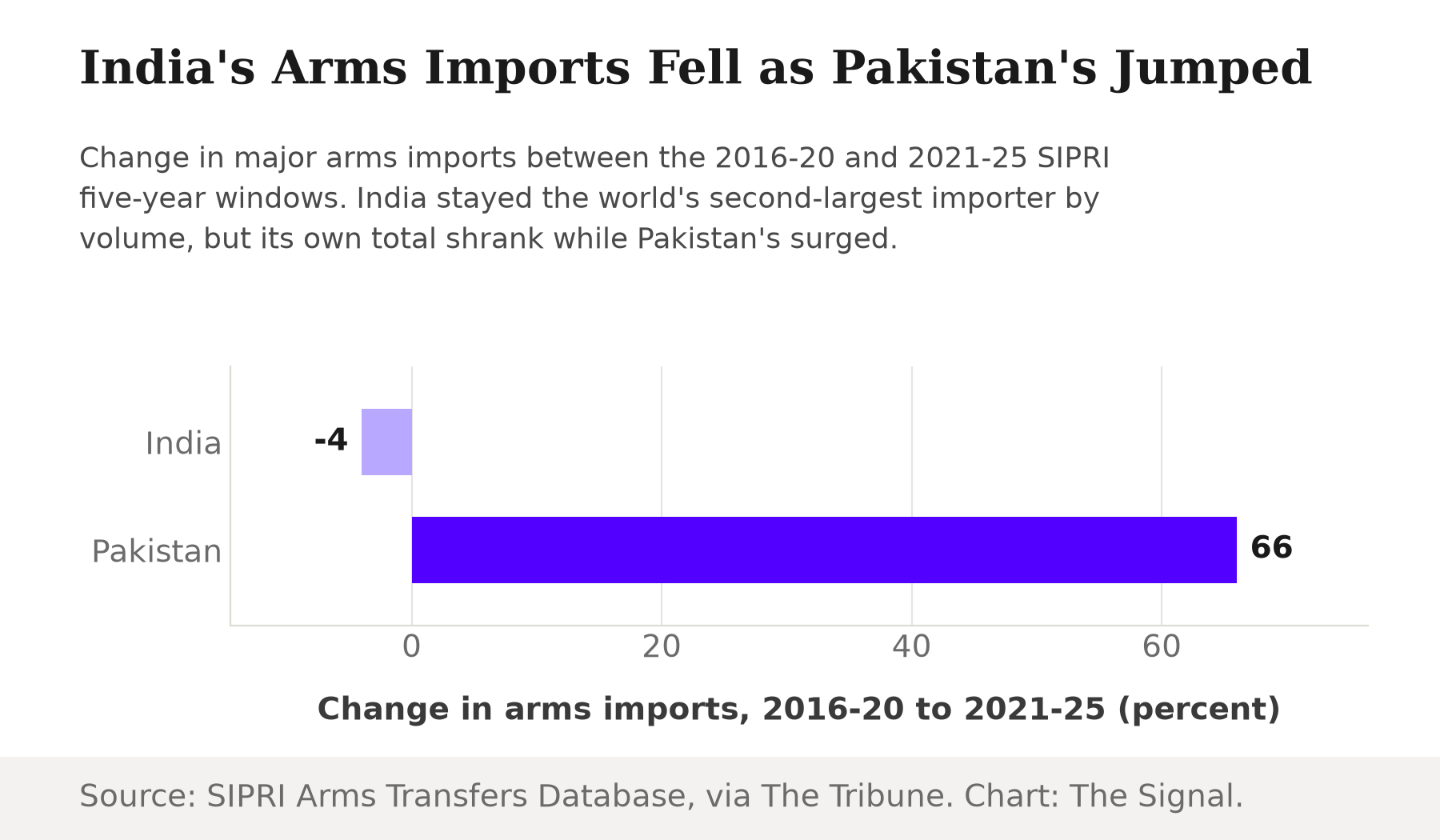
Start with the country everyone already tracks. India was the world's second-largest arms importer in 2021-25, accounting for 8.3 percent of global arms imports, even as its own imports fell 4.0 percent from the 2016-20 period. Pakistan is a fraction of that size, but its line is moving the opposite way: it was the 5th-largest recipient of major arms globally in 2021-25, up from 10th-largest in 2016-20, as its arms imports rose 66 percent between the two periods.
India stayed the bigger buyer. Its trend line and Pakistan's are moving in opposite directions.
Two suppliers, one customer that matters more than its size suggests
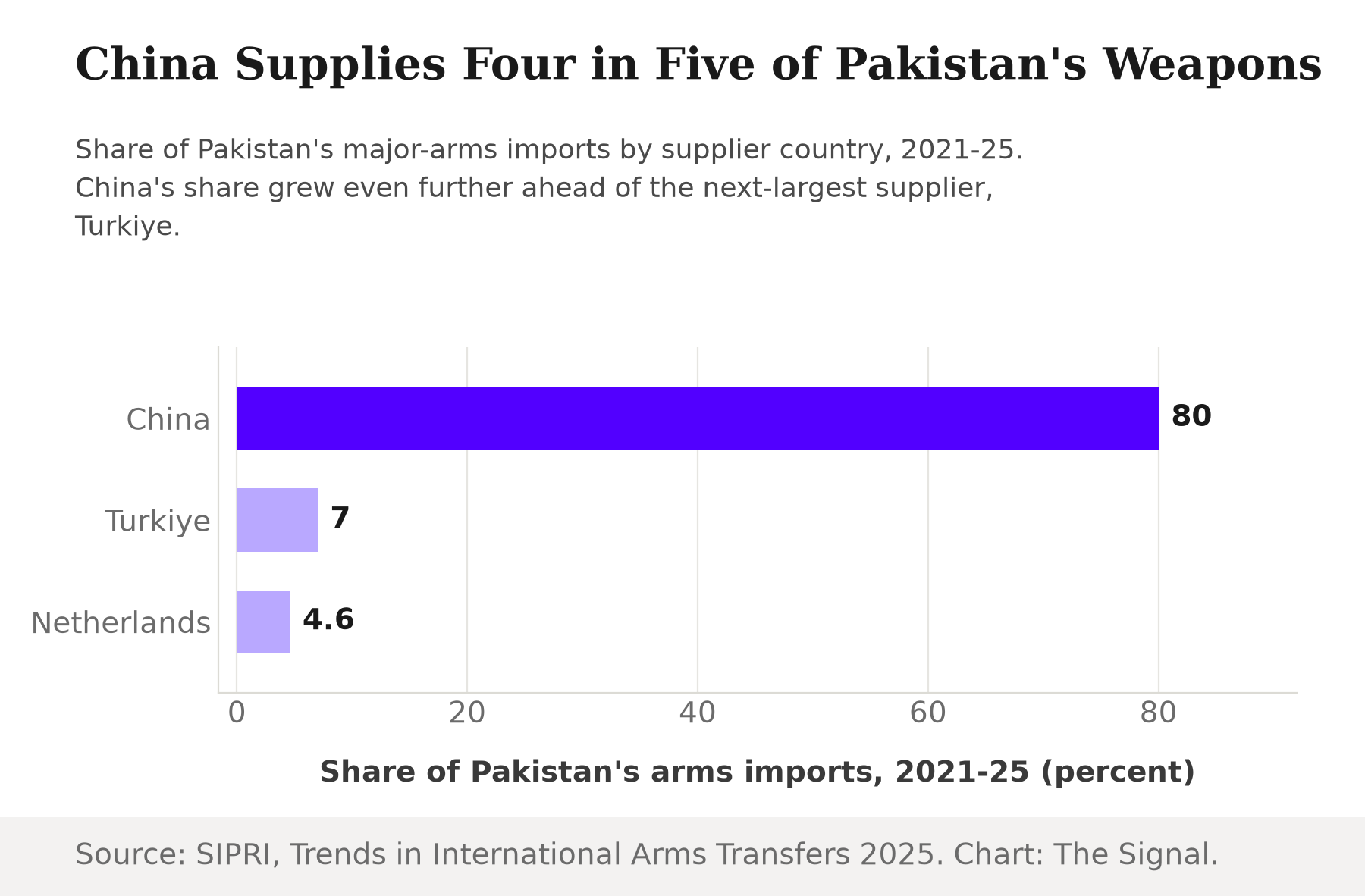
Pakistan's 66 percent rise did not spread across many sellers. China supplied 80 percent of Pakistan's arms imports in 2021-25, up from 73 percent in 2016-20. That is a familiar fact on its own. What is less familiar is how the dependency runs in the other direction too: of the major arms China exported to 47 states in 2021-25, 61 percent went to Pakistan alone. China is not simply Pakistan's arms supplier. Pakistan is, by a wide margin, the largest single customer China's arms industry has.
Turkiye leaned in even harder
China is not the only supplier for whom Pakistan has become disproportionately important. Turkiye's own major-arms exports rose 122 percent between the two SIPRI windows, and Pakistan was its single largest recipient, taking 16 percent of everything Turkiye sold abroad. On Pakistan's side of the same trade, Turkiye supplied 7.0 percent of Pakistan's arms imports in 2021-25, making it Pakistan's second-largest supplier after China.
Turkiye's arms-export growth outran even Pakistan's own import surge.
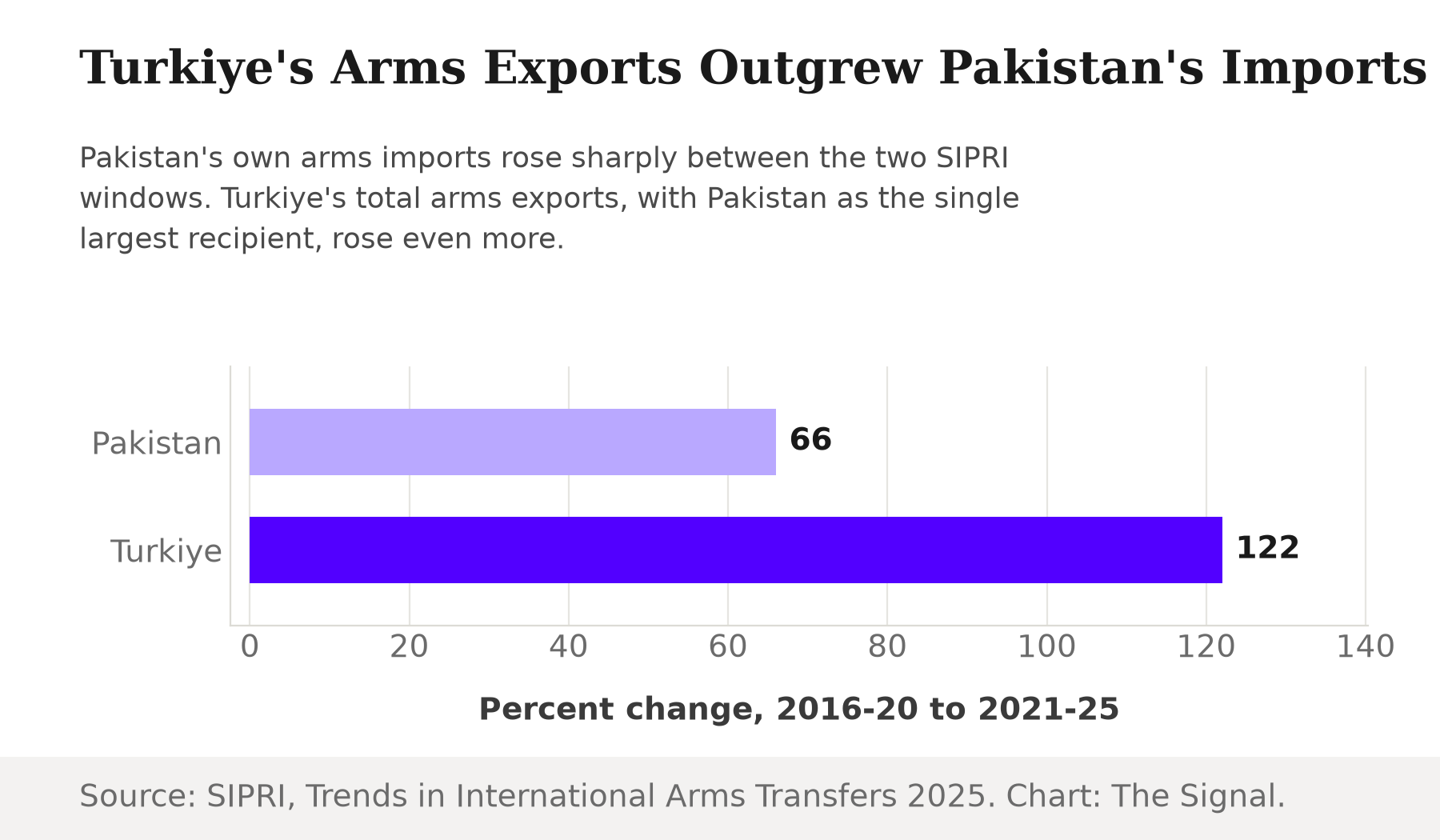
Two suppliers, growing their arms-export businesses at very different speeds, both ended up leaning on the same customer. That is the backdrop the Mecca pact was signed against, not a standalone alliance appearing out of nowhere.
More aircraft, a fraction of the budget
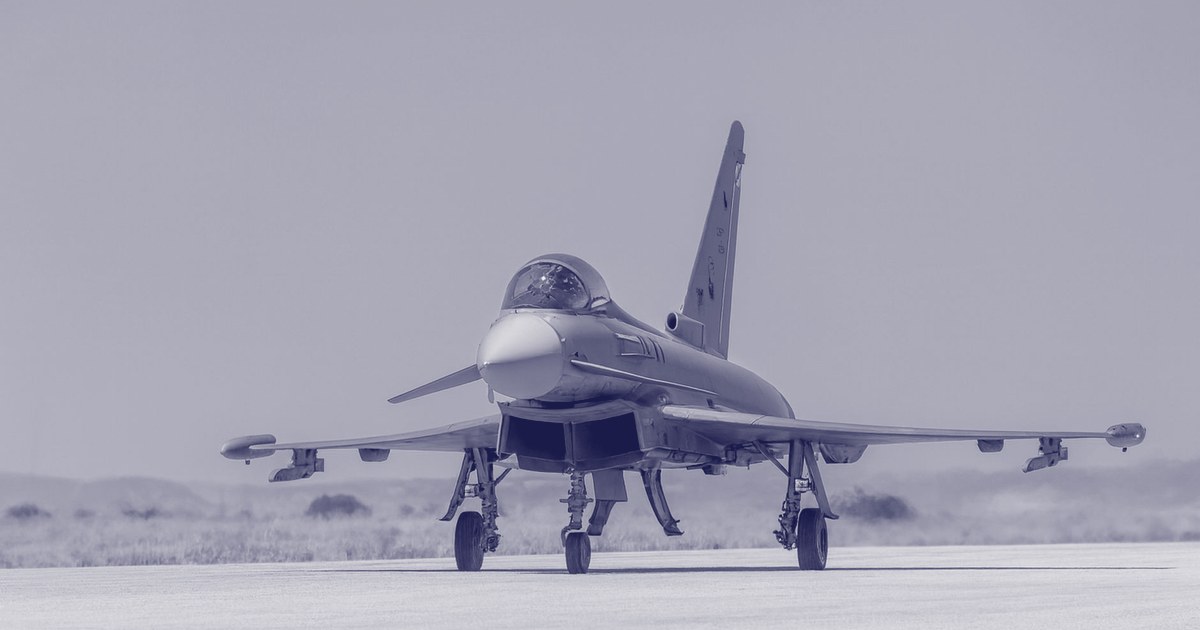
The new pact's third signatory offers a useful sanity check on what all this buying has actually bought. Pakistan fields some 1,397 aircraft against Turkiye's 1,101 and Saudi Arabia's 917, even though Turkiye's defence budget of $51.4 billion is more than five times Pakistan's $9.1 billion.
| Country | Military aircraft | Defence budget |
|---|---|---|
| Pakistan | 1,397 | $9.1 billion |
| Turkiye | 1,101 | $51.4 billion |
Source: Al Jazeera, citing Global Firepower.
Pakistan's fleet is larger on a defence budget less than a fifth the size of Turkiye's. That gap does not mean Pakistan's air force is more capable; a bigger count on a smaller budget usually means older or lighter aircraft, not better ones. Sit Pakistan down at the same table as Turkiye and Saudi Arabia, though, and raw hardware counts alone would understate how differently resourced the three militaries actually are.
What the new pact is building on
The Mecca agreement is not the first time this arrangement has been tested at scale. Under an earlier September 2025 pact, Pakistan's deployment to Saudi Arabia ran to around 13,000 personnel and up to 18 fighter jets, a scale that gives some sense of what "mutual defence" has meant in practice between these two countries already, before Turkiye's formal addition to the pact this August. Whatever the Mecca agreement adds on paper, it is layering onto a relationship that has already moved thousands of troops and dozens of aircraft once before.
That is the context India's Ministry of External Affairs is weighing when it says it is examining the pact's implications for national security and regional stability: not just a new signature, but a documented pattern of Pakistan moving large numbers of personnel and aircraft into Gulf deployments with a partner it now shares a formal pact with.
The honest objection
The strongest case against reading any of this as leverage is that Pakistan's supplier concentration could just as easily be read as a vulnerability. Western arms exporters have long kept Pakistan at arm's length over sanctions history and proliferation concerns, leaving China and, since 2021, Turkiye as the suppliers willing to sell at the volume and financing terms Pakistan wants. A customer with only two real sellers to choose from is not obviously powerful, it is dependent on both staying willing. And the aircraft-count comparison cuts the same way: a bigger fleet built on a fifth of the budget is just as plausible a sign of an under-resourced air force padded with older airframes as it is a sign of efficiency.
That case is real, but it does not erase the other side of the ledger. Whatever Pakistan's own constraints, 61 percent of everything China exported in major arms in 2021-25 went to Pakistan, and Pakistan alone took 16 percent of Turkiye's arms exports as that business grew 122 percent. A supplier that concentrated on one buyer has its own reasons to keep that buyer supplied, financed, and politically aligned. Dependency, in an arms relationship this lopsided, runs both ways.
The Signal
The Mecca pact reads, on its surface, as three governments formalising a defence relationship. Underneath it is a trade relationship that had already tied two of Pakistan's arms suppliers unusually tightly to Pakistan specifically, not just to the region. China's arms-export business now depends on Pakistan for well over half its arms revenue by SIPRI's count, and Turkiye's own arms-export growth has run through the same country as its single largest customer. That is not the profile of a client state so much as a customer both suppliers have strong commercial reasons to keep close, pact or no pact. Watch what comes next in the SIPRI data, not the pact's language: if China's or Turkiye's share of Pakistan's imports starts to fall, the supplier relationship is diversifying. If it keeps climbing, the Mecca agreement will look less like the start of something and more like the paperwork catching up with a dependency that was already this deep.
Reporting basis: the arms-trade figures for Pakistan, China, Turkiye and India are from SIPRI's Trends in International Arms Transfers, 2025 fact sheet and its accompanying March 2026 press release, both primary releases of SIPRI's Arms Transfers Database; India's ranking and year-on-year change are as reported by The Tribune, citing the same SIPRI database. The Mecca Joint Defence Agreement's signing is per the Atlantic Council's dispatch. The aircraft and defence-budget comparison is per Al Jazeera, citing Global Firepower data. India's Ministry of External Affairs statement is as reported by The Wire. The September 2025 Pakistan-Saudi deployment figures are per AeroTime. The Turkiye-Pakistan defence-budget ratio is The Signal's calculation from those Al Jazeera-reported figures.