In October 2024, India's Ministry of Defence signed a tri-service contract with the US government for 31 MQ-9B Predator drones: 16 SkyGuardians and 15 SeaGuardians, split across the Navy, Army and Air Force. The Defence Acquisition Council had accorded the Acceptance of Necessity back in June 2023, the US State Department cleared the sale in February 2024, and the Cabinet Committee on Security approved the finalised deal, valued at approximately $4 billion, on 9 October 2024. The government's own year-end account frames it as a modernisation milestone, paired with a separate logistics contract for depot-level maintenance inside India. Read the announcements in sequence and the story is a straightforward capability upgrade: India buys the same high-altitude, long-endurance drone the US flies, and gets a maintenance ecosystem to keep it flying at home.
It is worth slowing down on that framing. The MQ-9B is built by General Atomics, the same manufacturer that builds the US military's MQ-9A Reaper, the workhorse drone that has flown in Afghanistan, Iraq, Yemen and now Iran for two decades. And the manufacturer's flagship product has just had a very bad year in combat.
Forty-five Reaper drones, worth more than $1.3 billion, are gone since the war with Iran began.
Before the war with Iran, the US military operated about 185 Reapers, 165 in the Air Force and 20 in the Marine Corps. It has since lost at least 45 of them, as of 13 August 2026, the most recent reporting available. Three US officials told The Washington Post the cause is structural, not incidental: the Reaper's relatively slow speed and low-altitude operating profile make it an easy target for Iranian forces and Iran-backed groups in Yemen and Iraq. That is how the airframe behaves whenever it flies into airspace that can shoot back, not a one-off wartime accident.
A fleet that keeps shrinking
The Air Force's own inventory numbers show the same story from a different angle. Its MQ-9A count fell from 231 aircraft at the start of Fiscal Year 2025 to 165 at the start of FY2026, and down to 135 by May 2026, as combat losses from Operation Epic Fury against Iran piled up. General Atomics has told the Air Force that fewer than ten new MQ-9As are available to any customer anywhere in the world right now. The company that is about to hand India 31 drones is, at the same moment, struggling to replace the ones the US has lost.
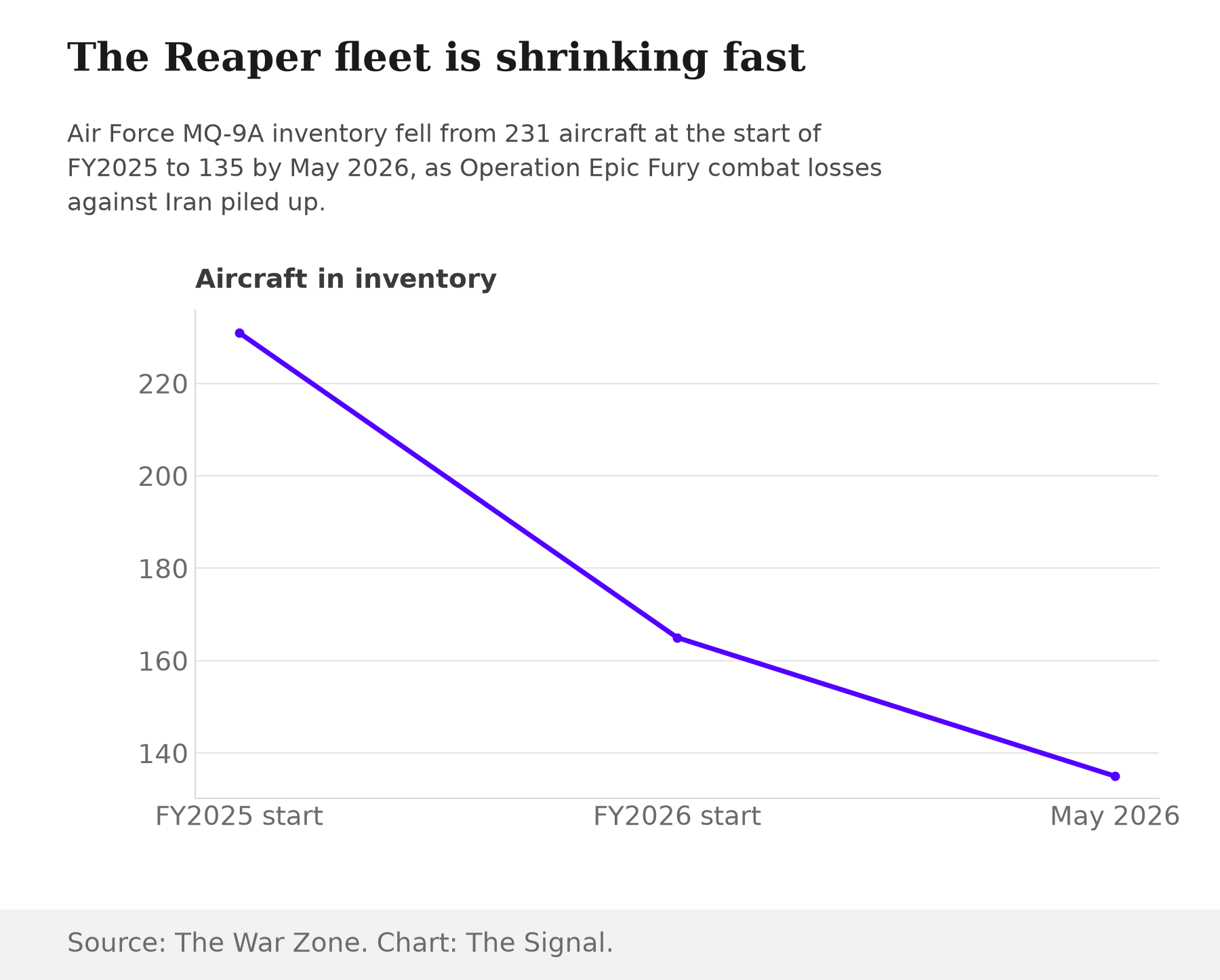
Source: The War Zone. Chart: The Signal.
This is not confined to one front. Houthi forces in Yemen shot down seven US Reaper drones in less than six weeks between 31 March and 22 April 2025, a loss of aircraft worth more than $200 million against an adversary with a fraction of Iran's air defence budget. The pattern now spans two separate conflicts, two years apart, against two different opponents, with the same result: a slow-flying, non-stealth drone loses aircraft steadily once it operates inside range of serious ground-based air defence.
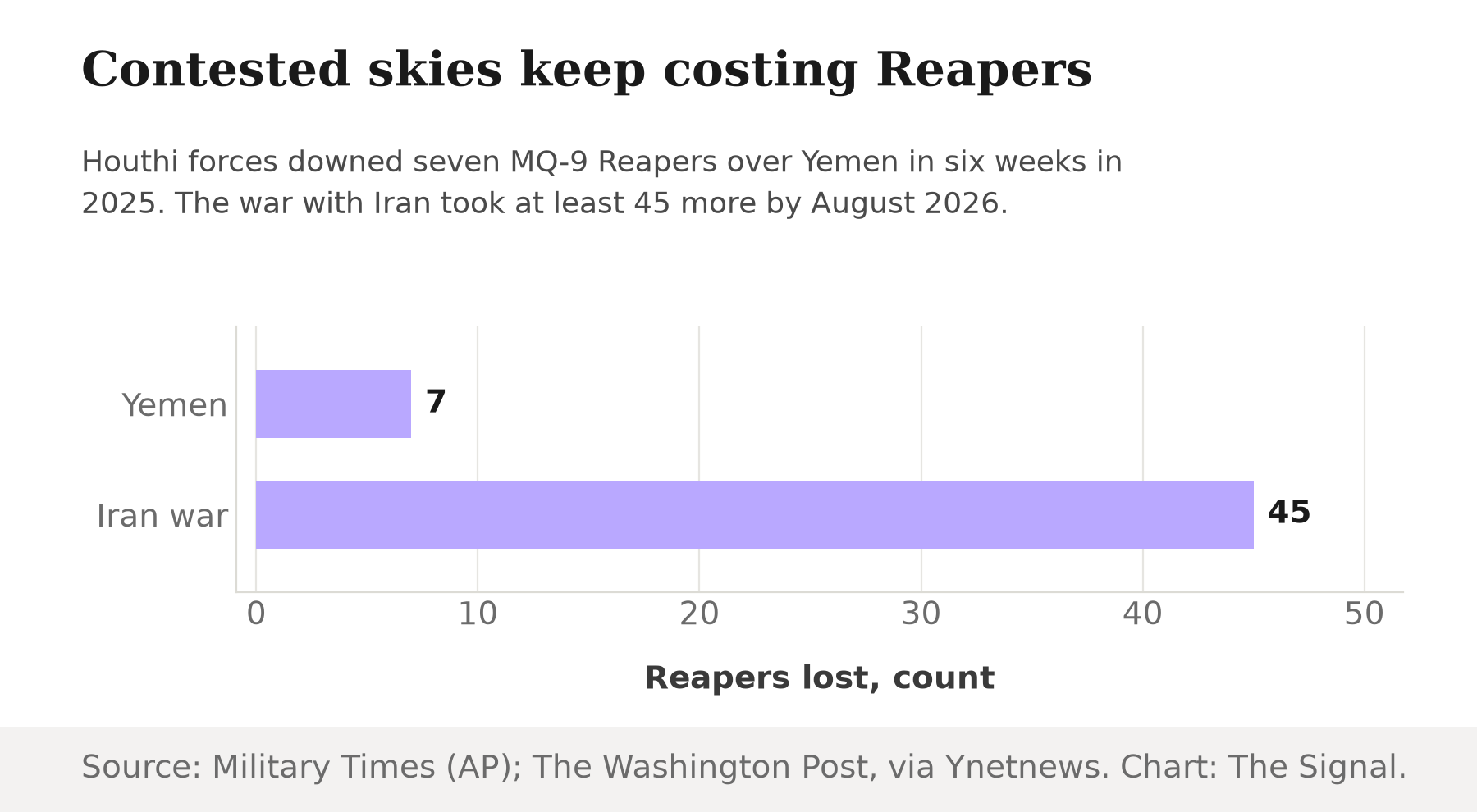
Source: The Washington Post, via Ynetnews; Military Times, citing the Associated Press. Chart: The Signal.
Why this is not just a US problem
India's own experience with this exact drone family already carries a warning, even without enemy fire involved. One of the Indian Navy's two leased MQ-9B SeaGuardians was lost in a controlled ditching into the Bay of Bengal after a technical snag in mid-September 2024; General Atomics has since delivered a replacement. The same report notes that Indian officials tied the follow-on 31-drone purchase directly to operations along the country's "contested borders with China," a border that includes some of the most heavily air-defended terrain either country holds. These drones are headed for the Line of Actual Control, not some quiet frontier.
| Milestone | Date | Estimated cost |
|---|---|---|
| DAC Acceptance of Necessity, 31 drones | 15 June 2023 | $3,072 million (US govt estimate) |
| DSCA notifies US Congress | 1 February 2024 | $3.99 billion |
| Contract signed, CCS approval | 9 to 15 October 2024 | Approximately $4 billion |
The estimate rose by roughly $900 million to $1 billion across the 16-month approval process. Source: PIB; Deccan Herald; The Tribune. Our calculation.
The deal's own spec sheet doubles as the case for why India wants it: the drones can stay airborne for more than 35 hours, carrying four Hellfire missiles and about 450 kg of bombs, an endurance and payload combination no manned aircraft can match for persistent border watch. That case is real. The question the US combat record raises is not whether the drone is useful. It is what happens to that same endurance advantage the day it flies within range of a modern integrated air defence system, the kind China has built up steadily along its side of the LAC.
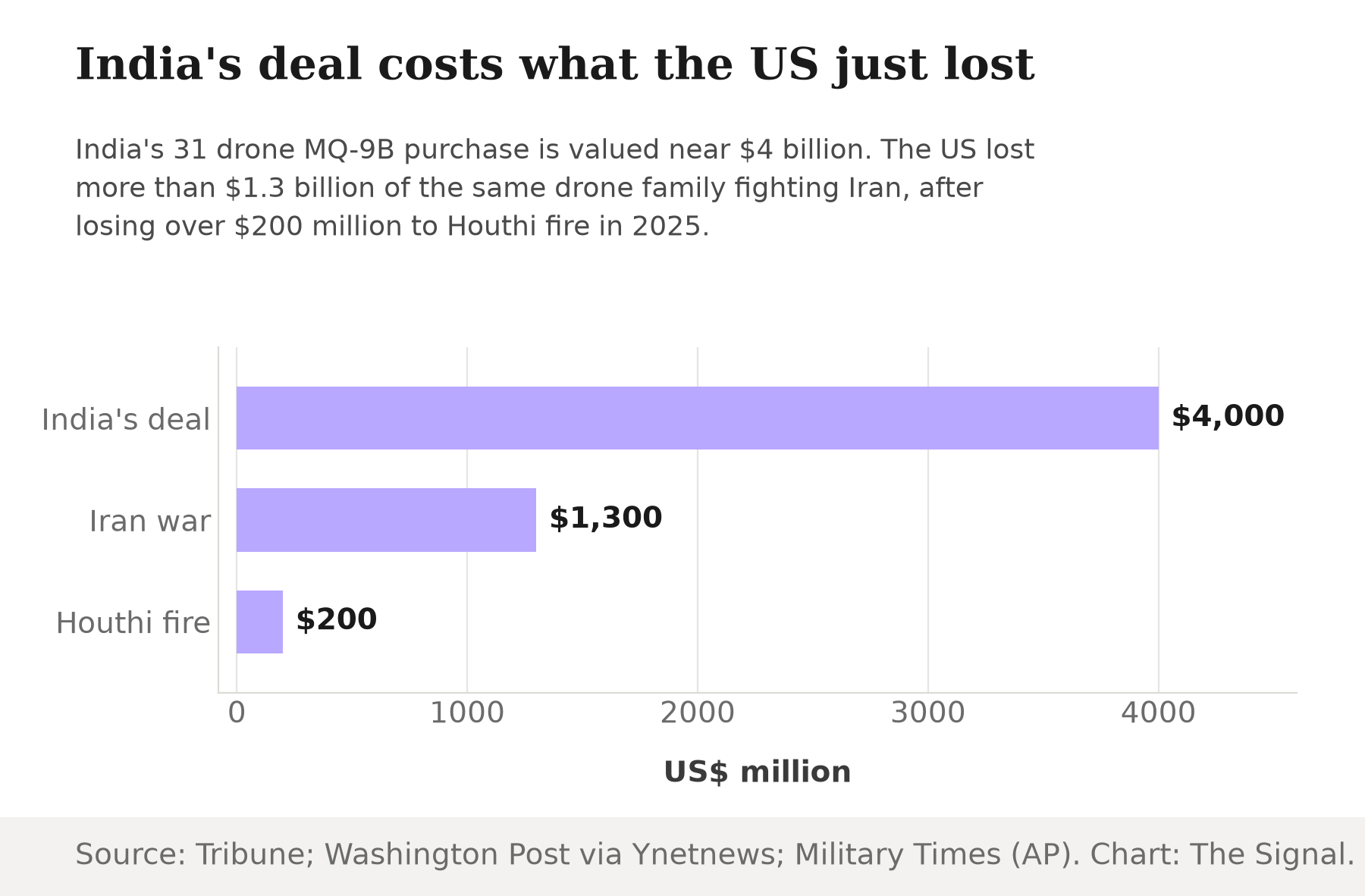
Source: The Tribune; The Washington Post, via Ynetnews; Military Times, citing the Associated Press. Comparison is The Signal's calculation. Chart: The Signal.
The honest objection
The strongest case against reading too much into the US combat record is that the MQ-9B is not the same aircraft as the MQ-9A Reaper being shot down in Yemen and Iran. It is a newer, more capable variant, certified for civil airspace and built with maritime patrol and long-range ISR as core missions, not the low-level strike sorties that have exposed Reapers to ground fire over contested Middle Eastern airspace. India's SeaGuardians will spend much of their service life watching sea lanes and the Himalayan frontier, not flying close support over active battlefields. Doctrine and mission profile matter as much as airframe.
That case holds only so far. The Washington Post's officials were explicit that the vulnerability is not incidental to the Yemen and Iraq campaigns; it is a function of "relatively slow speed and low-altitude operating profile," design traits the MQ-9B shares with its MQ-9A sibling because both descend from the same General Atomics airframe family. A border-watch mission does not require flying at 300 knots or above the reach of modern surface-to-air systems either. If China's air defence coverage along the LAC forces these drones to operate anywhere within its engagement envelope, in a crisis, the same physics that downed 45 Reapers over Iran applies regardless of which mission the aircraft was originally built for.
The Signal
India bought endurance and payload, not survivability, and the fine print of its own vendor's combat record says survivability is exactly what breaks down once one of these drones flies into contested airspace. The Bay of Bengal ditching in 2024 already cost India one aircraft to a technical fault, before a single shot was fired. Watch what happens if New Delhi ever needs to fly a SkyGuardian or SeaGuardian inside China's actual air-defence envelope rather than just along its edge. A deal valued at approximately $4 billion built for endurance is only as useful as the number of airframes still flying when it matters, and General Atomics' own recent order book says that number can erode quickly.
Reporting basis: the DAC Acceptance of Necessity and the 2024 Ministry of Defence year-end review are from Press Information Bureau releases; the tri-service contract signing is per All India Radio (Prasar Bharati). The DSCA's congressional notification is per Deccan Herald, and the Cabinet Committee on Security approval and deal specifications are per The Tribune. The Navy's SeaGuardian loss and its replacement are per Deccan Herald, citing PTI. The US Air Force's Reaper losses in the Iran war and its pre-war fleet size are from The Washington Post's reporting, via Ynetnews, citing three US officials; the Air Force's MQ-9A inventory count over time and General Atomics' near-empty new-build pipeline are per The War Zone. The Houthi shootdown figures are per the Associated Press, via Military Times. The rise in the deal's estimated cost across its approval timeline and the comparison between India's deal value and US combat losses are The Signal's calculations from those figures.