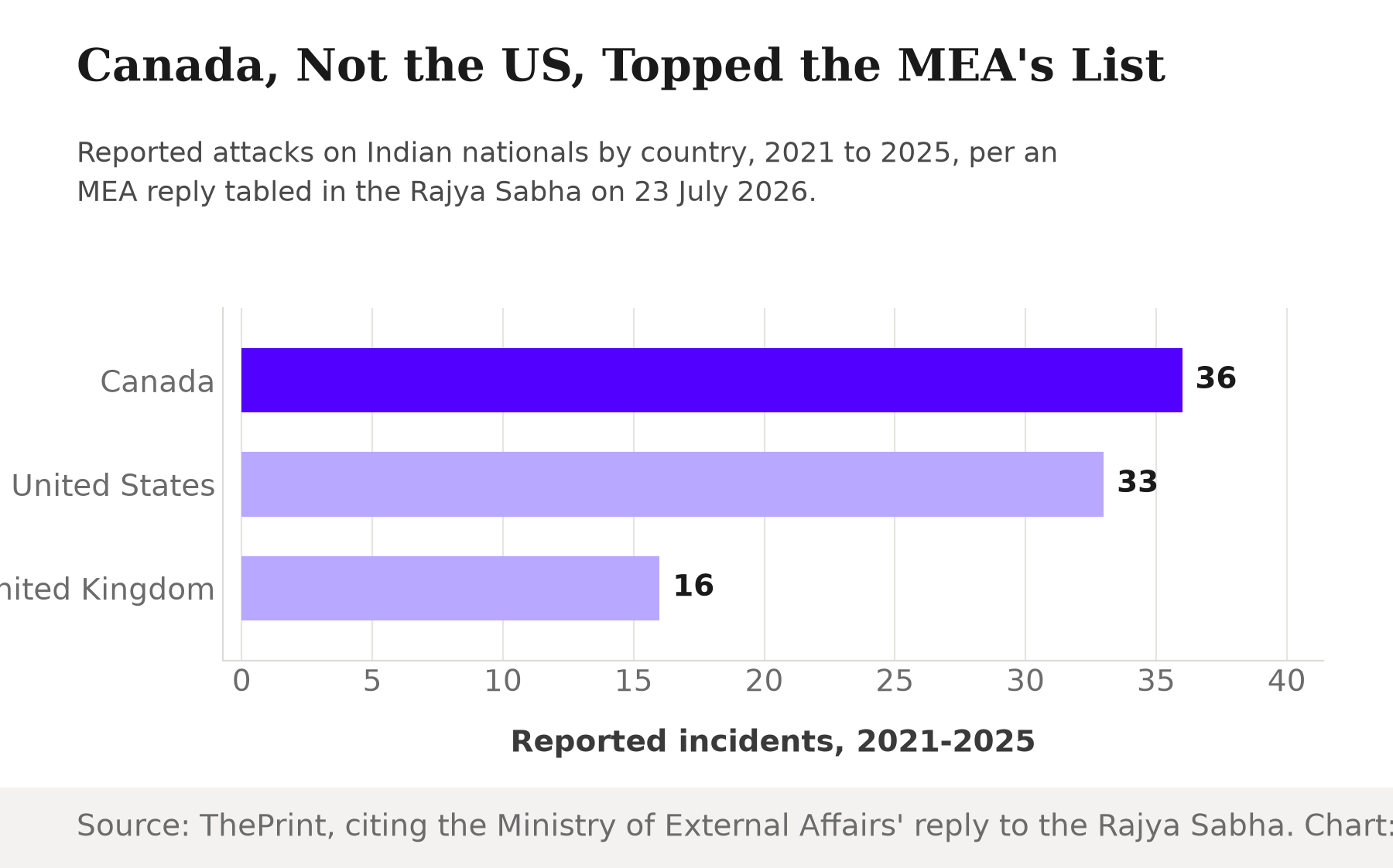
On 23 July 2026, the Ministry of External Affairs answered a question in the Rajya Sabha about attacks on Indian nationals abroad, and the reply overturned which country most people would guess leads the list. Canada recorded the highest overall number of reported incidents during the period, with 36 cases between 2021 and 2025, followed closely by the United States with 33 and the United Kingdom with 16. The gap between the top two is a single incident. In the same reply, the government recorded 14 reported attacks on Indian nationals in the United States in 2025, up from 11 in 2024, a rise of three incidents in a single year.
It is worth being precise about what this ranking is not: the first sign of trouble. The Ministry had already issued two separate advisories about Canada before this reply reached Parliament.
MEA advisories preceded the July 2026 ranking by nearly three years.
| Date | Event | MEA action |
|---|---|---|
| September 2023 | Rising hostility toward Indian nationals in Canada | Advisory citing "growing anti-India activities and politically-condoned hate crimes and criminal violence" |
| December 2024 | Three Indian students killed in separate incidents | Fresh advisory for over 400,000 Indian students citing a "deteriorating security environment" |
| July 2026 | MEA reply tabled in the Rajya Sabha | Canada confirmed as the highest of three countries on the cumulative 2021-2025 count |
Source: ThePrint, reporting the Ministry of External Affairs' advisories and reply.
In September 2023, the MEA issued a formal advisory to Indians in Canada citing "growing anti-India activities and politically-condoned hate crimes and criminal violence" as the reason for the warning. Fourteen months later, three Indian students were killed in unrelated incidents in Canada in early December 2024, and the MEA issued a fresh advisory for its more than 400,000 students in Canada to exercise extreme caution given the "deteriorating security environment". Both advisories predate the July 2026 reply by well over a year. Canada topped the ranking anyway.
What 36 is actually counting
Strip the ranking down to what it measures and the word "attacks" is doing more work than the number can support. Thirty-six incidents against Indian nationals specifically, confirmed through consular channels and reported to Parliament, over five years, is not a measure of how dangerous Canada has become for South Asians broadly. Canada keeps its own count of that, and it runs in a different order of magnitude. Statistics Canada recorded 483 police-reported hate crimes targeting the South Asian population in 2025 alone, up from 167 in 2021, a group far broader than Indian nationals but the closest population-level measure available. In 2025 alone, Canada's police counted more than thirteen times the MEA's entire five-year Canada tally: our calculation from the two counts.
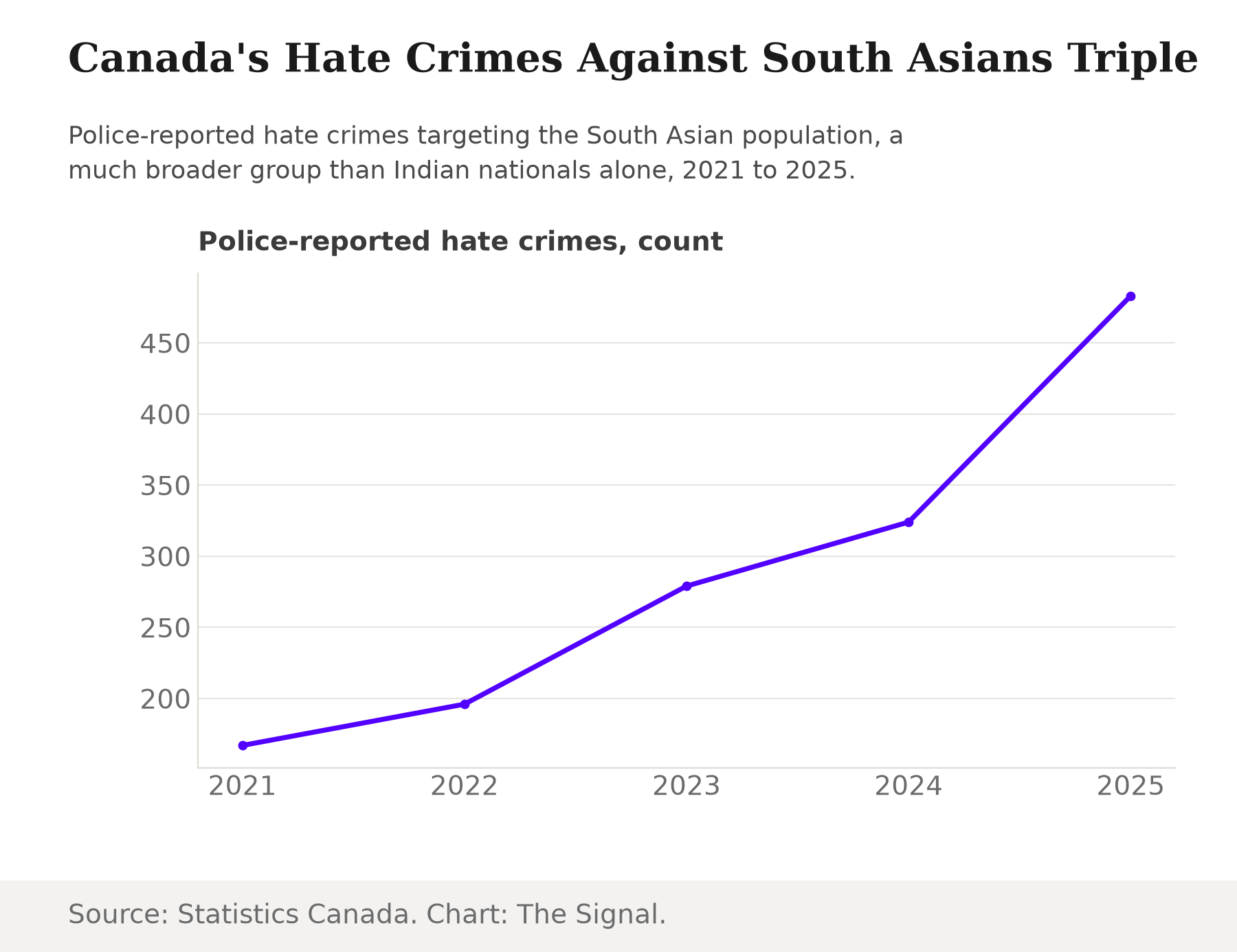
The direction has not reversed at any point since. Police-reported hate crimes against the South Asian population in Canada rose every year from 167 in 2021 to 483 in 2025, a run that passes through both of the MEA's own Canada advisories without slowing.
The population check
The same test works for the United States, where the MEA's cumulative tally is 33 incidents across five years. The Asian Indian population in the United States reached 5.6 million in 2024, the second-largest Asian-origin group in the country after Chinese Americans. Thirty-three incidents against a population of 5.6 million works out to just under six incidents per million people across the entire five-year window, not per year: our calculation from the two figures. That is not a population-wide risk. It is a small number of specific, serious incidents that the government considered significant enough to log and report to Parliament, sitting inside a population measured in the millions.
The UK, at a different scale
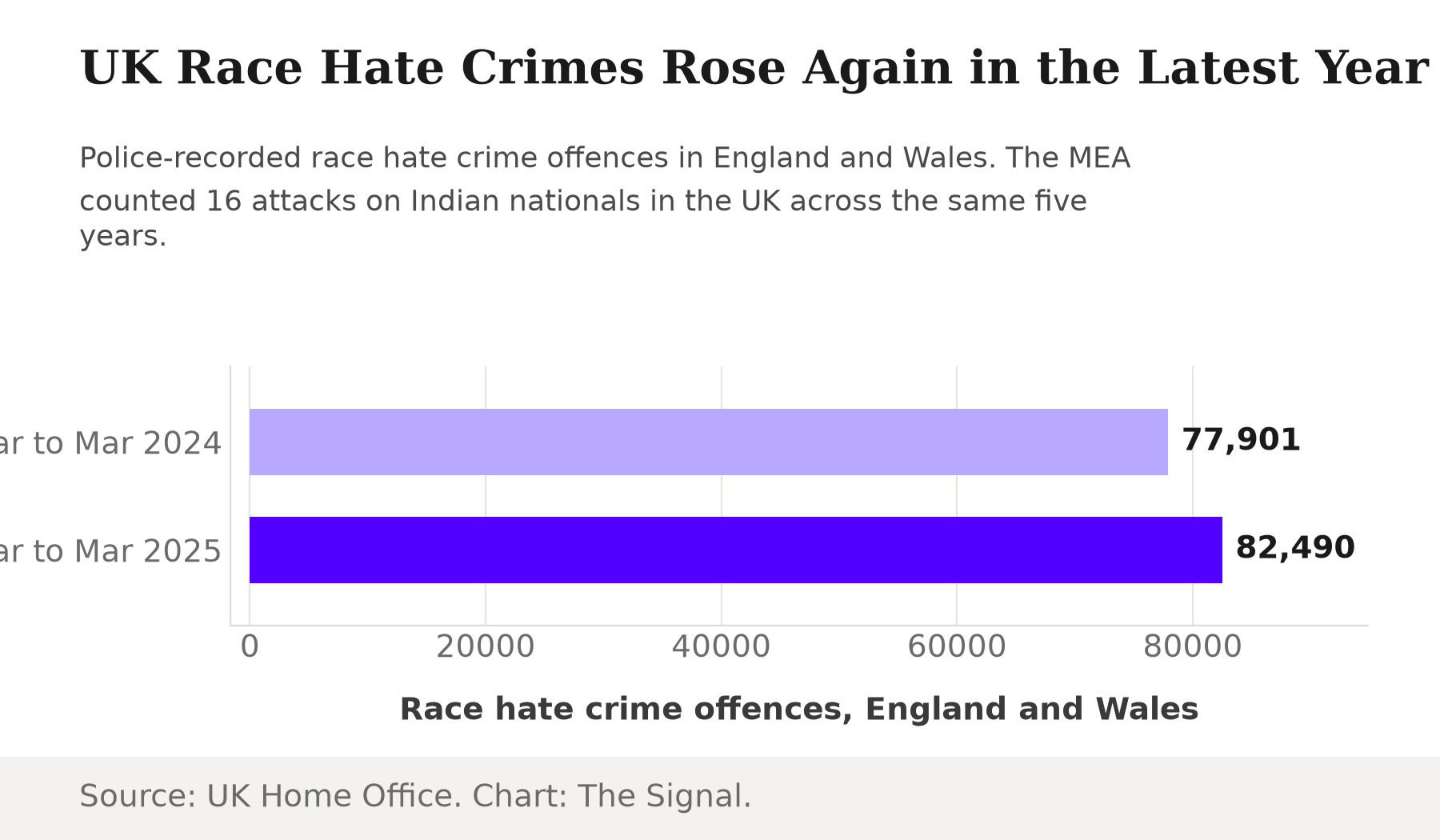
The UK follows the same pattern with its own numbers. Race-motivated hate crimes recorded by police in England and Wales rose 6 percent year-on-year to 82,490 offences in the year ending March 2025, up from 77,901 the year before. The MEA's cumulative count for the UK across the same run of years is 16.
The honest objection
The strongest case against stacking these numbers together is that they are not measuring the same thing. The MEA's tally covers incidents against Indian nationals specifically, confirmed through consular channels and reported to Parliament. Statistics Canada's and the UK Home Office's hate crime data cover much broader categories, all South Asians in Canada's case and all races in England and Wales's, gathered through standard police reporting rather than diplomatic channels. A small MEA number does not prove Indian nationals are safe; it may simply mean most incidents against them never reach a consulate to be logged at all. On this reading, the 36-versus-483 comparison is not exposing an undercount so much as comparing two instruments built for two different jobs.
That case holds up, and it is the honest reason not to read the MEA's country ranking as a safety index. But it argues against complacency, not toward it. The MEA's own September 2023 advisory and its December 2024 advisory both invoked the broader hate crime and criminal violence environment, not the consular incident count, as the reason for warning travelers. The Ministry's own actions already treat the wider trend as the real signal. Its published country ranking is just not built to show it.
The Signal
The number worth remembering here is not 36, and it is not "highest of three." It is the gap between the MEA's 36 and Statistics Canada's 483: two counts of the same underlying reality, in the same country, off by more than an order of magnitude. Parliament's tally will keep making headlines each time a fresh version is tabled, because it is precise, attributable to a named government reply, and easy to rank into a league table. Statistics Canada's count is the one that has risen every year without exception since 2021, and it is the measure the MEA itself has already been citing in its own advisories, well before this ranking existed. Watch which number moves the next time a country gets a fresh travel advisory. It will not be the one Parliament ranks by.
Reporting basis: the Rajya Sabha reply figures and the 2023 and 2024 MEA advisories are all as reported by ThePrint, across three separate pieces; that is one origin used three times, not three independent confirmations. The Canada hate crime series is Statistics Canada's own published data. The England and Wales hate crime figures are the UK Home Office's official statistics. The Asian Indian population figure is the US Census Bureau's. The thirteen-times comparison between the MEA's five-year Canada count and Statistics Canada's 2025 total, and the per-million rate for the United States, are The Signal's calculations from those figures.