On Saturday, Union Education Minister Dharmendra Pradhan resigned, and within hours the Cockroach Janta Party called off its 36-day protest at Delhi's Jantar Mantar with immediate effect, saying the government had accepted all its demands. By then the anger had long since left Delhi. Protests over the NEET paper leak had spread to Mumbai, Hyderabad, Bengaluru and Ahmedabad, and included a 26-day hunger strike by one activist. The story wrote itself: a Gen Z-led uprising over exam fairness had just claimed a cabinet minister's job.
It is worth slowing down on that read. NEET-UG has survived leak allegations before without costing a minister his post. What turned this leak into a resignation was not that it happened. It is how many people one leak could hurt.
India runs roughly 17 NEET aspirants for every sanctioned MBBS seat.
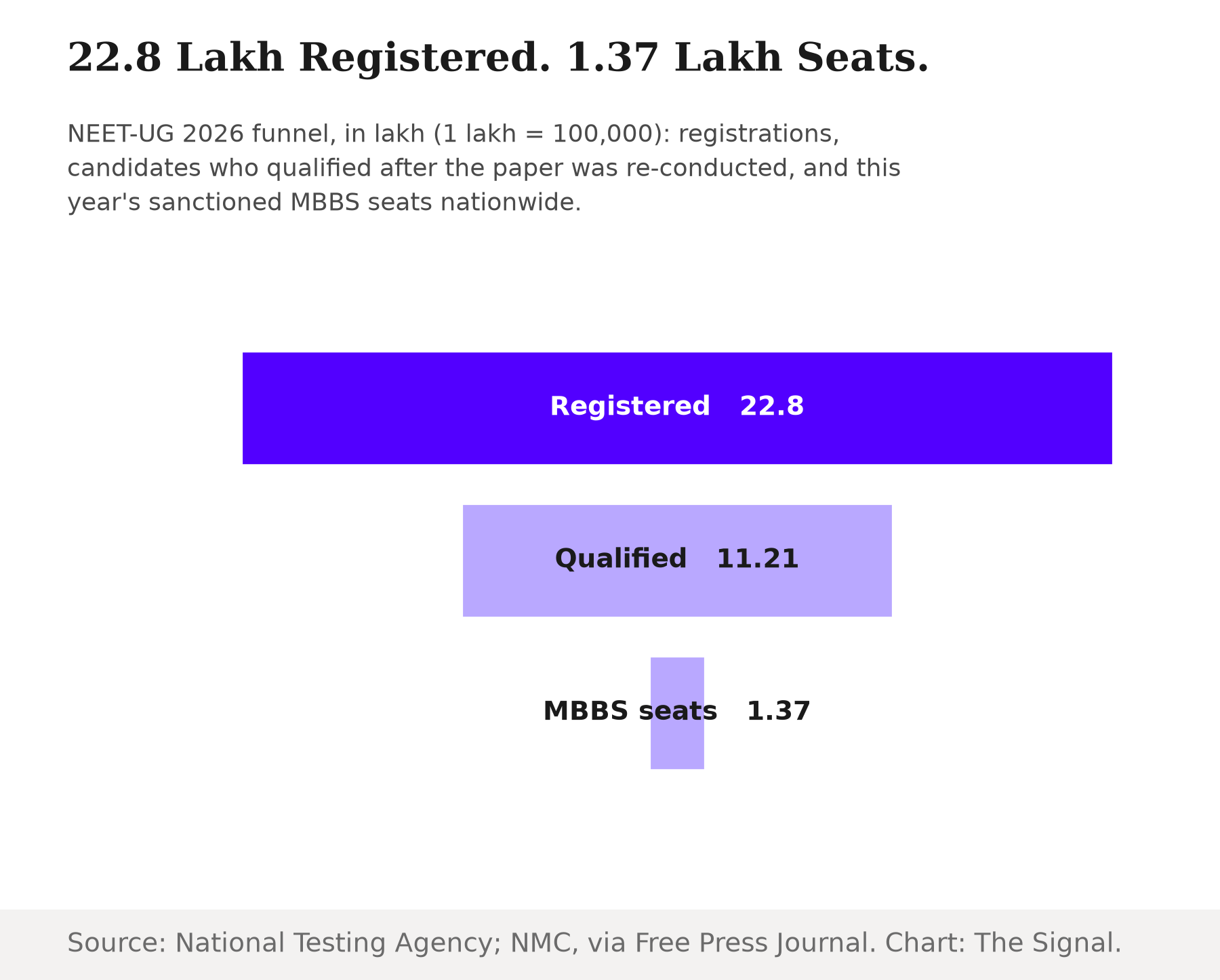
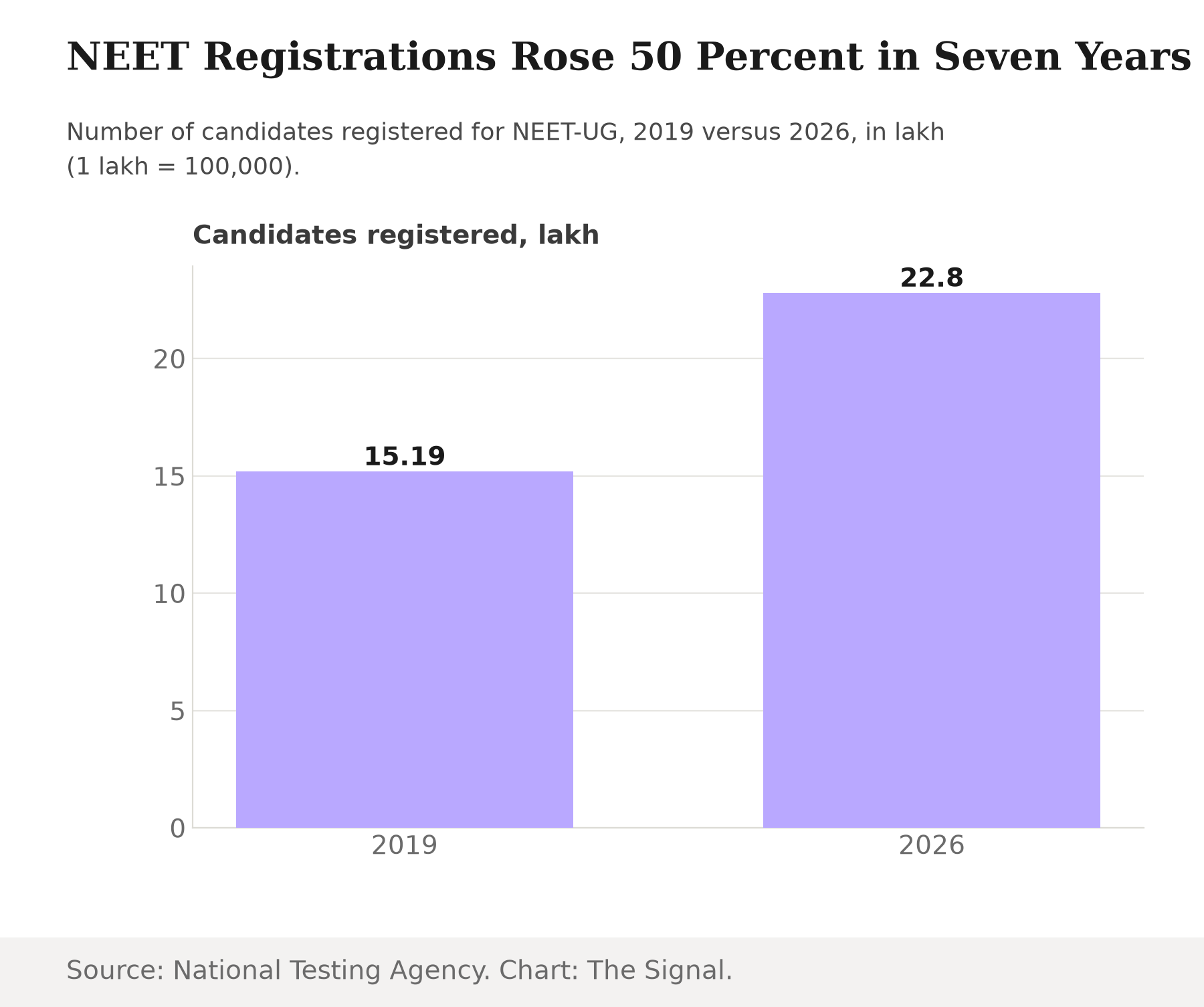
NEET-UG registrations rose from 15,19,375 candidates in 2019 to 22,79,743 in 2026, an increase of about 50 percent in seven years, the National Testing Agency's official data show. Against that pool, the National Medical Commission's seat-matrix notice puts the country's sanctioned capacity at 1,36,939 MBBS seats across 823 medical colleges for the 2026-27 academic session. Divide one by the other and the number is blunt: about 17 registered aspirants for every seat that exists. A leak on an exam that oversubscribed does not dent a handful of applications. It threatens the one shot millions of outnumbered aspirants were counting on.
The leak and the crackdown
The scandal began in May. The CBI registered an FIR on 12 May 2026 over alleged irregularities and a paper leak in the NEET-UG 2026 exam held on 3 May 2026, according to a Press Information Bureau release citing the Ministry of Home Affairs. Three days later, the CBI arrested the alleged kingpin of the leak, a chemistry lecturer involved in the exam process, on 15 May 2026 in Pune, a separate PIB release states. The agency then scrapped and re-ran the exam rather than let a compromised result stand. In the re-conducted NEET-UG 2026 exam, close to 20 lakh candidates appeared and 11.21 lakh qualified, with results declared on 16 July 2026, the National Testing Agency's press release states.
Each step, an FIR, an arrest, a re-conducted exam, was the system working as designed. None of it changed how many seats were waiting at the end. That gap between a functioning investigation and an unmoved seat count is what kept the protest alive for 36 days after the leak was already old news.
The scarcity math
The seat shortage is not new, and supply has genuinely grown. The number of medical colleges rose from 387 in 2014 to 844 now, and MBBS seats rose from 51,348 to 1,39,489 over the same period, Minister of State for Health Anupriya Patel told the Lok Sabha on 24 July 2026.
A decade of seat-building, in one table.
| 2014 | Now (2026) | |
|---|---|---|
| Medical colleges | 387 | 844 |
| MBBS seats | 51,348 | 1,39,489 |
Source: Business Today, citing a Lok Sabha reply from the Minister of State for Health.
Colleges more than doubled and seats nearly tripled since 2014, per that same Lok Sabha reply. But that is a twelve-year comparison, and demand did not wait a decade to catch up. Registrations alone climbed about 50 percent in just the seven years since 2019, keeping the current ratio of applicants to seats close to where it has long been.
Seventeen-to-one is not a universal feature of exam-gated medical admissions; it is a specifically Indian degree of scarcity. In the United States, 52,577 people applied to MD-granting medical schools in the 2023-2024 cycle and 22,981 matriculated, a ratio of roughly 2.3 applicants for every enrolled seat, per the Association of American Medical Colleges' own admissions data. India's aspirant-to-seat ratio runs about seven times deeper than America's 2.3-to-1.
The honest objection
The strongest case for the government is that it has not stood still. A decade of doubled colleges and near-tripled seats is a real supply response, not a paper promise, and the resignation and the CJP settlement itself came with a five-point reform charter and a government agreement to withdraw FIRs filed against protesters. On that reading, the system corrected itself twice over: once by expanding capacity for a decade, and once by giving protesters everything they asked for within days.
That case is real, but it answers a different question than the one the protest asked. The five-point charter and the withdrawn FIRs resolve the politics of this leak: who gets prosecuted, who gets to protest without consequence, who keeps their job. None of it adds a seat. The ratio that made one leak existential, registrations running near 17 times the sanctioned seat count, is exactly what it was before Pradhan resigned. The settlement fixed who answers for the last leak. It did nothing to the arithmetic that will make the next one just as combustible.
The Signal
Pradhan's resignation reads as a story about outrage, and the outrage was real. But outrage over a leak is not what makes a leak career-ending. Scarcity is. A country with two seats for every aspirant can absorb a leak as a scandal. Not one running near 17 aspirants for every seat: there, the leak threatens something close to everyone in the queue at once. The government's charter addresses the protest; it does not touch the queue. Watch what the seat matrix looks like at the next NEET cycle, not the next press conference. If registrations keep outrunning capacity the way they have since 2019, the seat math, not the next leak, is the story still waiting to happen.
Reporting basis: NEET-UG registration figures for 2019 and 2026 are from the National Testing Agency's official released data. The 2026-27 MBBS seat matrix is per the National Medical Commission's seat-matrix notice, as reported by Free Press Journal. The CBI's FIR and the kingpin's arrest are each from separate Press Information Bureau releases. The re-conducted exam's turnout and qualification figures, and the 16 July 2026 result date, are from the National Testing Agency's press release. Dharmendra Pradhan's resignation and the Cockroach Janta Party's settlement are per The Tribune's reporting; the protest's spread to Mumbai, Hyderabad, Bengaluru and Ahmedabad and the 26-day hunger strike are per NBC News. The decade-long growth in medical colleges and MBBS seats is from a Lok Sabha reply by the Minister of State for Health, as reported by Business Today. The US applicants-to-matriculants comparison is from the Association of American Medical Colleges' own data tables. The 17-to-1 registrations-to-seats ratio, the 2.3-to-1 US applicant-to-matriculant ratio, and the sevenfold India-US comparison, are The Signal's calculations from the National Testing Agency's, National Medical Commission's and AAMC's figures.