The easy reading of this week's Instamart news is an AI story. Instamart has laid off around 340 employees in a restructuring, amid increasing adoption of artificial intelligence, Business Standard reported on November 27, citing Moneycontrol, with the cuts falling mainly on corporate and support functions. It is the first major restructuring under Nandita Sinha, the former Myntra chief who took charge of Instamart on August 3. Read that way, it joins a long list of companies trimming office staff and crediting software.
The more useful reading starts with where Instamart actually loses money. That answer sits in Swiggy's own results, and it changes what 340 jobs can and cannot do.
The order is almost breaking even
In the quarter to September 2026, Instamart's contribution margin stood at -1.0% of gross order value, and its adjusted EBITDA margin was -9.7%, an overall loss of Rs 895 crore, Swiggy's results release says. Contribution is the line that captures the cost of fulfilling orders. Adjusted EBITDA is what remains after everything else the business spends to operate.
So the order itself loses about one rupee in every hundred. The business loses nearly ten. On gross order value of Rs 9,230 crore, a 1 percent contribution loss works out to about Rs 92 crore. The remaining Rs 800 crore or so, roughly nine-tenths of the quarter's loss, sits above the order line.
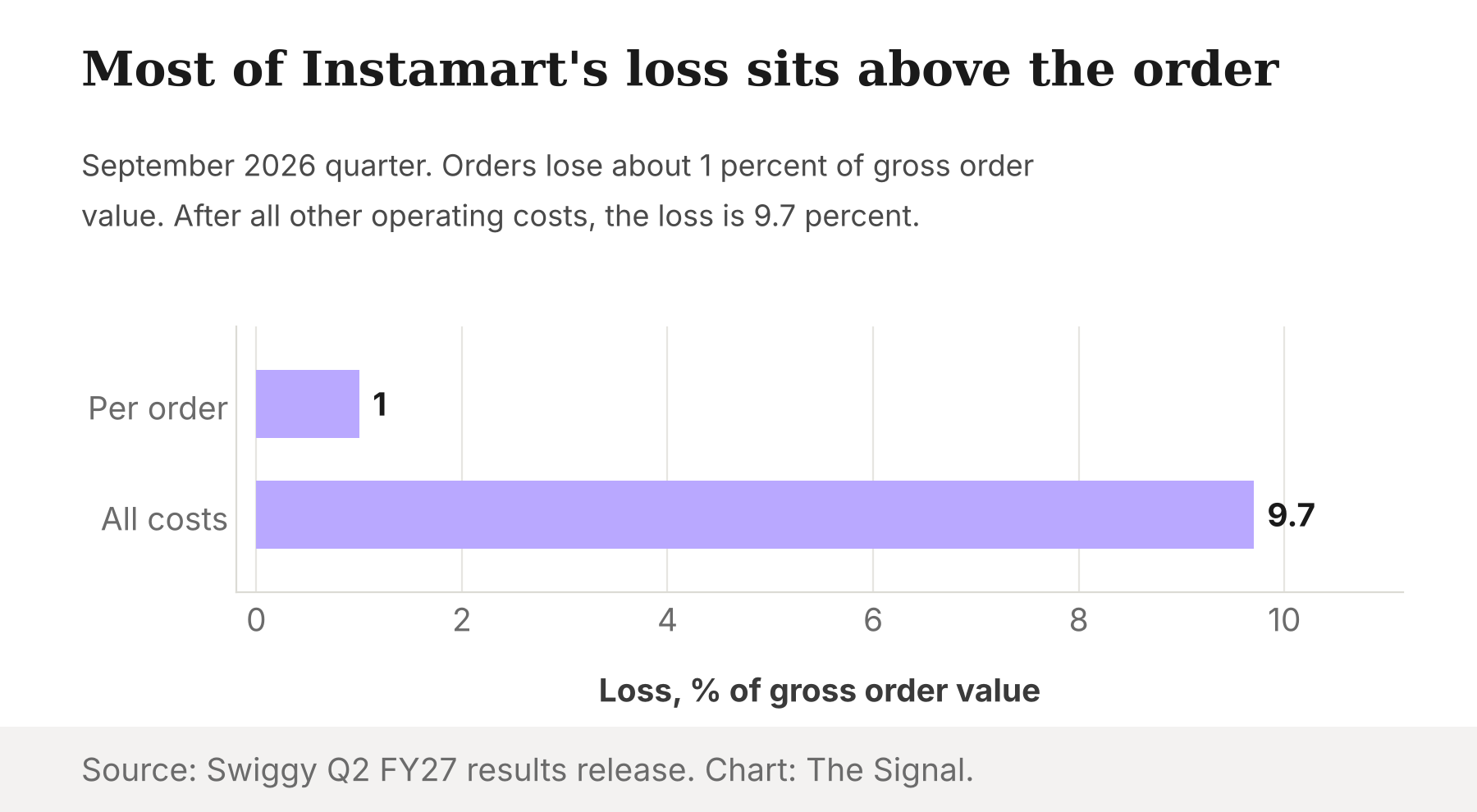
That is the layer corporate and support staff live in, so on this reading the cuts are aimed correctly. The problem is size.
340 salaries against Rs 895 crore
Swiggy does not disclose what the departing employees earned. Its annual report gives the nearest honest proxy. In FY2024-25, the median pay of Swiggy's permanent employees outside the board and key managers was Rs 14,33,366 for men and Rs 13,51,429 for women, excluding stock options. At those medians, 340 salaries come to roughly Rs 46 crore to Rs 49 crore a year, or about Rs 12 crore a quarter.
Set that against an adjusted EBITDA loss that widened to Rs 895 crore in the September quarter from Rs 778 crore in the June quarter. The saving is about 1.3 percent of one quarter's loss. It is smaller than the Rs 117 crore by which the loss grew between those two quarters.
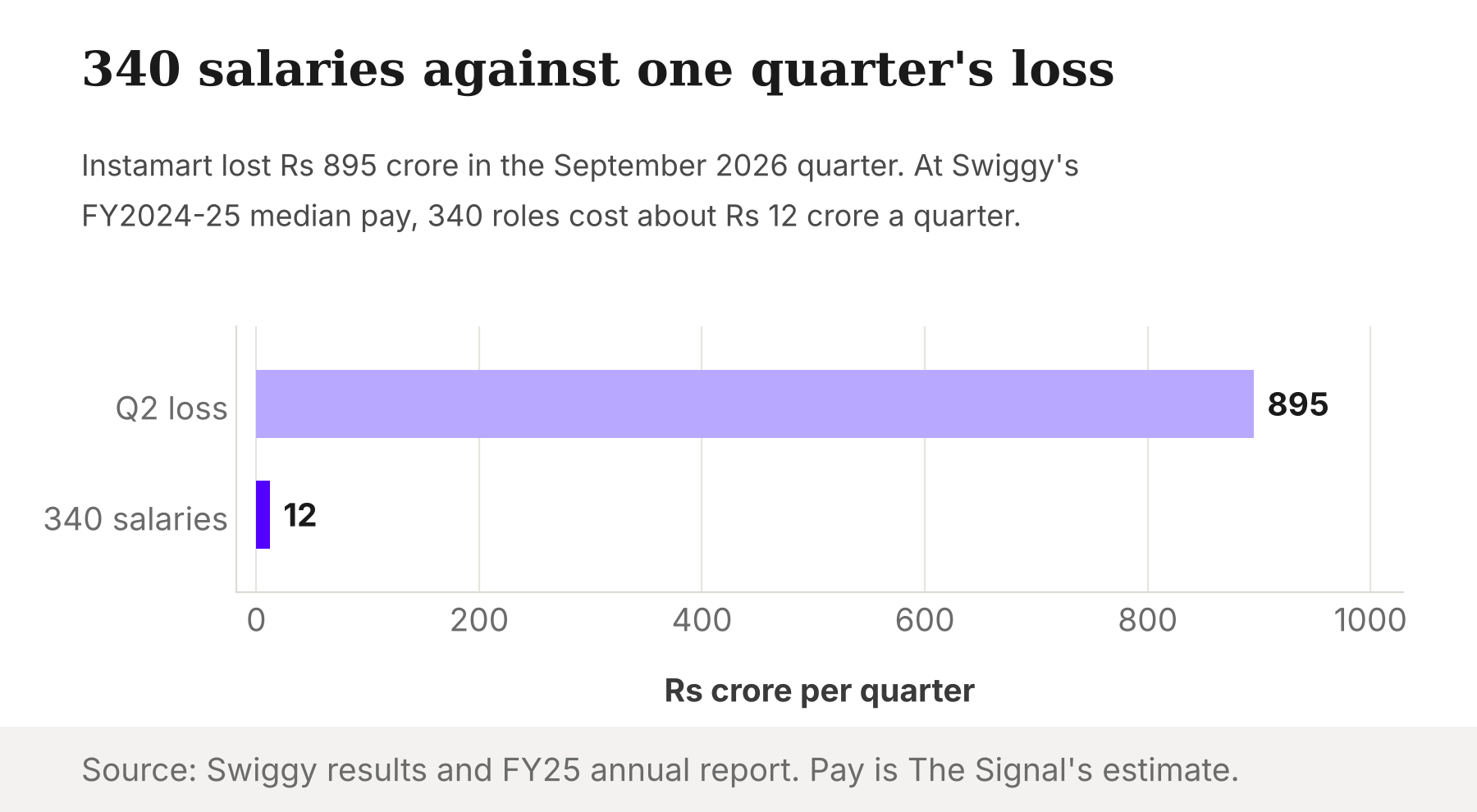
The cut is also not small for Swiggy as an employer. Swiggy had 4,488 permanent employees in FY2024-25, so 340 roles equal about 7.6 percent of that whole-company headcount. And Swiggy's consolidated employee benefits expense was Rs 25,488.62 million in FY2024-25, about Rs 2,549 crore, against Rs 20,121.64 million a year earlier. A meaningful share of people can leave and still barely move a loss this large.
The lever that moves the number
If headcount is too small a lever, the fixed costs above the order have to be spread over more orders instead. Here the comparison with Blinkit is blunt. In the same quarter, Blinkit's net order value rose 79.3% to Rs 20,940 crore, its adjusted EBITDA came in at Rs 184 crore, and its store count reached 2,751, Business Standard reported from Eternal's results. Instamart ended the quarter at 1,240 stores after adding 69, with net order value of Rs 6,594 crore.
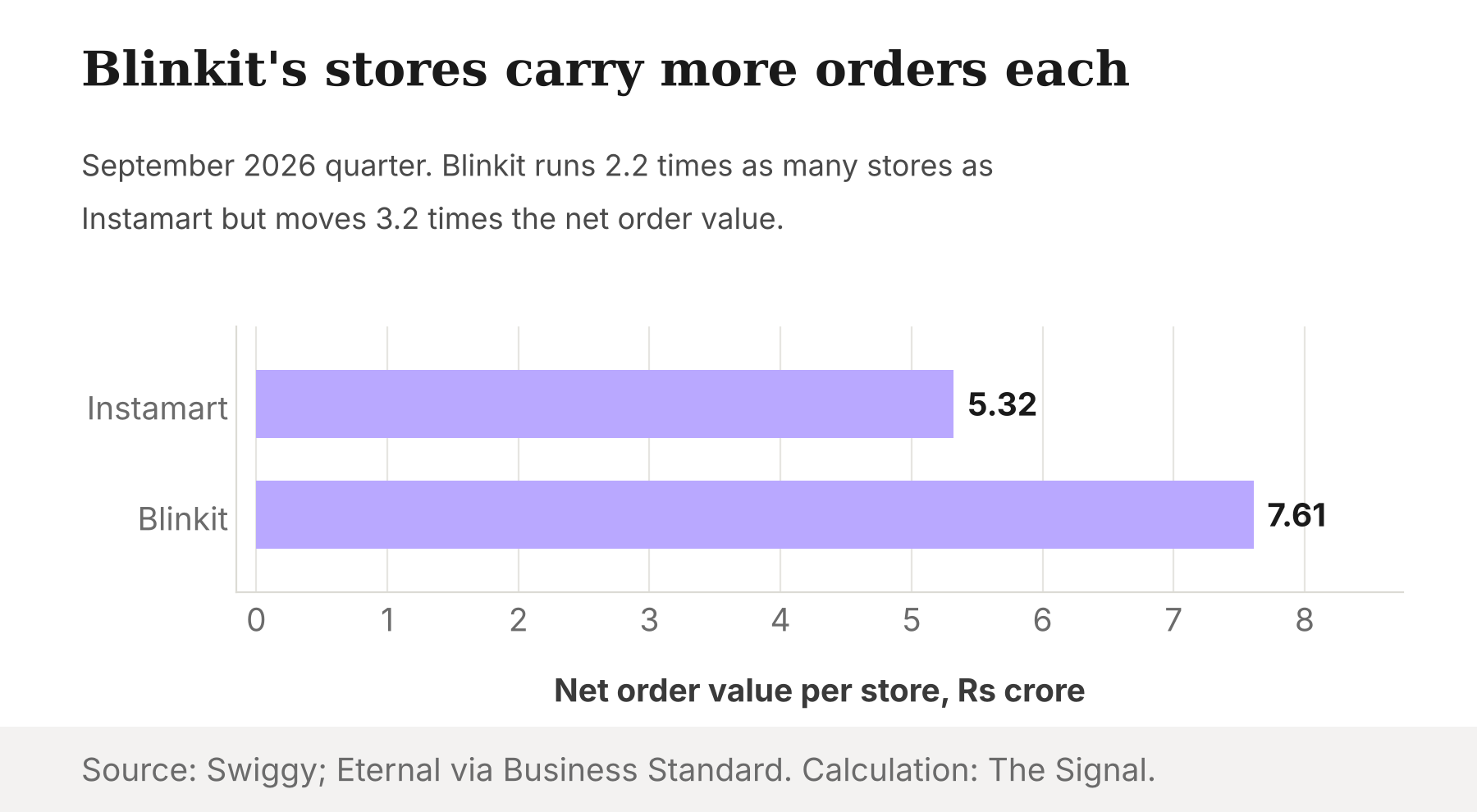
Set the Swiggy figures beside Eternal's: Blinkit runs 2.2 times as many stores and moves 3.2 times the order value. Per store, that is about Rs 7.6 crore of net orders in the quarter against Instamart's Rs 5.3 crore. Each Blinkit store carries roughly 43 percent more business to absorb the same kinds of fixed cost.
Zepto's prospectus shows the same mechanism from inside one company. Zepto's adjusted EBITDA loss per order fell to Rs 78.75 in FY26 from Rs 136.15 in FY25, according to its abridged prospectus filed with SEBI, and the company says cost per order fell as order volume scaled. Volume did more for Zepto's losses than any single cost cut could.
The profitable player has more business flowing through each store.
| Platform | Period | Stores | Net order value | Profit line |
|---|---|---|---|---|
| Blinkit | Jul to Sep 2026 | 2,751 | Rs 20,940 crore | Adjusted EBITDA of Rs 184 crore |
| Instamart | Jul to Sep 2026 | 1,240 | Rs 6,594 crore | Adjusted EBITDA loss of Rs 895 crore |
| Zepto | FY ended March 2026 | 1,139 | Not compared | Adjusted EBITDA loss of Rs 78.75 per order |
Sources: Eternal results via Business Standard; Swiggy Q2 FY27 release; Zepto abridged prospectus, SEBI.
The honest objection
The strongest case against this reading is that 340 jobs are a start, not a ceiling. A new chief executive often opens with a visible cut and follows with deeper ones. AI tools could also shrink overhead faster than headcount numbers suggest, if fewer people now handle more catalogue, support and planning work. On that view, judging the cut by one quarter's loss misses the direction.
There is also a second lever already moving. Swiggy says it will shift Instamart to an inventory-led model beginning in mid-Q3 FY27, a transition that takes two to three quarters. Owning stock gives it more control over pricing and availability, which could lift the order line itself.
Both points are fair. Neither changes the arithmetic. Even several rounds of cuts this size would leave most of a Rs 800 crore quarterly overhead gap in place. Meanwhile the parent can afford patience: Swiggy's food delivery business earned Rs 341 crore of adjusted EBITDA in the same quarter, and Swiggy's consolidated net loss narrowed to Rs 922 crore from Rs 1,092 crore a year earlier. Food delivery is funding a fight that order density, more than headcount, will decide.
The Signal
Instamart's problem is not that it loses money delivering groceries. On the order line it is close to even. Its problem is that a national network of stores, systems and staff is spread over too little business, and Blinkit's stores carry far more of it. The 340 cuts aim at the right layer and cover about a hundredth of it. What to watch is not the next layoff headline. It is net order value per store, against Eternal's plan for about 5,000 Blinkit stores by March 2028. In quick commerce, the cheapest cost to cut is the one shared by more orders.
Reporting basis: the 340 layoffs and their concentration in corporate and support roles are per Moneycontrol's report, as relayed by Business Standard; Swiggy had not publicly confirmed the figure, so this rests on a single originating report. The timing of Nandita Sinha's appointment is per Storyboard18. Instamart's gross and net order value, contribution and adjusted EBITDA margins, quarterly loss, store count and the food delivery result are from Swiggy's Q2 FY27 results release; the June-quarter loss and the inventory-model timeline are per Business Standard, the latter citing Swiggy's shareholder letter; Swiggy's consolidated net loss is per Business Standard. Headcount, median pay and employee benefits expense are from Swiggy's FY2024-25 annual report. Blinkit's order value, adjusted EBITDA, store count and store target are per Business Standard's reporting of Eternal's results, not Eternal's filing directly. Zepto's per-order loss and store count are from its abridged prospectus filed with SEBI. The order-level loss in rupees, the share of the loss above the order line, the estimated pay of 340 roles, the headcount share and the per-store order values are The Signal's calculations from those figures.