On Wednesday, 25 November 2026, India's statistics office put out the kind of report almost nobody reads. A sub-committee on regional accounts recommended new ways to measure the size of each state's economy. Business Standard reports that the proposed method would replace indicators such as state-wise consumption of cement and steel, a 2014 count of central government employees, and ratios fixed in the 2011-12 base year. The coverage treated it as a technical upgrade: better data in, better numbers out. That is true, and it is the least interesting thing about it.
It is worth slowing down on what state GDP is used for. In India, a state's gross state domestic product (GSDP) is not just a scorecard. It is the denominator in the rule that decides how much the state may borrow. Change how GSDP is counted and you change that limit, before any finance minister signs anything.
The number is a borrowing licence
MoSPI says this itself. Its May 2026 release on state accounts states that the Department of Expenditure uses GSDP to fix state borrowing limits, as the permissible borrowing ceiling is generally determined as a percentage of GSDP. The Sixteenth Finance Commission set that percentage at 3% for its 2026-31 award, and recommended that for determining yearly borrowing limits, GSDP should be estimated by applying the annual average growth rate of the actual GSDP observed during the latest three years.
So two things about the measurement feed the limit: the level of a state's GSDP, and its recent growth rate. A new method can move both.
The same May release noted that 34 States/UTs were still compiling GSDP on the 2011-12 base, even though the national accounts had already moved to 2022-23. The November report is the rulebook for how they cross over.
What the old method actually counted
Under the 2011-12 series, private companies' value added was split among states using indicators and ratios fixed in the base year. For the new series, the panel proposed industry-wise outward supply data from GST for all industries except agriculture, mining and manufacturing. Each company's national value added would be divided according to the sales it reports from each state.
The central government's share is the starker case. Its value added in each state was allocated by headcount, using a central government employee count from 2014, per the Business Standard report on the committee. The new method uses actual salary payments recorded by location in the government's payment system. A state that gained central offices or higher-paid postings since then is likely undercounted. One that lost them is likely flattered.
These are allocation changes, which move value between states. The bigger shift is to the total being allocated.
The economy already shrank on paper
When MoSPI moved the national accounts to the 2022-23 base in February 2026, India's nominal GDP got smaller. The old series put 2022-23 nominal GDP at ₹268.90 lakh crore and 2023-24 at ₹301.23 lakh crore. The new series puts 2022-23 at ₹261.18 lakh crore and 2023-24 at ₹289.84 lakh crore. That is 2.9% lower for 2022-23 and 3.8% lower for 2023-24, a gap of ₹11.39 lakh crore in the second year.
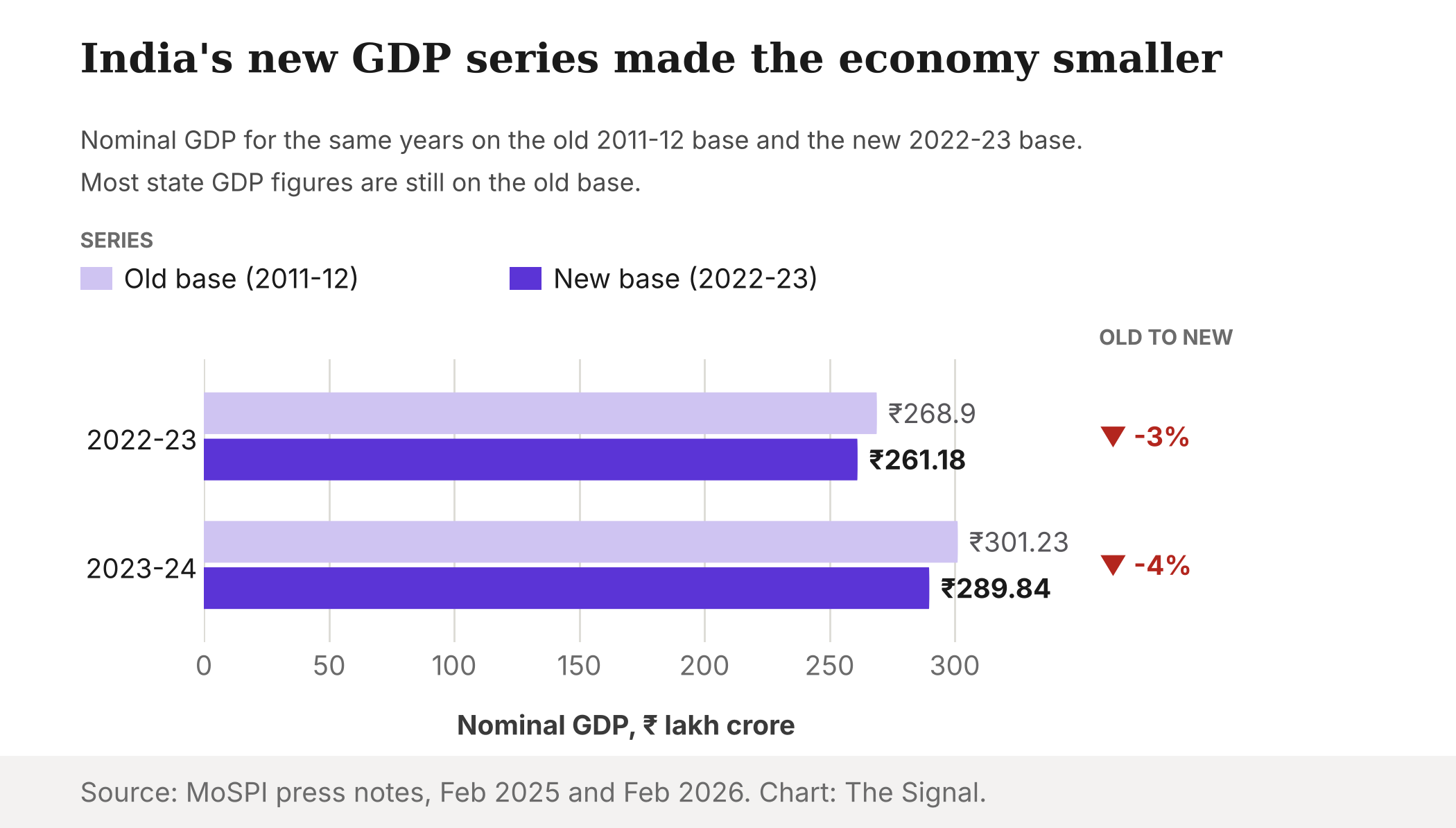
Growth was revised too. Nominal growth for 2023-24 is 11.0% in the new series against 12.0% in the old one. Because yearly limits are projected from recent growth, a lower growth history also trims the projected GSDP the ceiling is calculated on.
State accounts are built to add up to the national total. If state GSDPs follow the national level down, the ceiling, set as a percentage of GSDP, follows them. Applied to the ₹11.39 lakh crore gap for 2023-24, 3% comes to about ₹34,000 crore of annual borrowing room across all states. That is an order of magnitude, not a forecast: how the revision lands depends on each state's own numbers.
One state, worked through
Maharashtra shows the scale. In March 2026, after the national series had already changed, its statistics directorate still estimated 2025-26 nominal GSDP at ₹51.01 lakh crore on the 2011-12 base. At 3%, that supports about ₹1.53 lakh crore of borrowing room. Every 1% revision to that GSDP moves the ceiling by about ₹1,530 crore a year. A revision the size of the national one, 3.8%, would take out about ₹5,800 crore.
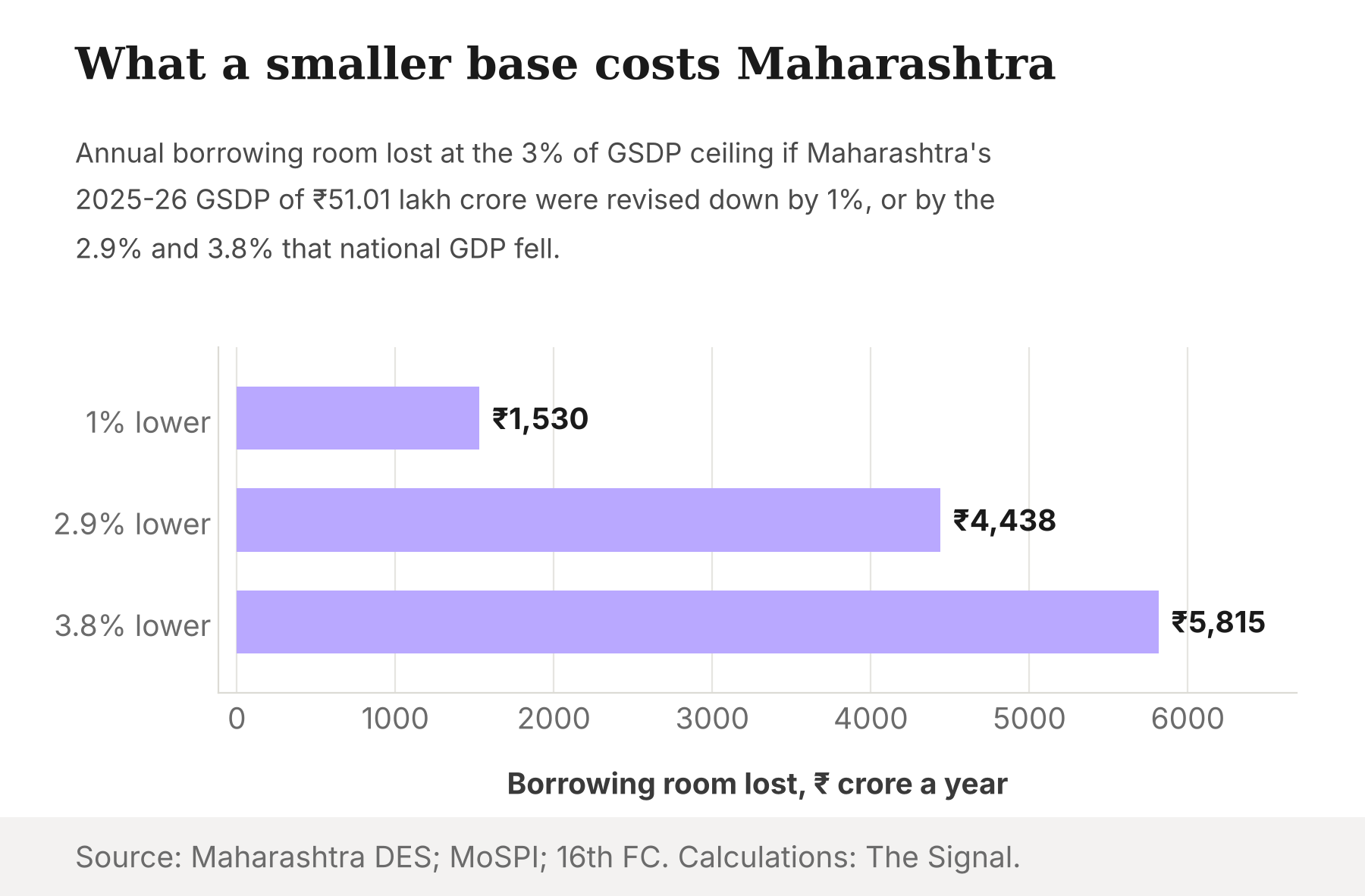
Maharashtra need not move by the national average. GST-based allocation could raise its share even as the national total falls, which is the point: until the new state series is published, no state knows which way its limit is going.
The states with no slack
For most states the ceiling is a comfortable outer wall. For some it binds. PRS Legislative Research's compilation of 2026-27 state budgets finds that nine states budgeted a fiscal deficit above 3%, including Jammu and Kashmir (3.7%), Himachal Pradesh (3.5%), Meghalaya (3.5%) and Punjab (3.4%), excluding interest-free central capex loans.
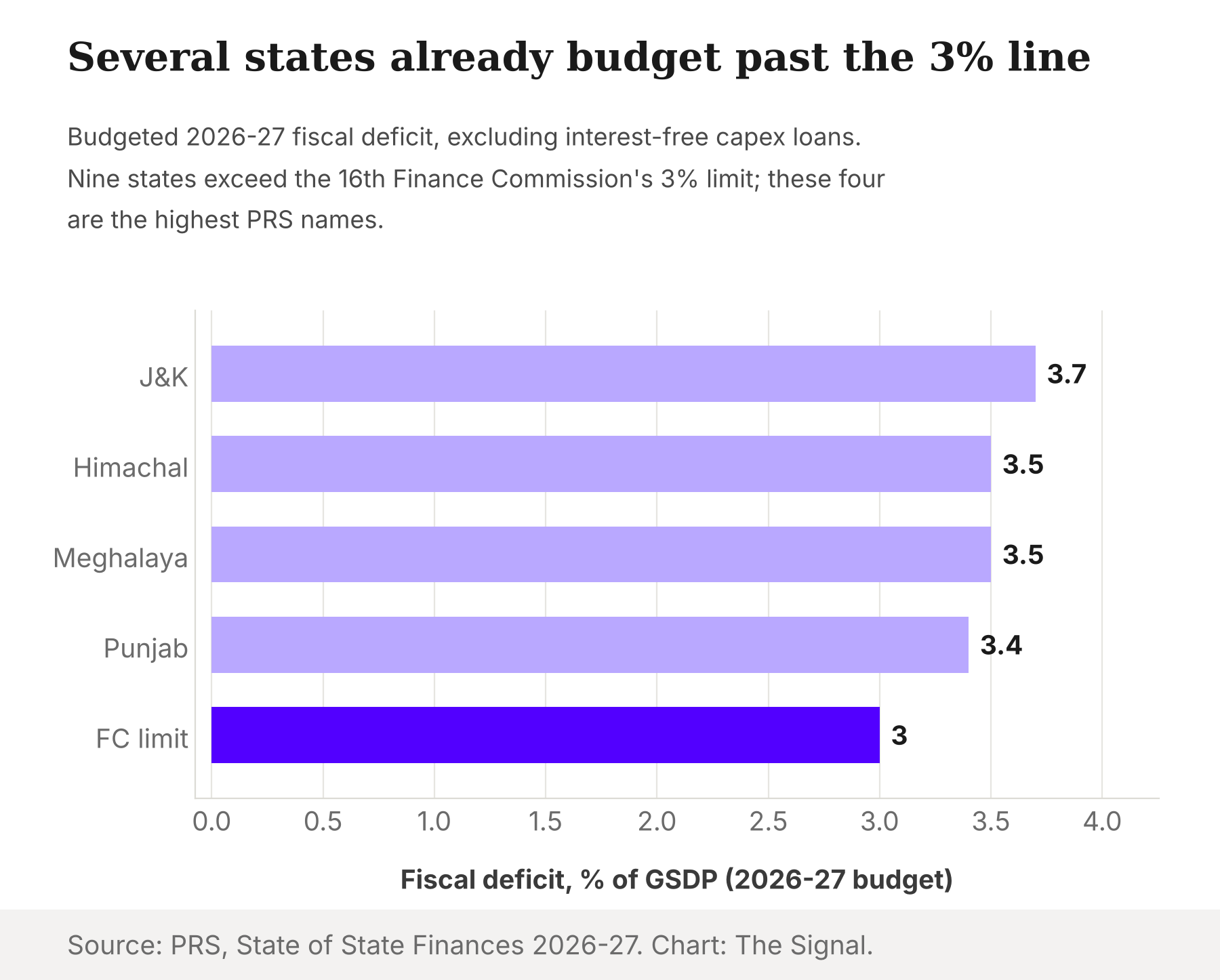
For these states the arithmetic runs one way. The deficit is a rupee amount fixed by spending and revenue. If the GSDP under it is revised down, the same deficit becomes a bigger share, and the gap to 3% widens without a single new rupee borrowed. Across all states the headroom was never wide: the RBI's study of state budgets shows states budgeted a gross fiscal deficit of 3.3% of GDP for 2025-26.
The Finance Commission channel is locked, for now
GSDP also drives how central taxes are shared. In the Sixteenth Finance Commission's formula, per capita GSDP distance carries 42.5% of the weight and contribution to GDP another 10%. More than half of each state's share of the divisible pool rests on GSDP.
But the Commission measured per capita GSDP using the average over 2018-19 to 2023-24 excluding 2020-21, on the old series, and its shares are fixed for 2026-31. The new method cannot touch devolution until the Seventeenth Commission. The borrowing limit is recalculated every year. That is where the rewrite bites first.
The honest objection
The strongest case against worrying is that better measurement is simply better. Fixed ratios from 2011-12 and a 2014 headcount are indefensible inputs for a 2026 economy. If a state's limit falls because its old GSDP was overstated, it was borrowing against income it did not have. Correcting that is fiscal hygiene, not a raid.
That case is right on substance. It is weaker on process. The GST method rests on an assumption, that a company's sales in a state reflect its production there, which tilts the count toward states that firms bill from, and that may not be where the work happens. The sub-committee accepted parts of the method in principle subject to state comments. A change that moves thousands of crores of borrowing room is being settled as a statistics question, by a technical panel, through a comment process most legislatures will never see.
The Signal
India has spent a decade arguing over Finance Commission formulas, weights and population years. The quieter lever is the input those formulas and limits are applied to. Watch the first state GSDP releases on the 2022-23 base, and watch the Department of Expenditure's borrowing letters for 2027-28: if the states running above 3% find their denominators shrinking, the next fiscal fight will be about statistics. Whoever measures a state's economy also sets how much it can owe.
Reporting basis: the sub-committee's recommendations are as described by Business Standard in two articles on the document released by MoSPI's NSO; the document itself was not independently reviewed, so the method details rest on that one origin. The use of GSDP for borrowing limits and the count of states still on the 2011-12 base are from MoSPI's May 2026 release, via PIB. The deficit limit, the borrowing-limit projection rule and the devolution weights are from the Sixteenth Finance Commission's award document. National GDP on both bases is from MoSPI's February 2025 and February 2026 press notes, via PIB. Maharashtra's GSDP is from the state's Directorate of Economics and Statistics. State deficit ratios for 2026-27 are PRS Legislative Research's compilation from state budgets, and the 2025-26 aggregate is from the RBI. The percentage revisions to GDP, the all-state borrowing-room figure and the Maharashtra scenarios are The Signal's calculations from those figures.