
For most of this decade the story of Indian services work has run in one direction. Instead of renting Indian engineers and accountants from firms like Infosys or Wipro, many multinationals set up their own offices, called global capability centres. A Press Information Bureau explainer from December 2025 counted over 1,700 of them employing over 19 lakh people. Nasscom and Zinnov estimate the count reached 2,117 centres and 2.36 million people in FY2026, with $98.4 billion of revenue. The usual read is simple: the captives are winning, and the IT services firms are losing the back office to them.
On 25 November 2026, bp moved the other way. bp's announcement says around 3,000 bp employees supporting finance operations in India, Hungary and Malaysia will move to Wipro, with the new operating model expected to take effect in 2027. These are not contractors being swapped for other contractors. They are bp's own staff, in exactly the kind of offshore unit the capability-centre boom is built from, and bp is handing them to an outsourcer.
What bp is keeping, and what it is not
Read the release closely and the deal splits the finance function in two. bp says it will retain overall accountability for standards, controls, data and technology governance, with PwC providing controls oversight. What leaves is the processing: the people, the payroll and the job of making the work cheaper.
That split is the point. A captive centre gives a company control, and a fixed cost to go with it. bp has decided it wants the control without the fixed cost, and it has hired a separate firm to check the controls.
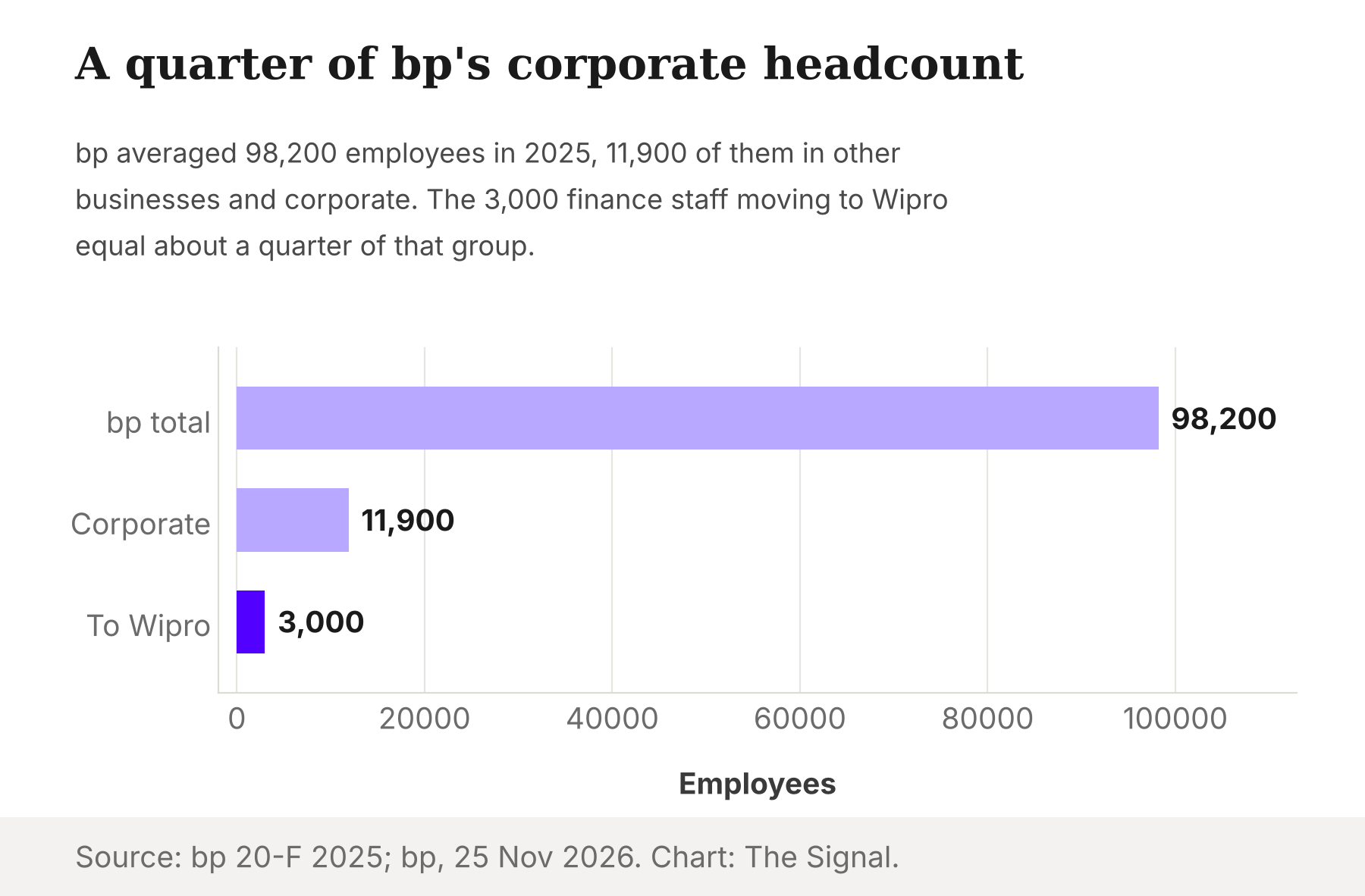
The scale inside bp is modest but not trivial. bp's 2025 Annual Report and Form 20-F shows an average of 98,200 employees in 2025, of whom 11,900 sat in other businesses and corporate. The 3,000 finance staff are about 3 percent of the whole company, and equal to roughly a quarter of that corporate group.
The local picture is sharper. Reuters reports, citing bp's website, that bp has roughly 7,500 employees in India, more than 3,300 in Hungary and about 1,400 in Malaysia. Together that is about 12,200 people in the three countries, so the 3,000 leaving are close to a quarter of bp's entire workforce there. bp declined to tell Reuters what share of its finance operations team the move represents.
Why now: the cost target is already met
The timing is the revealing part. In its third-quarter 2026 results statement, bp said it had already delivered its net debt and structural cost reduction targets. The company had already hit the number it promised investors, and only then turned to changing who runs the work.
That fits the release's own language. bp frames the deal around Wipro's AI, automation and transformation capabilities and around long-term cost competitiveness. The logic is about who should pay for automation. Rebuilding invoice matching, reconciliations and close processes around AI tools is a large one-time investment with an uncertain payoff. A captive centre spends that money for one client. An outsourcer can spend it once and sell the result to many, and it takes on the headcount risk if automation means fewer people are needed later.
bp knows this vendor well. A 2009 Wipro filing records a five-year agreement for Wipro to maintain bp applications, signed while bp was consolidating its IT vendors. The difference in 2026 is that bp is handing over people on its own payroll as well as a contract.
What Wipro is buying
For Wipro, the deal lands in a weak quarter. Wipro's Q2 FY27 results release, filed with the SEC, shows total bookings of $2,595 million in the September 2026 quarter, down 22.9 percent, and large deal bookings of $674 million, down 58.6 percent. Its guidance for the December quarter is IT services revenue of $2,571 million to $2,625 million. Wipro's press release puts September-quarter IT services revenue at $2,611.5 million, up 0.3 percent on a year earlier, at a 16.5 percent operating margin. The midpoint of that guidance sits slightly below the quarter it follows.
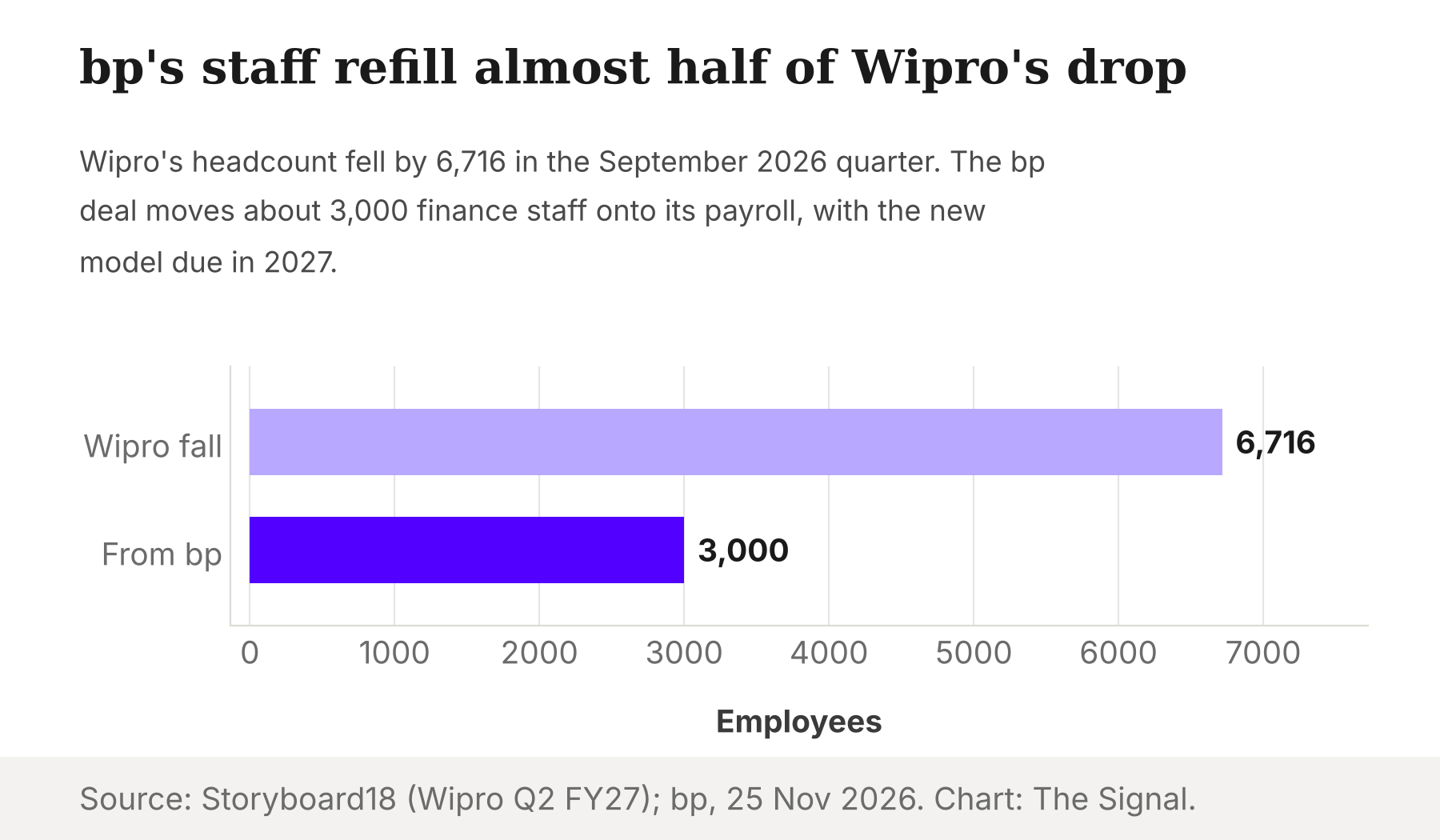
Headcount tells the same story. Storyboard18 reports, from Wipro's quarterly disclosures, that Wipro's workforce fell by 6,716 in the September quarter, to 236,328 from 243,044. The bp transfer alone would refill about 45 percent of that drop.
This is where the deal becomes tricky for Wipro. It gains a large client relationship and a defined book of work. It also takes on 3,000 people whose pay was set by an oil major, and its margin on the work depends on how fast it can automate what those people do. Wipro is being paid to make the work need fewer people, and the people it would need fewer of now work for Wipro.
The honest objection
The strongest case against reading this as a turn is scale. Against the 2.36 million people Nasscom and Zinnov count in India's capability centres, 3,000 is about 0.13 percent, and not all of bp's 3,000 are even in India. Moving staff to an outsourcer is also not a new idea, and one company's choice says little about 2,117 others. Capability centres were never only about cost. Many exist to hold engineering and product work that a company wants close, and nothing in the bp deal touches that.
All of that is fair, and it limits the claim. The bp deal does not show that capability centres are shrinking. It shows something narrower: for routine, rules-based work like finance processing, a large company that already owned the centre, and had already met its cost target, decided an outsourcer could automate it better. That kind of work is exposed to AI, and it is where the in-house model has the weakest defence.
The Signal
India's capability-centre numbers measure where the work sits today. They do not say which firm will own it once software can do much of it. bp's deal adds a second road: a company can build the centre, run it, and then hand the whole team to a vendor when the work turns into an automation job. Nothing in the announcement says the work leaves India. What changes is the employer, and with it whose automation targets these jobs now answer to. Watch for more finance and accounting transfers from capability centres to IT firms, and for what happens to Wipro's headcount once the transferred work is automated. The back office has not left. It has changed hands.
Reporting basis: the deal terms (about 3,000 staff in India, Hungary and Malaysia, the 2027 start, and bp's retained controls with PwC oversight) are from bp's own announcement, as also carried by Analytics India Magazine, which adds no independent figures. bp's 2025 average headcount is from its Annual Report and Form 20-F filed with the US SEC, and its statement that it met its structural cost target is from its third-quarter 2026 results filing. Wipro's bookings, revenue, margin and guidance are from its Q2 FY27 results release, filed with the SEC and published on its own site; its headcount figures are per Storyboard18's account of the company's disclosures and rest on that single relay. bp's headcount in India, Hungary and Malaysia is per Reuters, citing bp's website, and is the only source for those country figures. The 2009 contract is from a Wipro SEC filing. Capability-centre counts come from two separate origins that use different methods: a Press Information Bureau explainer (December 2025) and the Nasscom and Zinnov FY2026 estimate, which is an industry-body figure. The share of bp's workforce, the combined three-country headcount and the transfer's share of it, the share of Wipro's headcount drop, the guidance comparison and the share of capability-centre employment are The Signal's calculations from those figures.