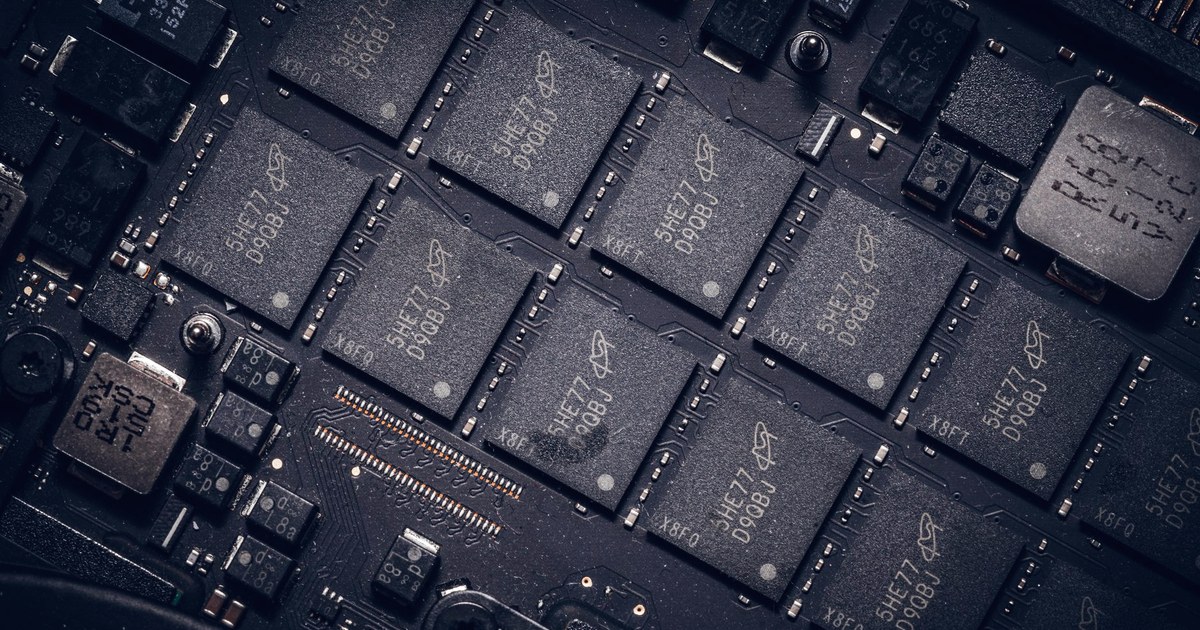
On 27 July 2026, a DRAM chipmaker built entirely inside China listed on Shanghai's STAR Market and finished its first day of trading as the country's most valuable listed company. TrendForce reports CXMT's stock surged as much as 471.6 percent on debut, lifting its market capitalization to roughly RMB 3.3 trillion, about $487 billion, ahead of Intel and Cisco. The surface read writes itself: years of American export controls aimed at China's chip industry, and yet the industry produced a company worth more than two storied names in American semiconductors.
It is worth slowing down on why that listing was even possible. In October 2022, the US Bureau of Industry and Security's press release states it added new license requirements for items destined to a semiconductor fabrication facility in the PRC that fabricates ICs meeting specified thresholds, including DRAM memory chips of 18-nanometer half-pitch or less, a rule aimed at exactly the class of advanced DRAM fabrication CXMT has spent the years since building. Four years on, CXMT is not a sanctions-hobbled also-ran. TrendForce's data for the first quarter of 2026 ranks CXMT fourth among global DRAM suppliers by revenue, holding a 7.6 percent share, while Samsung, SK Hynix and Micron together held 89.7 percent. Micron alone, the company anchoring India's own chip bet, ranked third with a 22.4 percent share and $21.75 billion in Q1 2026 revenue, per TrendForce, behind Samsung's 38.5 percent and SK Hynix's 28.8 percent: CXMT's 7.6 percent is not yet close to Micron's, but it is no longer a rounding error next to it either.
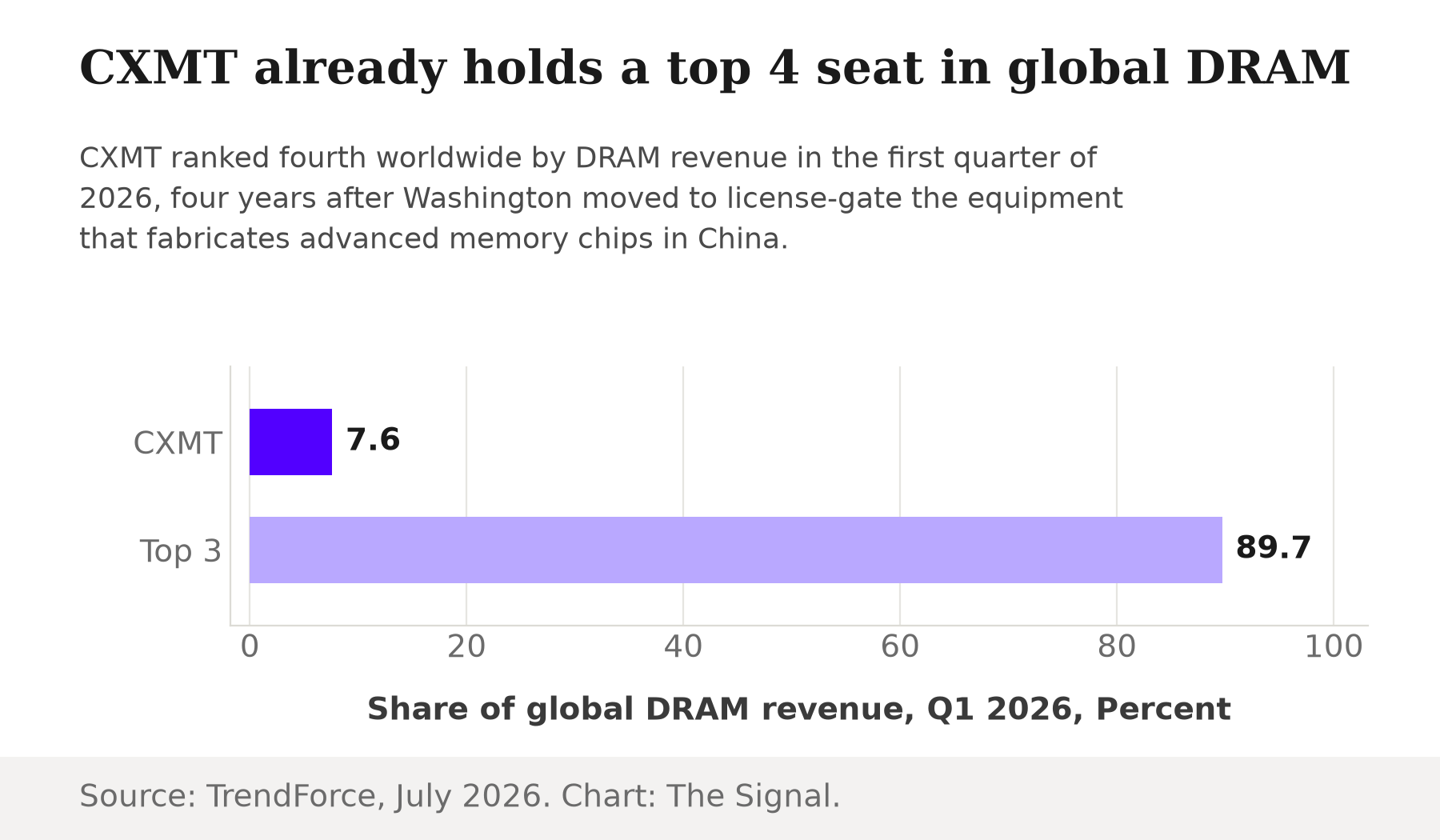
That is the number that carries this story. A license requirement written around a specific fabrication node did not stop the company operating at that node from reaching a top-four seat in the global market it was supposed to be shut out of.
The ban that did not hold
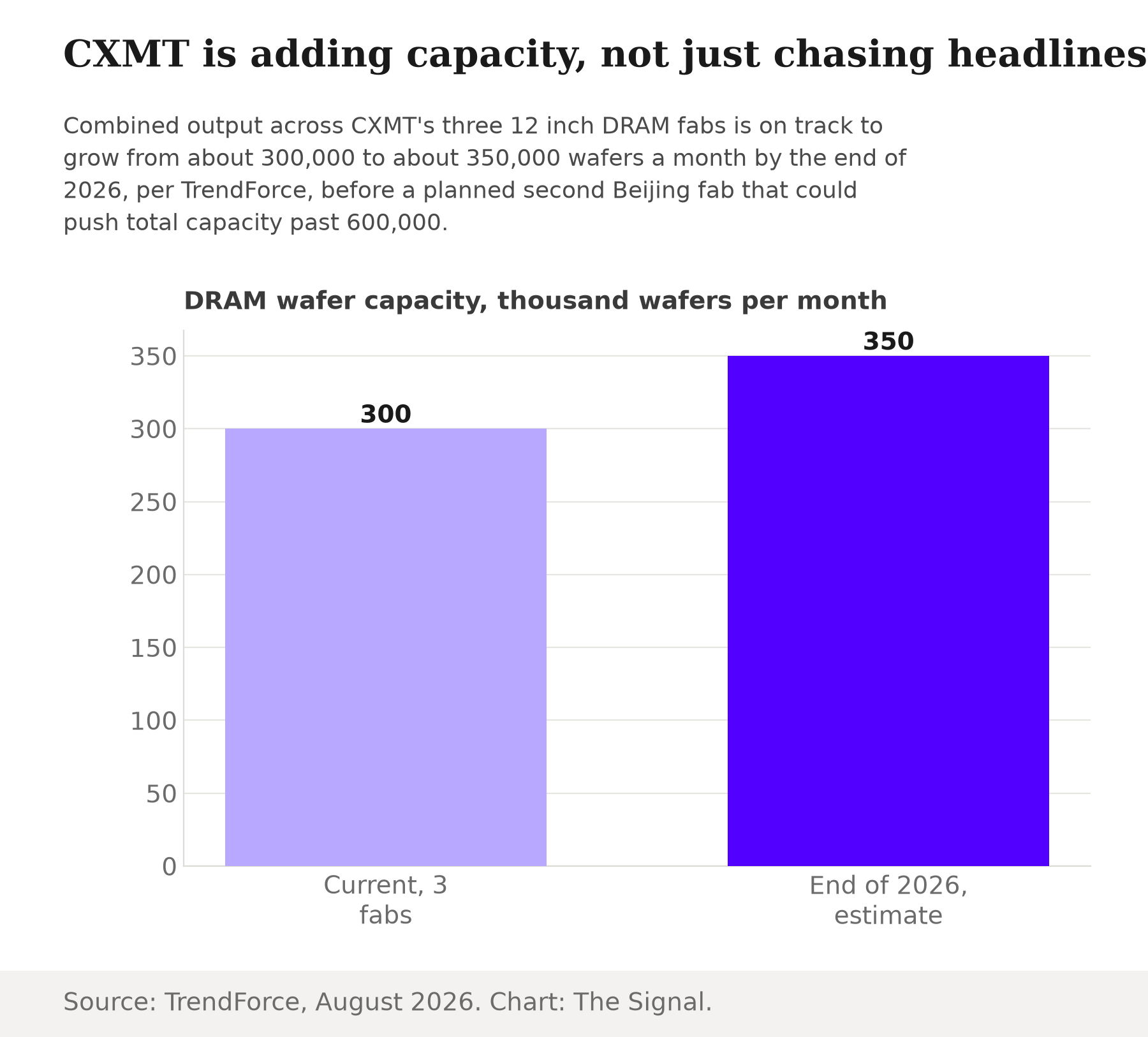
CXMT operates three 12-inch DRAM fabs, two in Hefei and one in Beijing, with combined capacity of about 300,000 wafers a month, and TrendForce expects that to reach roughly 350,000 wafers a month by the end of 2026. The company is also reportedly pursuing a second Beijing fab that could push its total capacity past 600,000 wafers a month, roughly double where it stands today.
The chips coming off those lines are also closing the technical gap with the companies the 2022 rule was meant to protect. CXMT's DDR5 memory reached an effective speed of more than 9,014 MT/s on an AMD platform in August 2026, TrendForce reports, up from roughly 8,000 MT/s the company had announced in late 2025, narrowing its distance from Samsung, SK Hynix and Micron. That gap-closing is not confined to desktop and server memory. Xiaomi's XRING O3 mobile processor, launched in August 2026, is the world's first flagship mobile chip to support LPDDR6, the next-generation mobile memory standard. CXMT is Xiaomi's key supplier for that LPDDR6 memory, TrendForce reports, citing Cailian Press, marking the first use of domestically developed Chinese LPDDR6 memory in a flagship phone. A license requirement written around fabrication nodes did not stop CXMT from reaching the mobile memory chips inside a flagship phone either.
Where India's chip money actually goes
While CXMT was adding wafers, India was building its own semiconductor bet, at a different point in the supply chain. Micron's Assembly, Test and Packaging facility in Sanand, Gujarat, inaugurated on 28 February 2026, represents a total investment of over ₹22,500 crore and was the first project approved under the India Semiconductor Mission, Prasar Bharati's news service reports. The plant's own name states what it does: it assembles, tests and packages memory chips fabricated elsewhere. It does not turn silicon into a wafer of working DRAM the way CXMT's three fabs do.
The Mission is not funding assembly and test alone. Tata Electronics' semiconductor fab in Dholera, Gujarat, built with Taiwan's PSMC and backed by 50 percent fiscal support from the India Semiconductor Mission, is India's first commercial wafer fabrication plant, DD News, India's public broadcaster, reports. Its planned capacity is 50,000 wafers a month, with investment of over ₹91,000 crore. That is a real fab, the kind Sanand is not. But the same report states it will serve the automotive, computing, communications and AI sectors, not memory. India's one wafer fab under construction has a path to logic and analog chips. It still has none to DRAM.
India is not treating that as a one-off. India's Union Cabinet approved Semicon India Programme 2.0 on 15 July 2026 with a total outlay of ₹1.27 lakh crore, ThePrint reports, citing India's IT Minister, against the ₹76,000 crore the government had allocated for the first edition of the mission: about 1.67 times more.
| Programme | Outlay | Approved |
|---|---|---|
| India Semiconductor Mission 1.0 | ₹76,000 crore | Earlier round |
| Semicon India Programme 2.0 | ₹1.27 lakh crore | 15 July 2026 |
Source: ThePrint, citing India's IT Minister.
The price cycle both are riding
The reason fabrication capacity matters so much right now is that memory itself is becoming scarce and expensive. J.P. Morgan Global Research estimates DRAM prices will have risen more than 400 percent from the start of 2024 to the end of 2026, as AI data-centre construction and hyperscaler demand absorb a disproportionate share of global memory capacity.
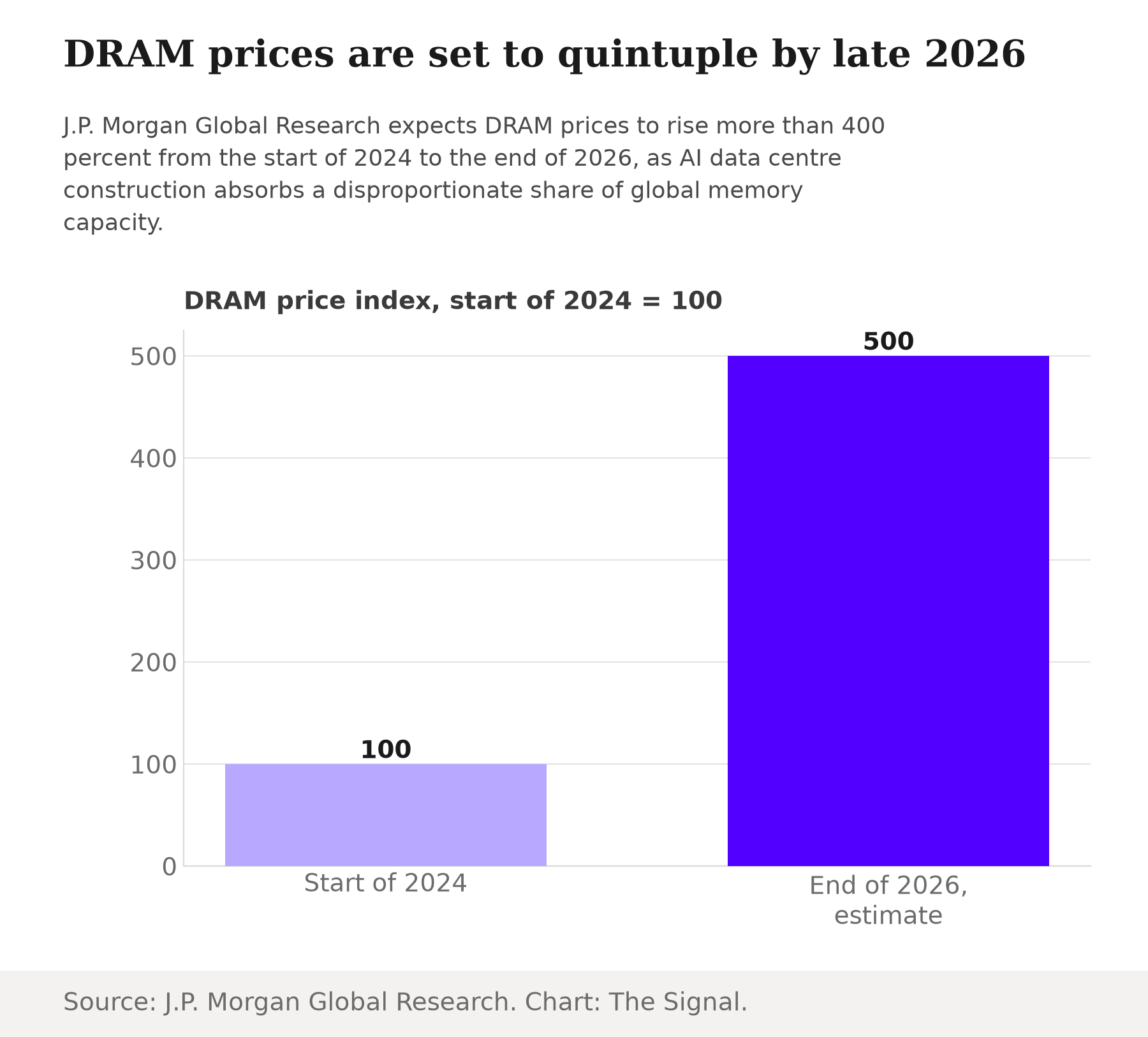
A surge that size rewards whoever controls the wafer, not whoever tests and packages the finished chip. CXMT's push toward 350,000 wafers a month by the end of 2026 captures the upside of a market where the underlying product is getting several times more valuable. An assembly and test plant processes whatever comes off someone else's line, at whatever price that line's owner has already set.
The honest objection
The strongest case for India's approach is that assembly and test is where semiconductor industries typically start, not an admission of defeat. It anchors skilled jobs and export revenue without the multi-billion-dollar capital risk of a fab, and it builds the workforce and logistics a future fabrication plant would need anyway. On that view, Micron's Sanand plant is a sensible first rung, and India's ₹1.27 lakh crore Semicon India Programme 2.0 outlay is simply the next rung being funded.
That case is real, and it likely explains why New Delhi picked this entry point first. But it does not close the gap the last four years opened. CXMT's DDR5 speed is narrowing the distance to Samsung, SK Hynix and Micron, not closing it, and the company doing the narrowing is the one investing in wafers, not the one investing in test sockets. Almost every rupee India has committed so far, Sanand's assembly and test line and the ₹1.27 lakh crore Semicon India Programme 2.0 outlay alike, buys a role in a supply chain whose lower rungs move a percentage point at a time, in a market where the value at the top is now moving in multiples. The one rupee that does not, the fab under construction in Dholera, is not building memory.
The Signal
CXMT's listing is not proof that export controls are toothless everywhere. It is proof that a license requirement written around one fabrication node did not stop a determined, subsidized competitor from reaching that node's output at scale, in four years, in both desktop memory and now mobile memory. What follows is a memory market where the number that matters most, DRAM prices J.P. Morgan expects to more than quintuple by the end of 2026, gets set the moment a wafer is fabricated, not when it is packaged. India has committed real money to chipmaking, including to its first wafer fab in Dholera. But that fab is built for logic and analog chips, and the flagship investment in memory, Sanand, only assembles and tests it. The number worth watching from here is whether any future outlay buys India a wafer fab for DRAM itself, not just another packaging line or another logic fab.
Reporting basis: the October 2022 export-control rule is per the US Bureau of Industry and Security's own press release, a primary government document. CXMT's IPO debut, market capitalization and DRAM revenue share are from TrendForce's July 2026 report, and its fab count and wafer capacity and DDR5 benchmark come from further TrendForce dispatches, one origin recarrying its own research each time. Its LPDDR6 role in Xiaomi's XRING O3 is per TrendForce, citing Cailian Press as the original source, a second origin behind that one claim. Micron's individual Q1 2026 DRAM market share and revenue are likewise TrendForce's own data. The Micron Sanand facility's investment size and its status as the first project approved under the India Semiconductor Mission are per Prasar Bharati, India's public news service. The Semicon India Programme 2.0 outlay and its comparison with the mission's first edition are as reported by ThePrint, citing India's IT Minister following the Union Cabinet's approval, a separate Government of India disclosure from the Sanand announcement. The Dholera wafer fab's capacity, investment and ISM fiscal support, and the sectors it serves are per DD News, India's public broadcaster. The DRAM price estimate is J.P. Morgan Global Research's own published analysis. The 1.67 times comparison between the two mission outlays and the indexed presentation of the DRAM price forecast are The Signal's calculations from those figures.